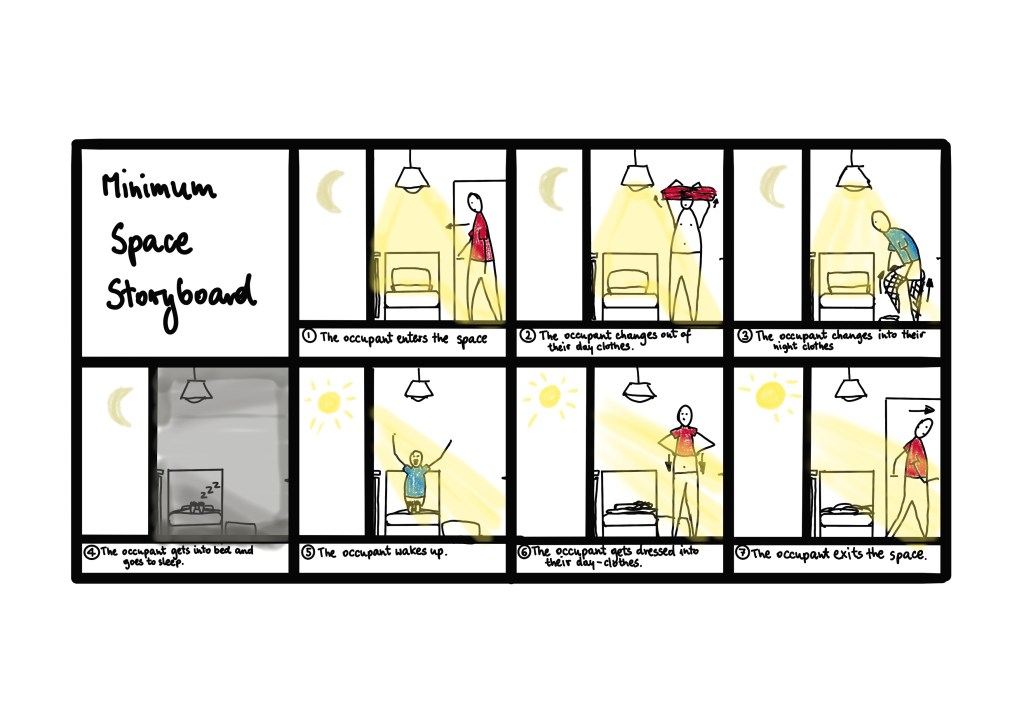
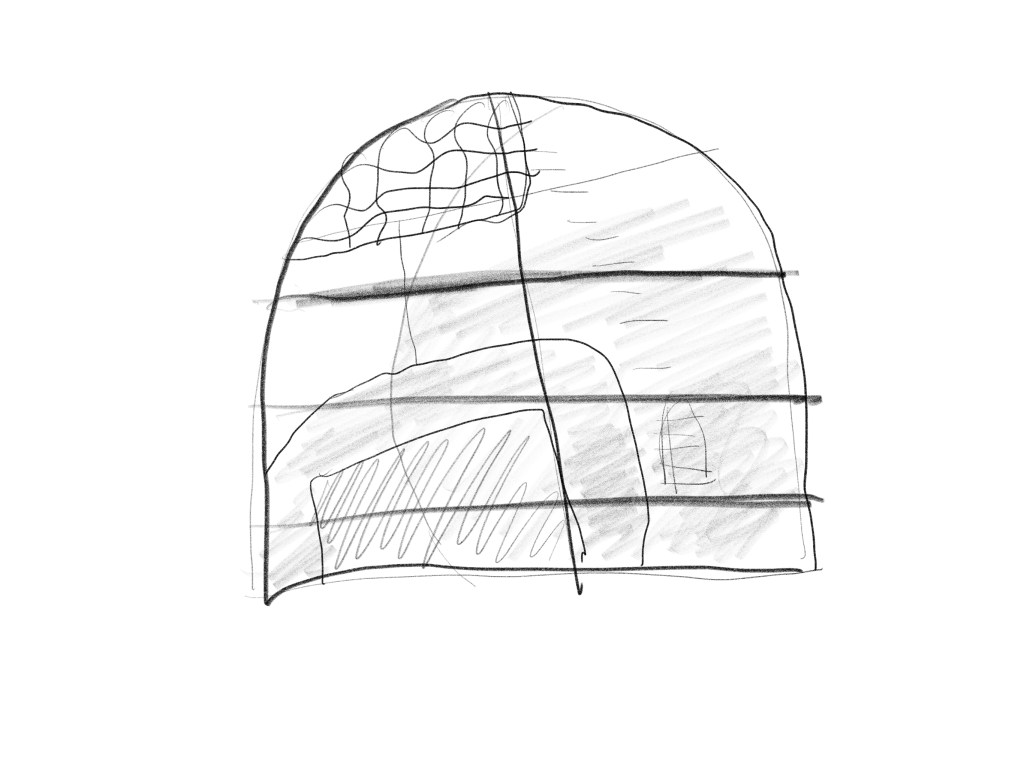
I gave it some thought, how to present my findings. I decided that for the story to be cohesive and easy to understand I should have same/ similar background in the images. I decided to present the story as if the camera was positioned at the feet of the bed. In first few images I accentuated the ceiling light being on, illuminating the room, to show it is night-time. This is then followed by the action of undressing and putting the pyjama on by my character. He then goes to sleep; the light is off and moon crescent is present next to pictures 1-4. Daytime pictures show the sun shining. I thought I’d show my character stretching and yawning as he wakes up, he then gets dressed and leaves the room.
In my storyboard research, I’ve seen examples of each picture having a little description, I used that description here. I considered the look of the storyboard and didn’t like the idea of seven squares. I decided to make it eight squares, first one to contain the title. I considered carefully what sort of movements are made by the human body in the requested examples, I even mock tried making some movements and then drew what I thought represented them.
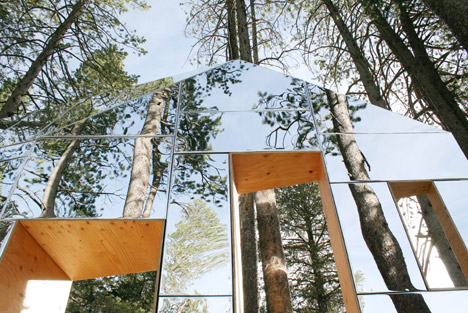
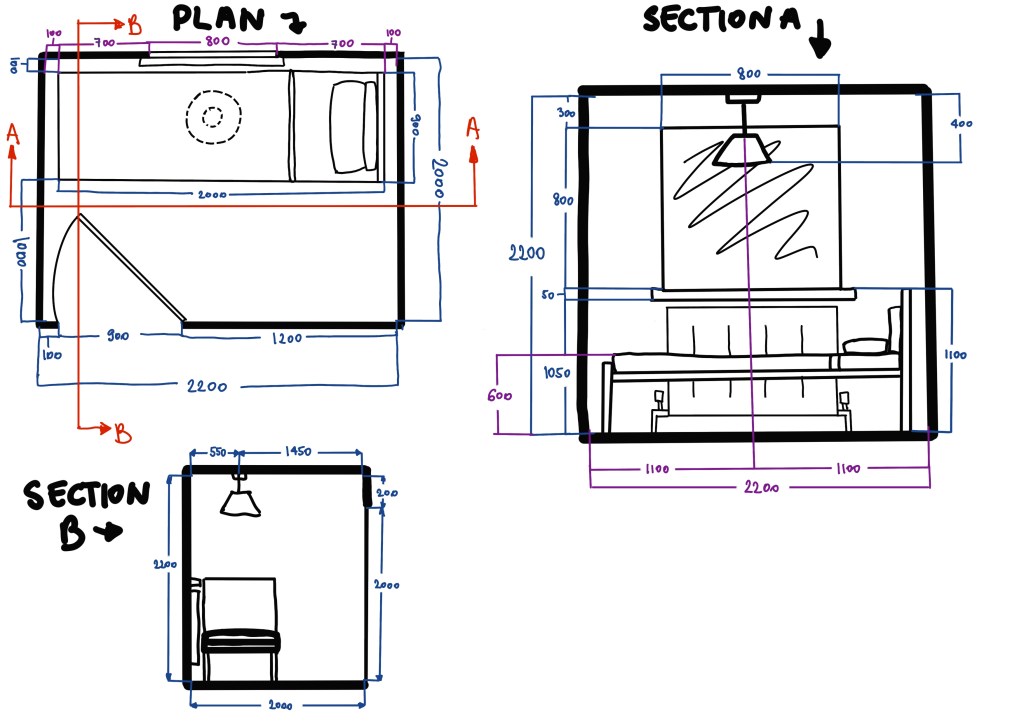
Drawing my design sketches, got me thinking of what these dimensions could be… I know as a fact that a single bed is usually 90cm wide and 200cm long. As my character is quite tall, I decided (after a quick look online at average data) that top of mattress to the floor distance should be 60cm. My storyboard had a bed that is quite a bit lower than that. I also keep thinking that this isn’t smallest space I could have had these actions in. The bed could be placed on a platform (like in Trailhead Tiny Mansion). The character could ‘exercise’ (stretch, bend etc) more while getting dressed or undressed. The door could have been a sliding one to save space. I enjoyed this exercise; it was fun and creative. The drawings were created using Procreate app on iPad.
To research how other designers have used storyboarding as a tool, do an online search for ‘storyboard’ and look at some of the images that you find. You will see lots of different styles of storyboarding from impressive ‘finished’ slick frames, to those with stickmen representing how a person moves around a space. Both are useful in working out the extent and functionality of a space and are helpful in exploring and defining a brief.
For this research task I simply googled word ‘storyboard’. Seemingly all image results were connected to video/ movie making.
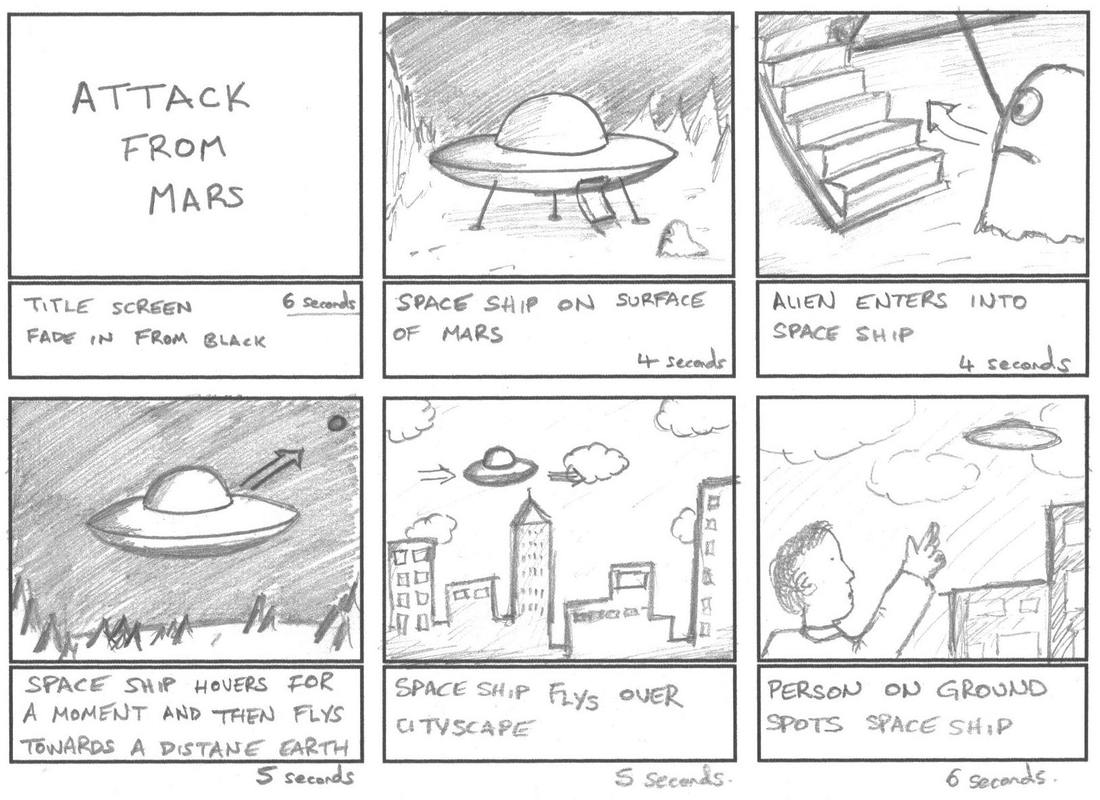
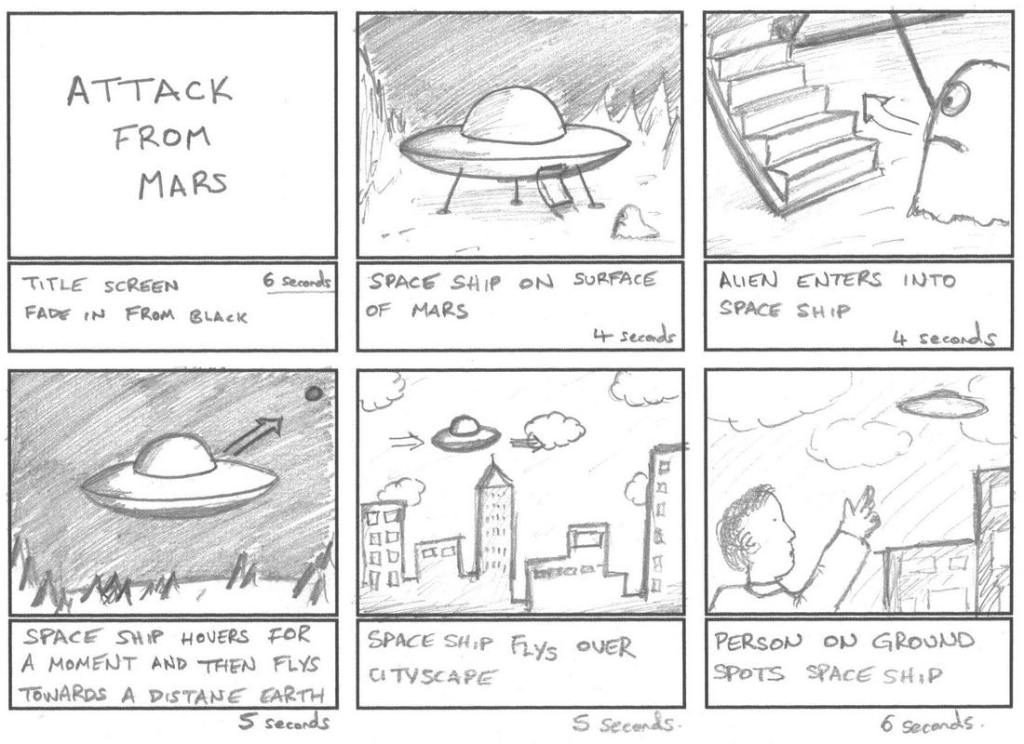
The above example comes from a Dream Farms Studios Website, the article explains how storyboards can be used instead of a script in the process of creating an animation. The drawing clearly states the order of action, direction of movement with very clear arrows and a bit of text below explains the details and length of the ‘shot’. The drawings are a little crude, (the artist is just a little bit better than me at drawing human hand, which is my nemesis), yet they communicate very clearly the order and content of action in the film. In this little story the content is not as important as skill, the drawings certainly don’t need to be neat or perfect, they need to be easy to understand. I like the neatness of the design of this story board, with all rectangles being uniform in size and position. The squares are so neat I think they may have been drawn on the computer, printed out, and then artist drew and wrote on the printout.
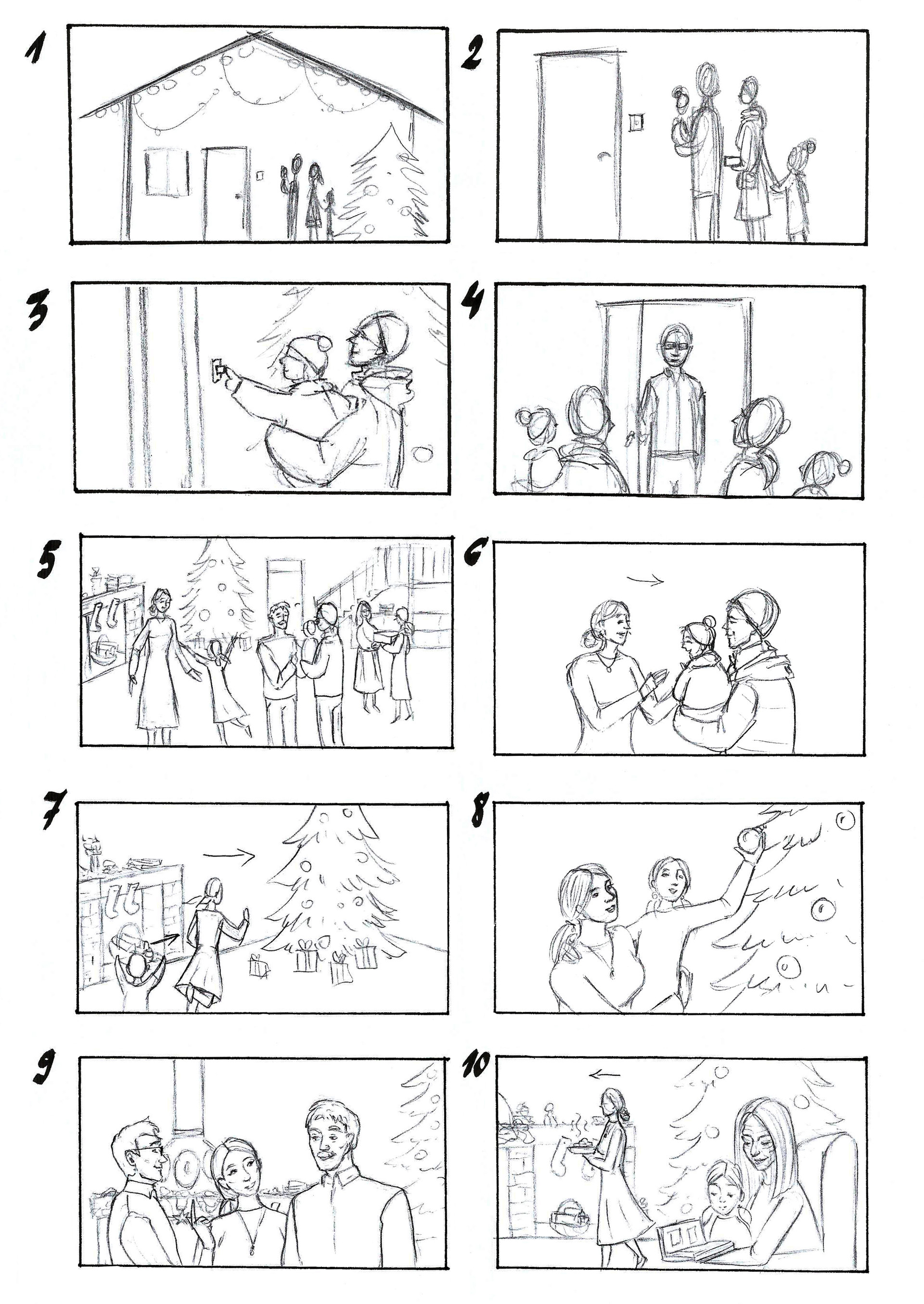
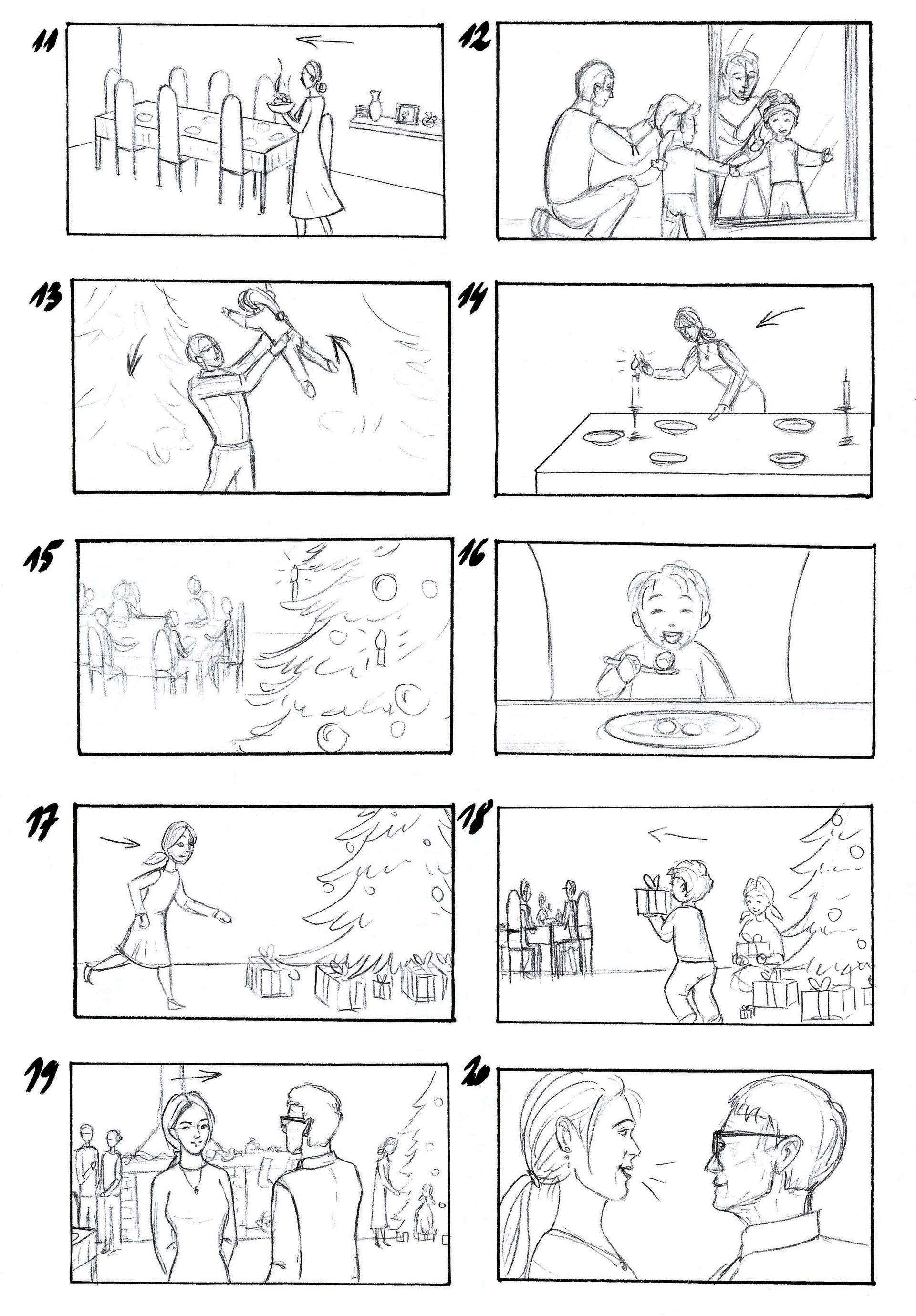
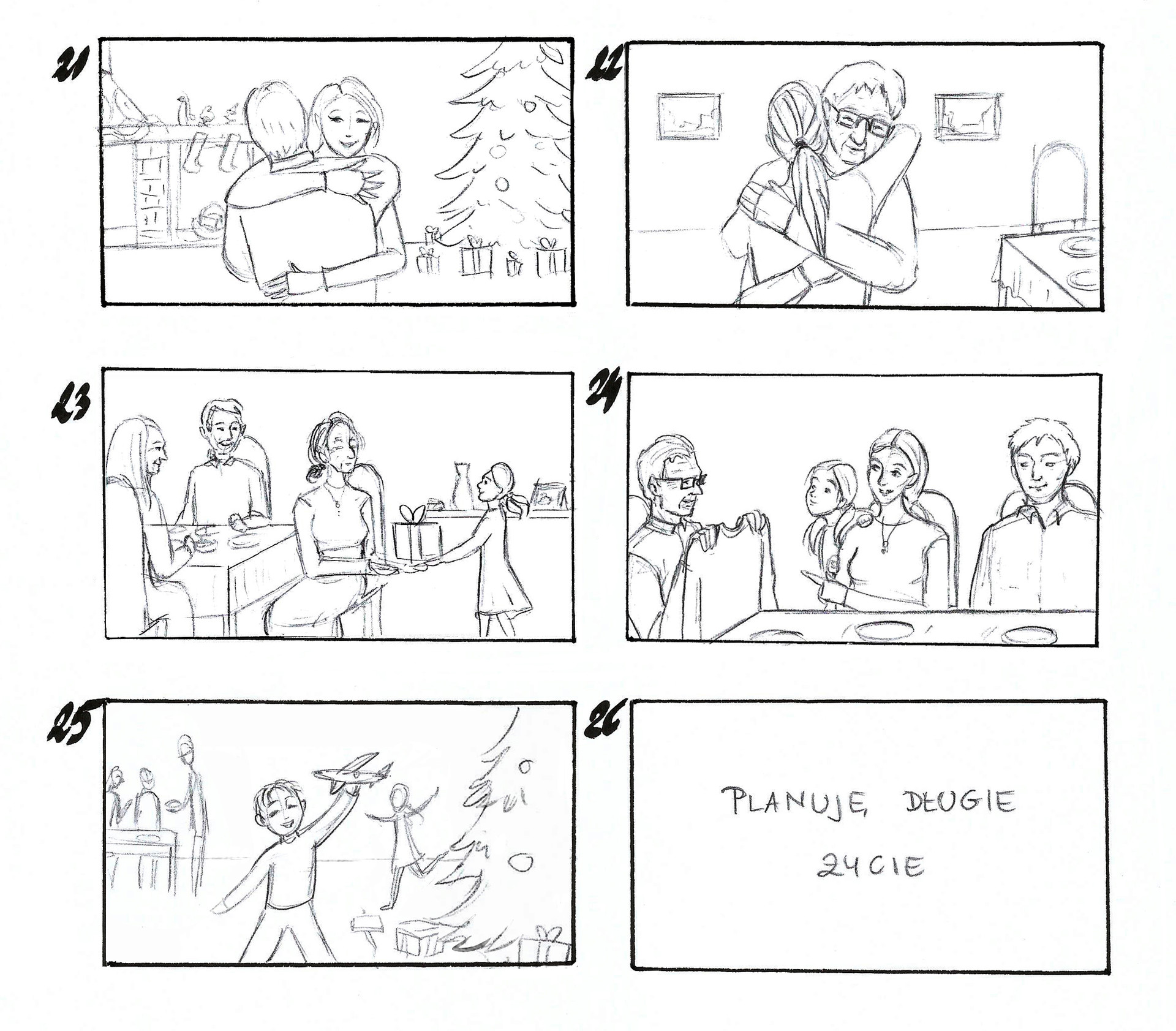
Another storyboard I found was for a health campaign video, promoting preventative cancer testing. This example is quite nice as it comes with a video of the after product. The video can be viewed here https://youtu.be/VnRxhULO1Zk
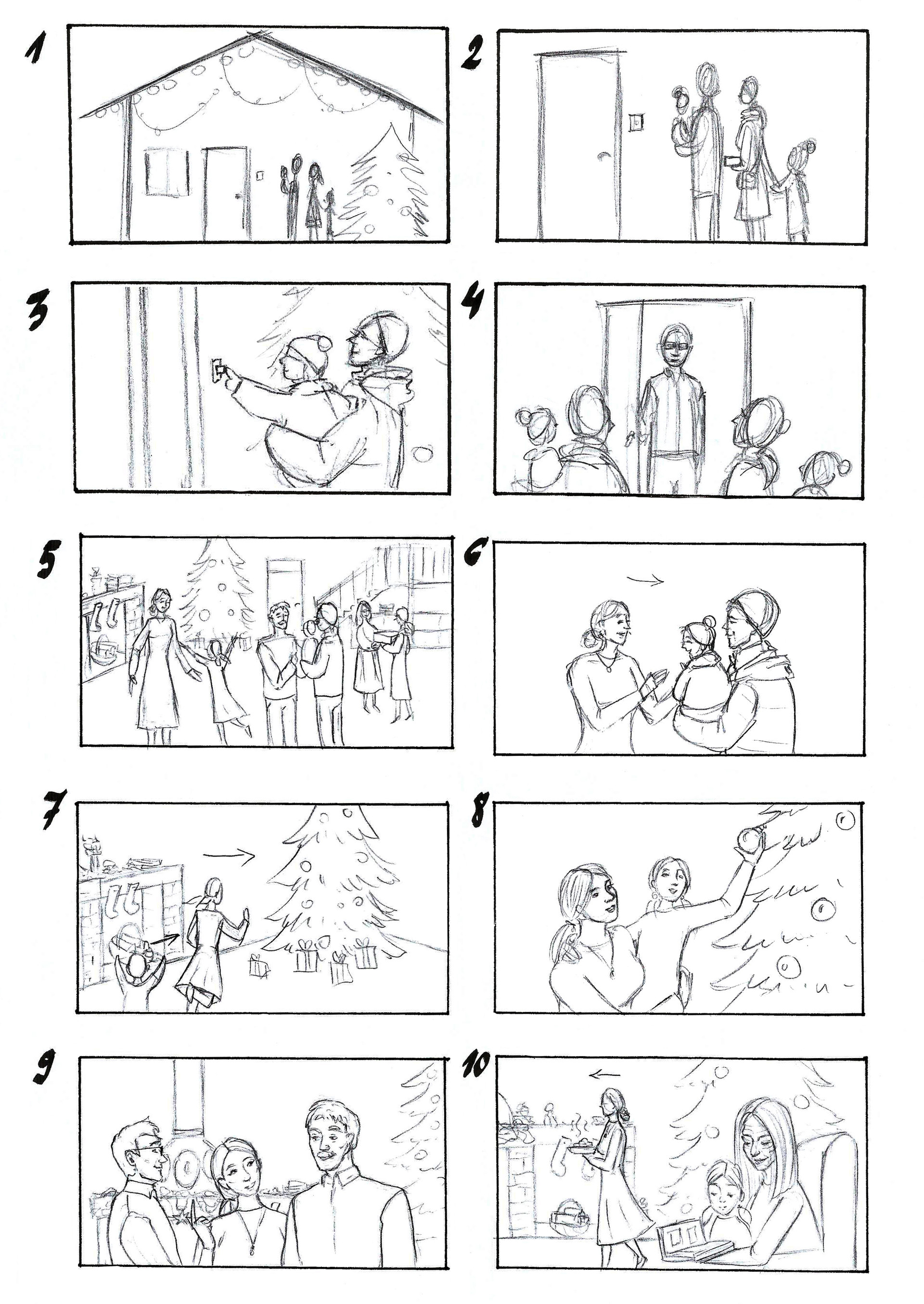
In the video the woman says to the man (in case you were curious) ‘Dad, I have a gift for you. I had that test done (cytology), it’s all right, I am healthy’. The last shot of the video says, ‘I am planning a long life.’ I like this story board, it explains all actions and shots, using the arrows to show direction of movement. I quite like the box no 20, where it’s clearly shown to woman is speaking to her dad, even though we can’t know what she said, we can see emotions of happiness in the following boxes. The order is also very clear thanks to the numbers next to each box. I stumbled across this storyboard as I hoped it may be a bit more related to interior design, showing the house and interior elements. Even though it isn’t interior design related it shows the use of space and crucial elements within it. All the elements are Christmassy as the action is clearly happening at Christmas time, we have a Christmas tree, Fireplace with stockings hanging, large table and chairs to accommodate the entire gathering, the gifts are being exchanged. The video and the storyboard preceding it leave no doubt when and where it is all happening. It also shows the use of space, and how it is used at Christmas time, even though that wasn’t the intended purpose of it.
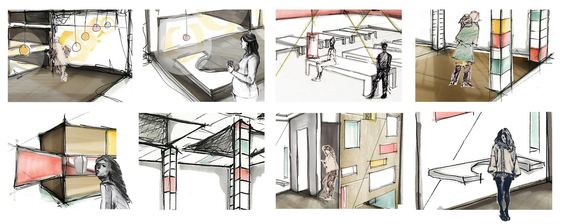
I tried looking for interior design storyboards but google seems to think that those are the same thing as mood or design boards, which they obviously aren’t. Then I stumbled across this Pinterest image; I am pretty sure it is interior design related.
Fig. 5 Interior Design Storyboard
I like the use of colour and the energy of these drawings, coming from confident hand. The wobbly lines and high contrast add charm and interest. I also like how the person on the last picture is sticking out from her square…
The internet is full of examples of storyboards, but I think I best stop here, it is so easy to get lost in the research.
Whenever I look at story boards, I can’t help myself but to think of comic books straight away. There is similar energy, especially in showing emotions and movement. All the little boxes are missing are speech clouds to rely detailed conversations…
I received feedback from my tutor. As always, I found feedback helpful in understanding what I am doing right as well as challenging me to consider doing some things differently.
Hallway and lodgers room survey and drawings: It was good choice to draw in people to demonstrate the scale as well as using different colours for measurements – this aids understanding of the drawing. Next time – if drawing only plan, I should note the ceiling height on the plan. It is handy to draw elevations as well as plan drawings, as elevations show many aspects that plans don’t, such as ceiling, door, skirting board heights. Perhaps also light fittings, pendants etc, how low they drop could indicate and conflict (I’ve seen some homes where doors interfered with pendant lampshades)
My tutor noted that it ‘would be more helpful to see move development work’. I must admit this is the hard bit. Often there isn’t a lot to show. Mainly because I come up with an idea in my head and just do it. So, what I put on the learning log, is all there is to show. I suppose it makes tutors work harder, trying to understand my process, that’s mainly in my head. My tutor recommends making more sketch models, which I find the hardest to do.
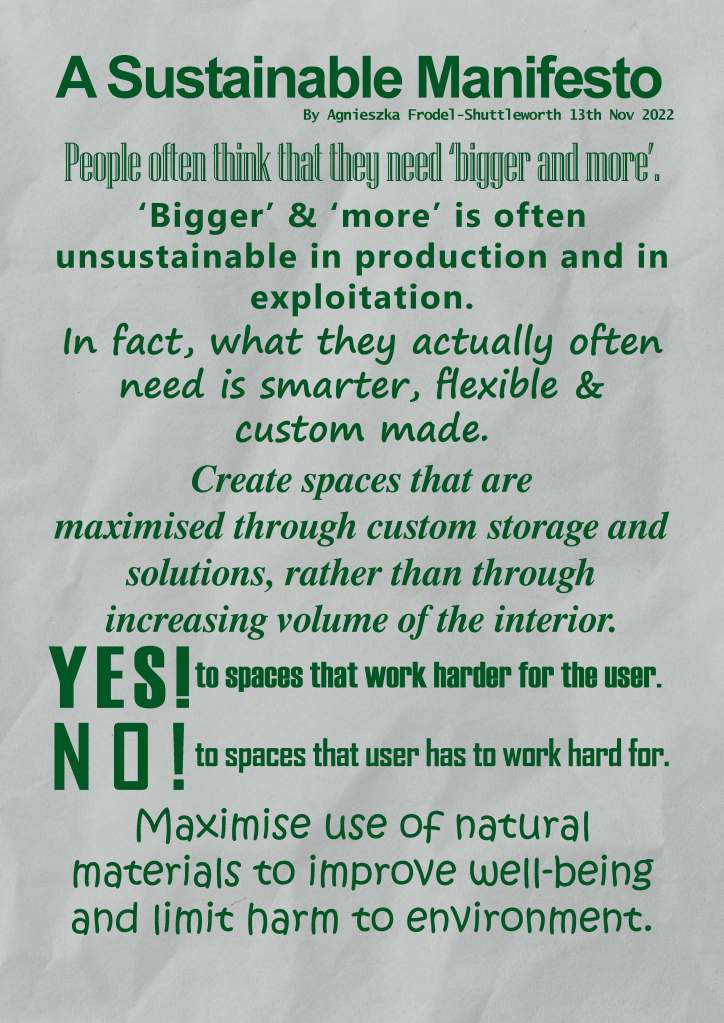
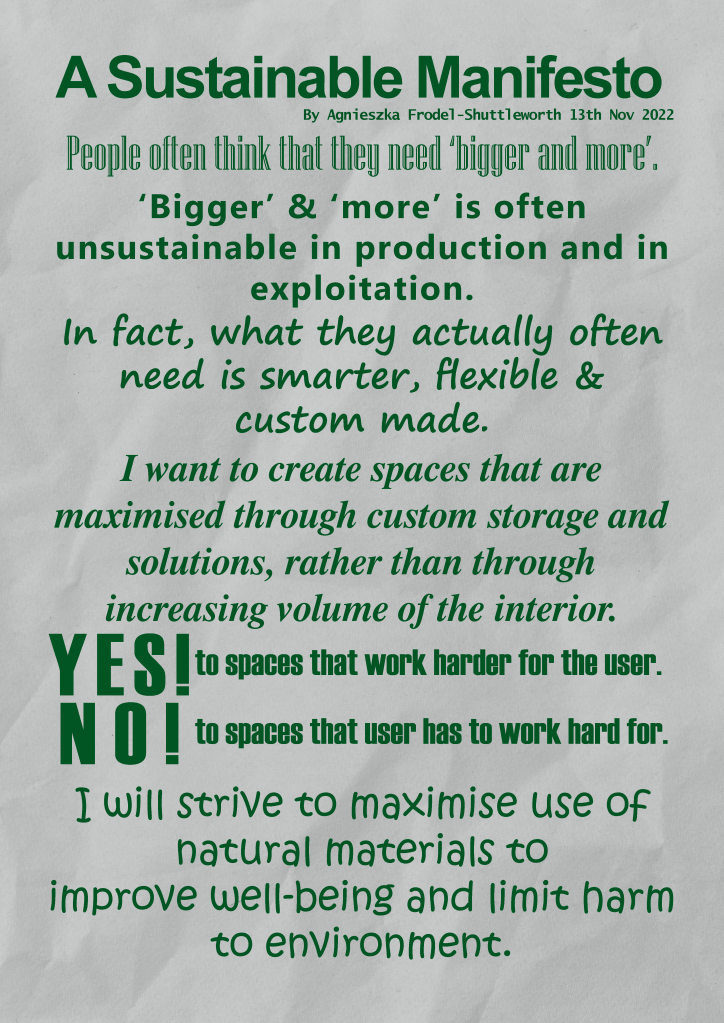
For my manifesto my tutor suggested some challenging ideas, such as remove the ‘I’s (want, will etc) and also make ‘yes’ and ‘no’ statements in different fonts to make them contrast with each other. I tried it and I like my manifesto more now. The statements are stronger now, the manifesto looks punchier. As I reflect and look back now, I realise that one of the design inspirations for my manifesto was a poster with message in different fonts. I can’t remember by whom or where I saw it… My tutor also challenged me to think about how / where my manifesto could be presented – I think this particular one would look good in print – poster or a t-shirt but could also be placed on a website. I don’t think Billboard would be good – they use a lot of material to display the message (therefore not sustainable, contradicting my manifesto), also the layout of a page would have to be changed (which of course is possible, just needs changing).
My tutor recommended that in future research task / study presentations I should research, analyse, and include images of technical drawings for the researched projects. This will allow me to discover more in depth what made the design work, as well as enhance the already in-depth research. I can see how it would have helped me if I looked up Barbican original plan drawings or Holmes Road Studios Design Development Documents.
My Es Devlin’s manifesto research had a good level of personal response (as opposed to Roberto Venturis analysis). I should try and include my personal responses all the time. I could have dived deeper in the analysis of manifesto’s and compared the ones I analysed with each other. Doing so would have helped me form opinions and improve my critical thinking and analysis skills.
Including more of my own drawings is also suggested by my tutor. I should show more development work, perhaps redevelop ideas I already put to paper, tweak them a bit (as I did in this reflection with my manifesto), test and retest the ideas. This will help me refine the ideas as well as give my tutor an insight into my processes.
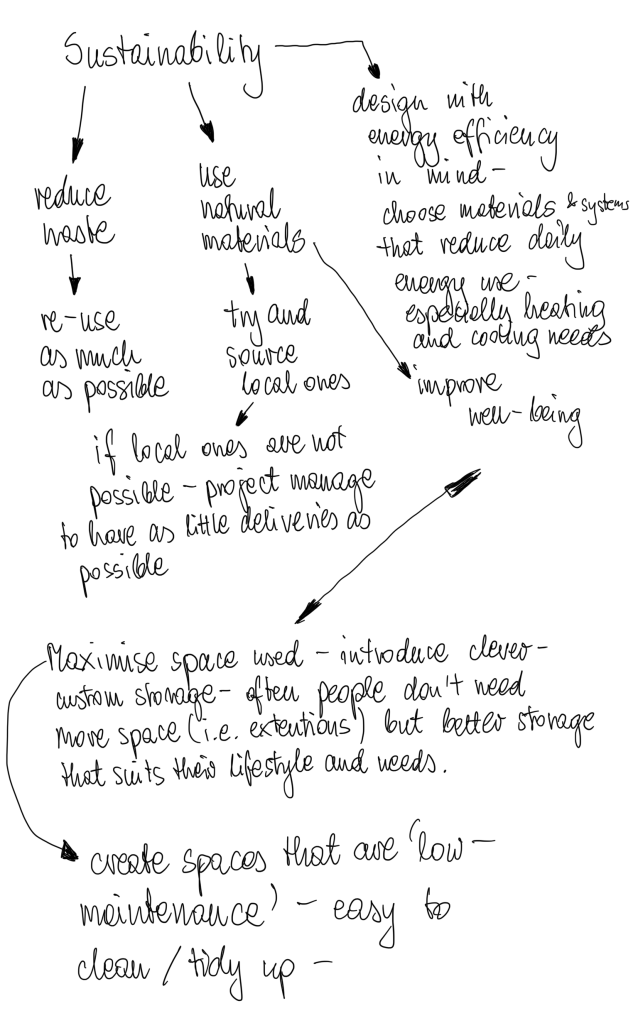
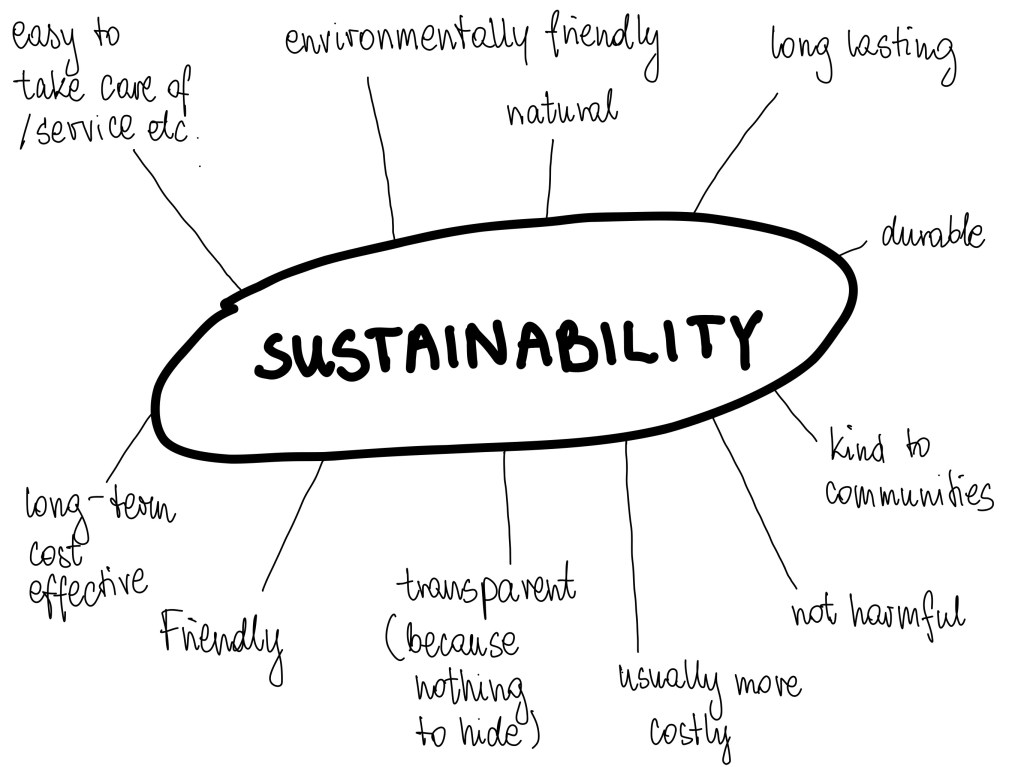
Looking back, I should have researched the idea of sustainability before creating my mind map, to enrich it.
It will be beneficial to me if I include such ‘looking back’ in my future reflections – think of what I could have done better or just differently and how this could have benefitted my progress or even research results.
Drawing on the methods and processes learnt throughout Parts 1, 2 and 3, make
or write your own Spatial Design Manifesto to be used throughout the rest of this
unit.
Develop your manifesto to celebrate and visually present your position on an
issue related to spatial or interior design. Present it to reflect your position. For
example, you may want to explore the enjoyment of playful spatial design, the
importance of functionality through the material choices you make or
demonstrate your position by presenting examples of design you think are
unsuitable, ugly or dull.
Use your manifesto to say what key elements of interior design you find good,
interesting, bad or beautiful – and why. You may want to use quotes from other
artists or designers as part of your manifesto.
Reflect on your own experience as an occupant-of-interior-space. What kinds of
spaces do you enjoy and how do other spatial designers help to support this?
Celebrate these examples of good practice or innovative approaches by
proclaiming what makes for a better spatially designed world!
Use the most appropriate means or medium to do this (written, modelled,
2D/3D, digital, technical or hand drawn) to ensure that your manifesto ideas are
communicated in a coherent, clear and concise manner.
Reflection on the assignment / how did I get there:
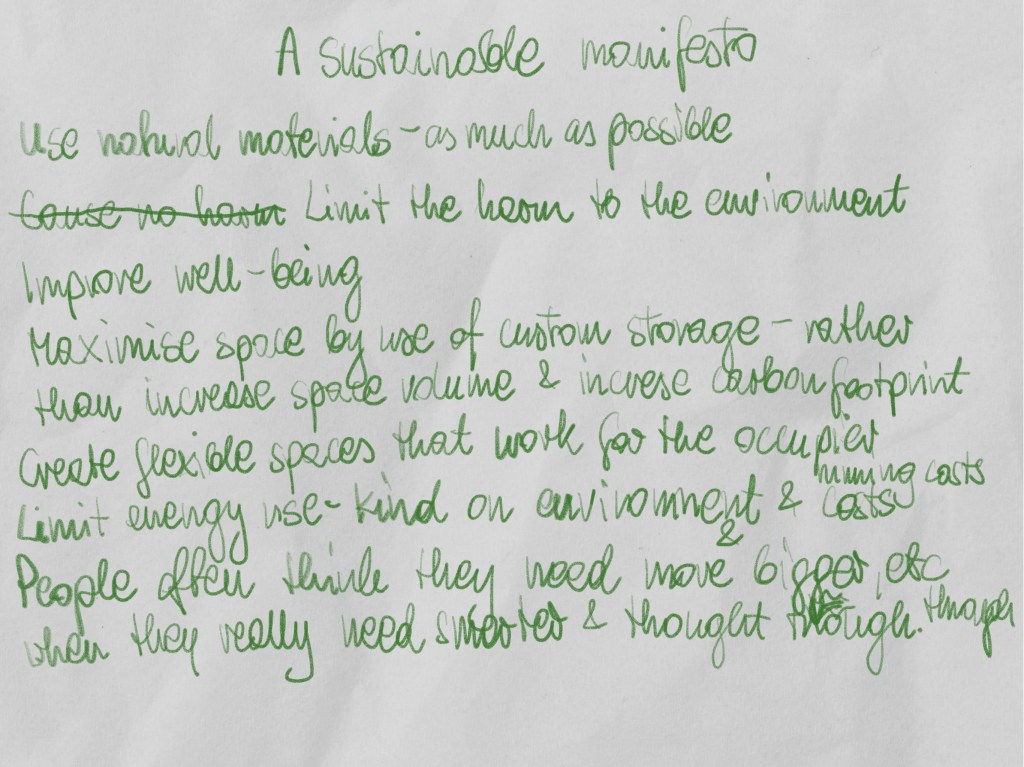
First, I thought long and hard about what is important to me and why. My main interest is in the interiors that have custom designed features, to suit the user needs. Sustainability is equally important to me. I believe that often we don’t need more space – we just need to use what we have wisely. I jotted some notes and then thought about how I can present my ideas. I purposely made my manifesto very concise. I want to get my message across, but I wanted to keep it short and sweet. Our lives are fast paced, and I wanted my manifesto fit in it. To underline the sustainability issue, I created a background of a crumpled piece of paper – one that you might discard otherwise – yet still perfectly usable. I made the text green as that colour is often associated with nature and well-being. I used different fonts for different points to add to the interest. I uploaded the manifesto into the padlet.
Finding the issue for my manifesto was relatively easy, yet it took longer than the hard part of deciding on the look of it.
I wanted my manifesto to look like poster, I think I achieved that goal.
Reflection on the unit as a whole:
I enjoyed most work in this unit. I found all exercises interesting and most importantly informative.
I found it interesting to read about philosophical approach to the idea of a home in research task one, now I am thinking I should actually read the entire books I briefly studied in 1st research task.
Case study: small space of living was just wonderful. I found it really interesting reading about the architect (Peter Barber), the project Holmes Road Studios and the architecture aiding the therapy. Creating the research presentation document also helped me brush up on the InDesign skills once more.
‘Your living space’ and ‘AN Others space’ exercises helped me brush up and improve my site surveying skills. I also chose to draw by hand for this exercise, despite my preferred method being digital – just to practice on paper.
Research into Barbican helped me to practice sifting through vast amounts of material available and selecting the important bits to present. It’s so easy to get lost in the research!
193 Grove Road research – I feel just grateful to learn it. Fascinating story but it was quite hard to find extensive information on what Sydney Gale might have been feeling. Just had to imagine I was in his position. Despite his bruised ego, it’s a shame the artwork was destroyed…
I found researching and analysing manifestos quite hard. Mainly because personally, I find most of them pompous and quite frankly many of them are long and boring… It was helpful to be given specific tasks in regard to the manifesto text –it helped me fleece out the relevant information out of it. I was pleased I chose Roberto Venturis ‘Non-straight forward manifesto’. Such a joy to find that signature with a shape of a house he designed in the past. It was also useful to just analyse his manifesto in bullet points.
It was a bit harder to draw it. Took me a while to come up with a concept but once it popped in my head, I knew what to do and had it ready in a matter of minutes.
Finding the right contemporary manifesto to analyse took a little bit of searching. Luckily, I came across Dezeen 15 Festival where 15 artists / designers wrote special manifestos for the occasion. I chose ‘Swap card for trees’ by Es Devlin’s the easiest to read and understand. Manifestos should be able to reach the reader rather than just exist for the benefit of its creator. It was also just nice to dream about what the future could look like. This text really spoke to me, I keep thinking about it – hope it comes true soon!
Jimmy Caunty and his ‘Riot in a jam jar’ was quite a hard story to research. There is a lot of information about him but not a lot about the exhibition. I even watched some music videos from his music career, and oh boy – some of them are something else. (The KLF – What Time Is Love? (Live at Trancentral) (Official Video) – YouTube )
Mind maps were invaluable in helping me to create my own manifesto.
Great part, enjoyed the work in part three very much!
Sustainability is about being environmentally friendly by offering often natural, long-lasting products
Sustainable product is not only kind to environment, but also often kind to communities who are making the product.
The sustainable process is transparent as there is nothing to hide and is not harmful (to environment or people)
As the production process is not as developed as mainstream the initial purchase cost is usually higher.
The long-term cost of using the product is often lower due to its effectiveness, durability and quality.
Reflection:
The process of creating this mind map and bullet points felt incredibly easy and quick. I hope I did it right! I knew straight away that the main issue many designers currently face is about sustainability. It must be hard to juggle to project cost against the prices of different solutions – and the sustainable ones being often higher. Yet it is so important that the designers influence the clients, convince them that it is worth if – for the long-term use, their conscience, health and planet. Just realised I should have written ‘healthy’ on my mind map too…
Using contemporary design journals and/or online resource, research and find a
contemporary manifesto, or statements or sentences from a recent manifesto
document – i.e. one published within the last 24 months. The quotes that you find
should have some relevance to issues concerning interior or spatial design today,
and also, be ideas that you are happy to adopt or apply in your own design work.
Record your findings in your learning log, and reflect on the issues raised in the
manifesto that you have found. Make reference to how they relate to your own
practice of interior and spatial design.
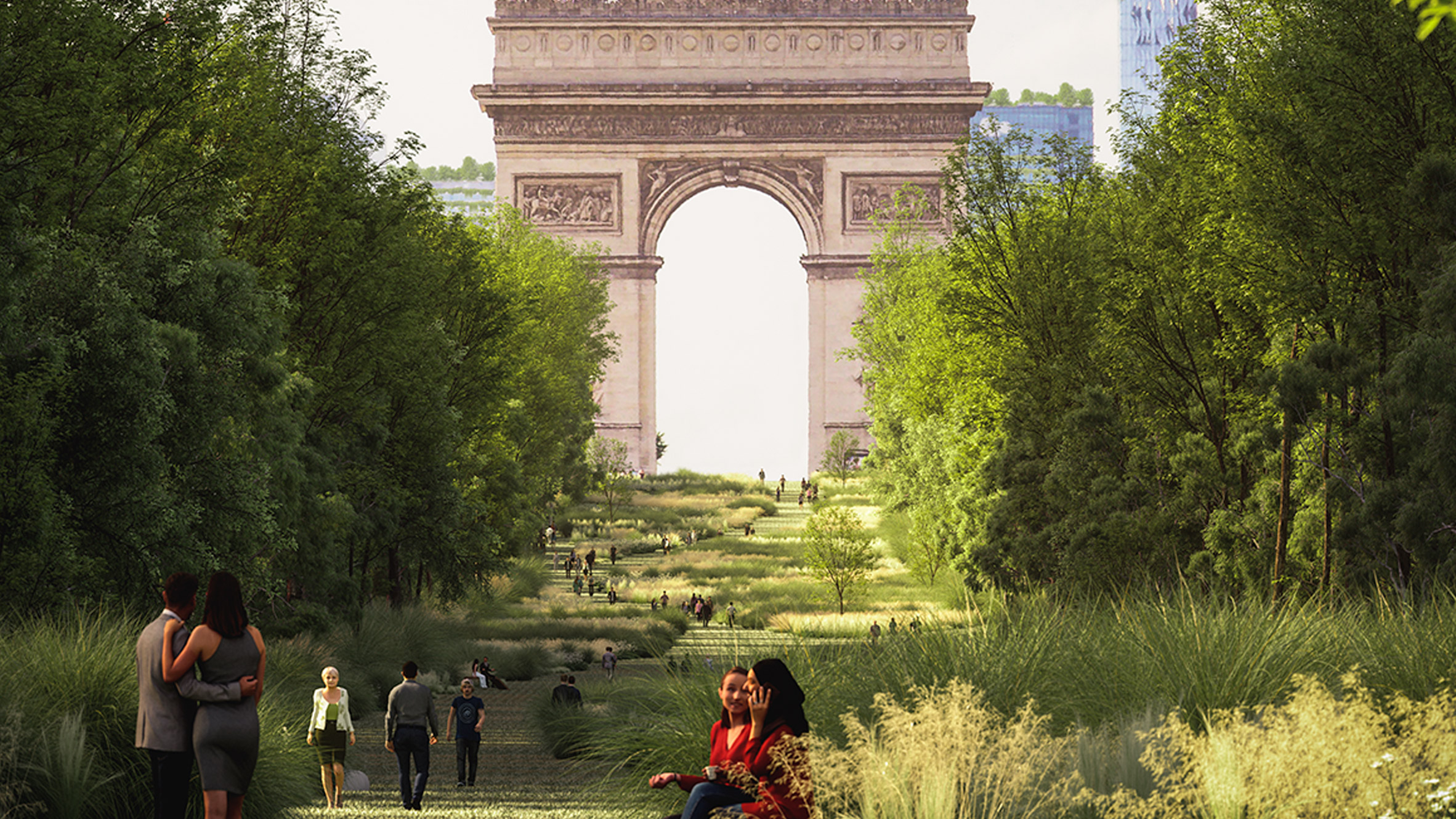
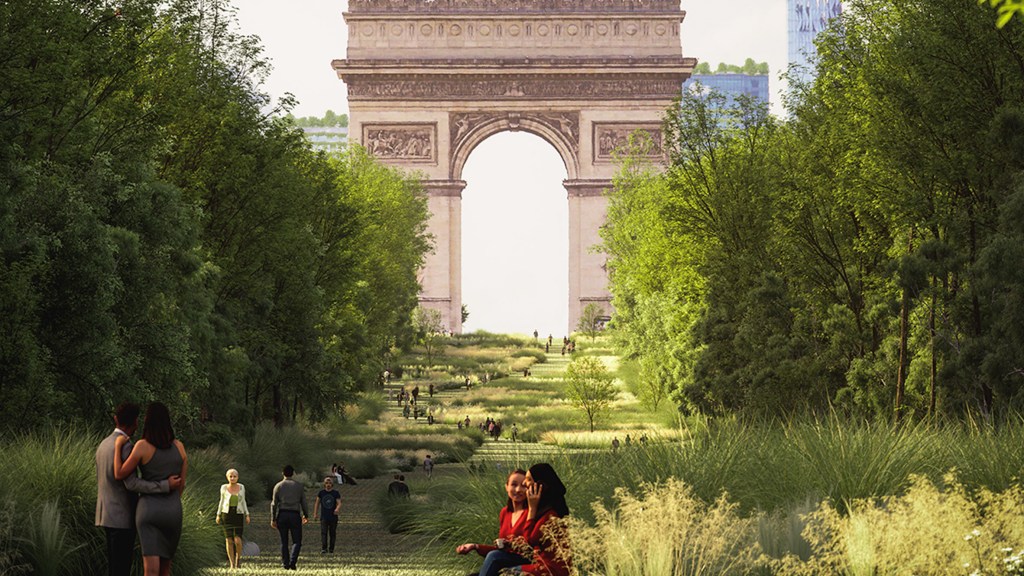
Fig. 1 A rendering of a car-free Paris produced by Es Devlin Studio
I found a brilliant manifesto by Es Devlin, written for Dezeen 15 Digital Festival in 2021. I liked it because it was easy to read, unlike other manifestos I’ve read, that were written in a pompous tone and used complicated language. Es Devlin’s manifesto is titled ‘Swap cars for trees’ and the whole text can be found here: https://www.dezeen.com/2021/11/01/november-2036-every-city-swapped-cars-for-trees-says-es-devlin/amp/
It’s a dream like story, imagining what the world could be like in just 15 years (at the time of writing) – in 2036.
She mentions every product made and sold would have entire life cycle, including servicing and recycling / disposal at the end incorporated in the transaction. Wouldn’t that be just amazing? If the businesses instead of caring for making quick profit, cared about how their product will affect nature in the end? Not only at end of life, but during production too. The lifespan of products would be extended by having prepared servicing etc.
This led to the next point raised in the manifesto: Designers and architects would have to sign an oath to do no harm to the planet. That’s why every product sold would have servicing, repairs, parts available throughout its entire life span. On the other hand, I’m a little worried about the economy, wouldn’t that cause a massive recession? Isn’t the GDP supposed to be growing? Less consumption will lower the growth.
But if we continue on the current path then we will destroy the planet and humankind.
I am also curious how construction of new buildings will develop, currently construction is the biggest landfill waste contributor.
The title of manifesto is ‘Swap cars for trees’ and it proposes pedestrianising all city centres on the entire planet and planting trees instead of having parking spaces. This would improve general health and quality of life. It would also reduce pedestrian and cyclists’ mortal accidents. All this would be facilitated by improved public transport, cycling lanes etc.
Essential workers would live in affordable, cleverly designed micro homes.
It is a bold proposal, one that sounds utopian.
It sounds amazing, but my initial feeling was of not believing it could happen, with economy shrinking who would spend that sort of money. The world would need a tru revolution to make it happen, however…
The manifesto mentioned Oslo pedestrianised its city centre in 2019. I checked it out and according to the article I read about it, the change has made the city centre a destination (as opposed to going out of town). The city centre also became attractive residential area (due reduced noise and pollution) and the footfall in the shops within the area has increased by 10%. (https://www.wired.co.uk/article/oslo-pedestrianisation)
The manifesto compares the change to the smoking bans implemented since 2006. How it denormalised smoking. Es Devlin believes it will be similar with this change, and car free city centres can soon become a new norm.
A few years ago, my tv broke. It was only 4 years old. Yet it could not be repaired due to lack of parts available. Current mentality of every business is: why repair if we could sell more and increase profits? This has to change. I remember feeling bitter about having to dispose this large appliance, complete waste of resources with such a negative impact on the environment.
I liked this manifesto for it dreamy tone. A gentle nod towards sustainability benefitting everyone. Lets hope and see…
I received Assignment 2 feedback from my tutor. It was a positive and encouraging one. Especially good to hear that generally I am progressing well through the coursework.
My tutor would like to see more sketch models, we had a chat afterwards and she suggested using card and stick it together with pins is a good way of quick sketch models to demonstrate the process.
My tutor noticed an error in my technical drawing, where I didn’t include a thickness of the mdf if the section drawing. I must admit I find sections particularly challenging, especially of things that do not exists (yet). Despite that my technical drawings look professional, and use of CAD is good and helpful in completing tasks. I was pleased to hear that in the feedback.
The design choices of my folly could have been better, and I should consider re-using and thus limiting environmental impact of the structure. During the design process I should consider future renovation/ conservation of the design.
My tutor gave a tip to overlay the materials on the material board, so it is clearly visible how they’ll go together, specifications could be on a separate sheet.
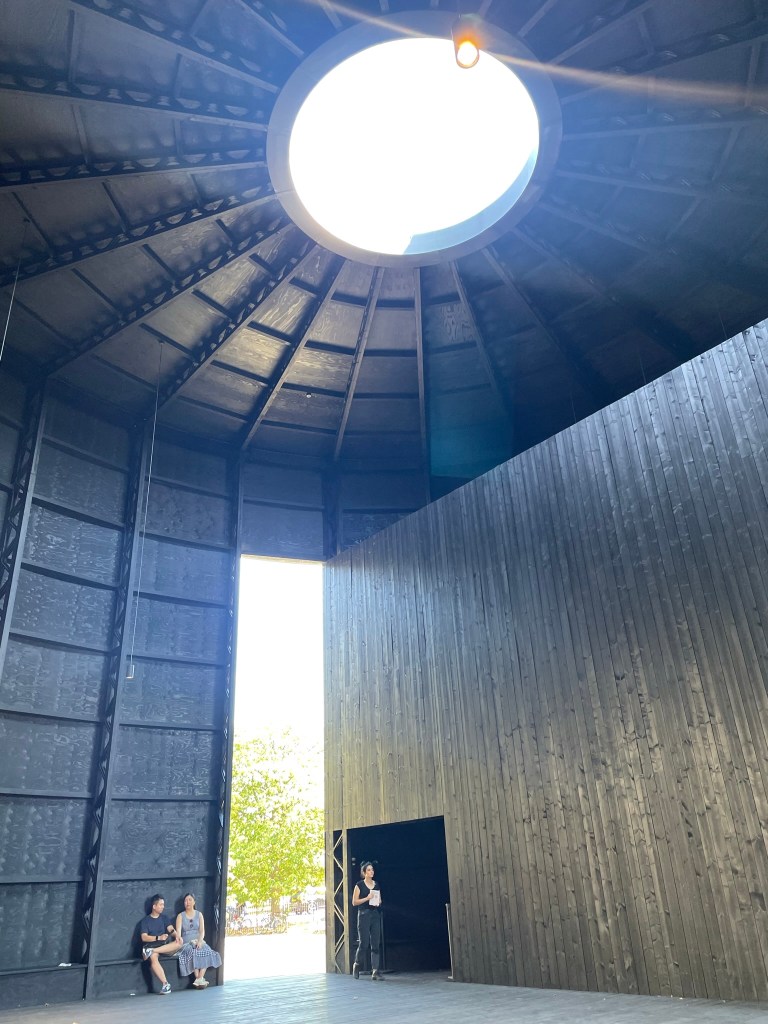
My tutor was impressed by the scale of my Serpentine Pavilion research. She suggested I visit this year’s one – Black Chapel Pavilion. I went to see it last weekend. It felt serene and quiet. Reminded me of silos. Despite being all black structure sitting in the sun – it was cool and pleasant inside. Theaster Gates must have carefully thought of airflow throughout the interior.
Black Chapel Pavilion by Theaster Gates (2022) – photograph by A. Frodel-Shuttleworth (2022)
My tutor gave me a tip to look at technical drawings when completing precedent studies as this will challenge me to understand the design better.
I should add images when reflecting on designs – so the reader could understand better what I am describing.
My tutor suggested searching OCA library for some books about symbolism in architecture – referring to scaled up objects – kitsch American designs that I skipped in one of my exercises.
Generally the work was well done, but as usual there is room for improvement. I am grateful for all the tips and suggestions.
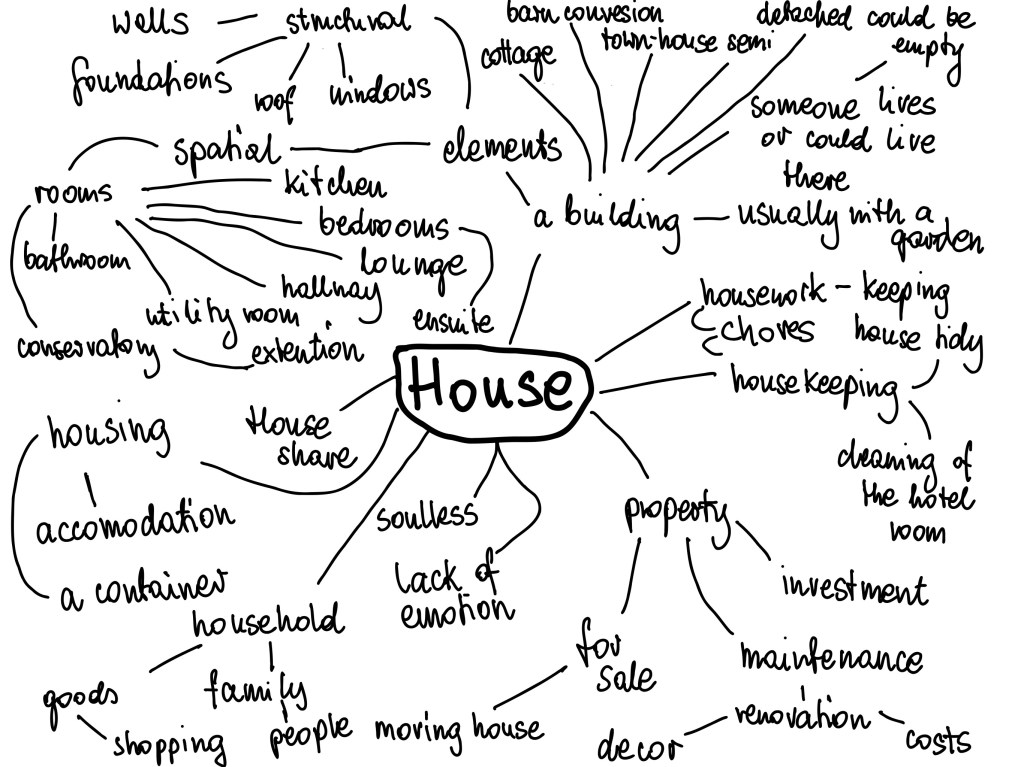
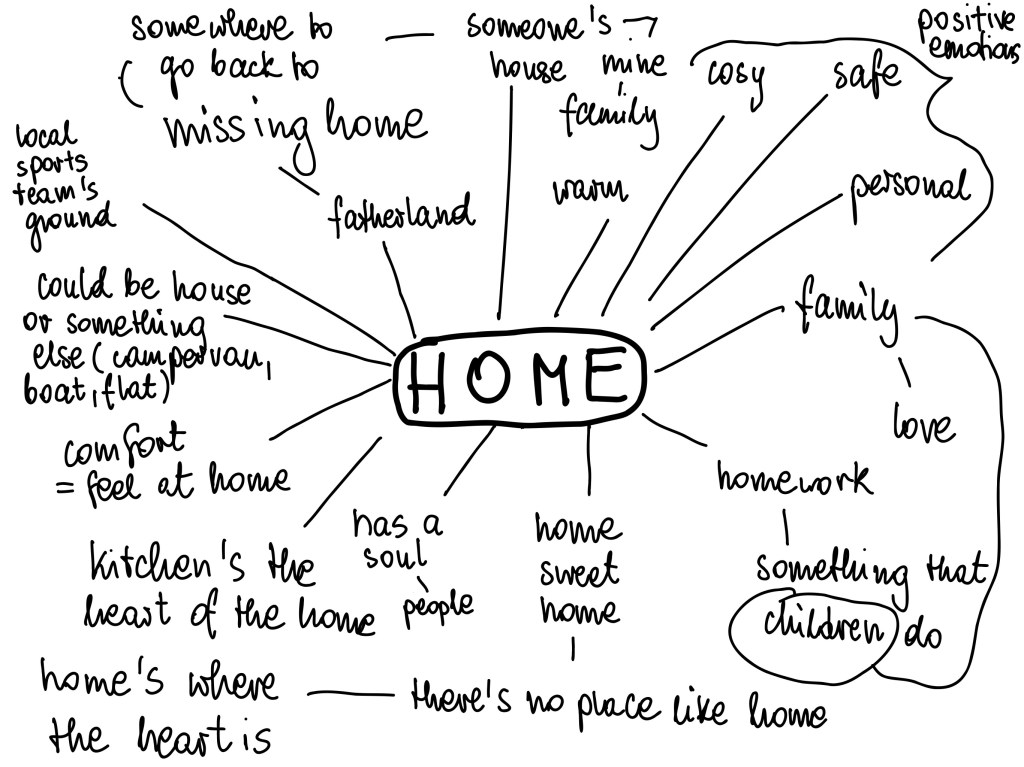
In my opinion the difference between a house and a home is the feeling about the place. A house is just a building, walls with a roof over, no attachment. Home is a place where people go back to, to feel safe and comfortable and cosy.
An interesting thought occurred to me when noting down ‘moving house’ – the actual house, the building does not get moved – but all the home belongings do – to make home in anew place. Yet it is called moving a house.
Home is usually in a house, but it doesn’t have to be.
Home could also be a place, as a foreigner in England I often get asked if I ‘go back home often’. And then I usually say here is ‘home’ now. But many people moving countries may not feel at home in their new location, and for them home is back where they grew up, where their family is.
I often consider differences between English and my mother tongue. In Polish language house and home are the same word. Yet somehow, we can tell the difference between the two meanings of the word.
What a wonderful project! Seems like every detail has been carefully considered, along with any potential resident’s needs. The cottages look cute, tiny homes – mini safe havens for vulnerable adults to start the new life in such pleasant surroundings. I can imagine that it will have a great success rate in helping the homeless start over and move on to a better future. Hopefully in future there will be a study into effects of this or a similar project into the outcomes of these people journeys. Usual hostels can be depressing and dangerous places – here the therapy should be so much more efficient. Architecture and design – when user is at its heart – can really help achieve goals.
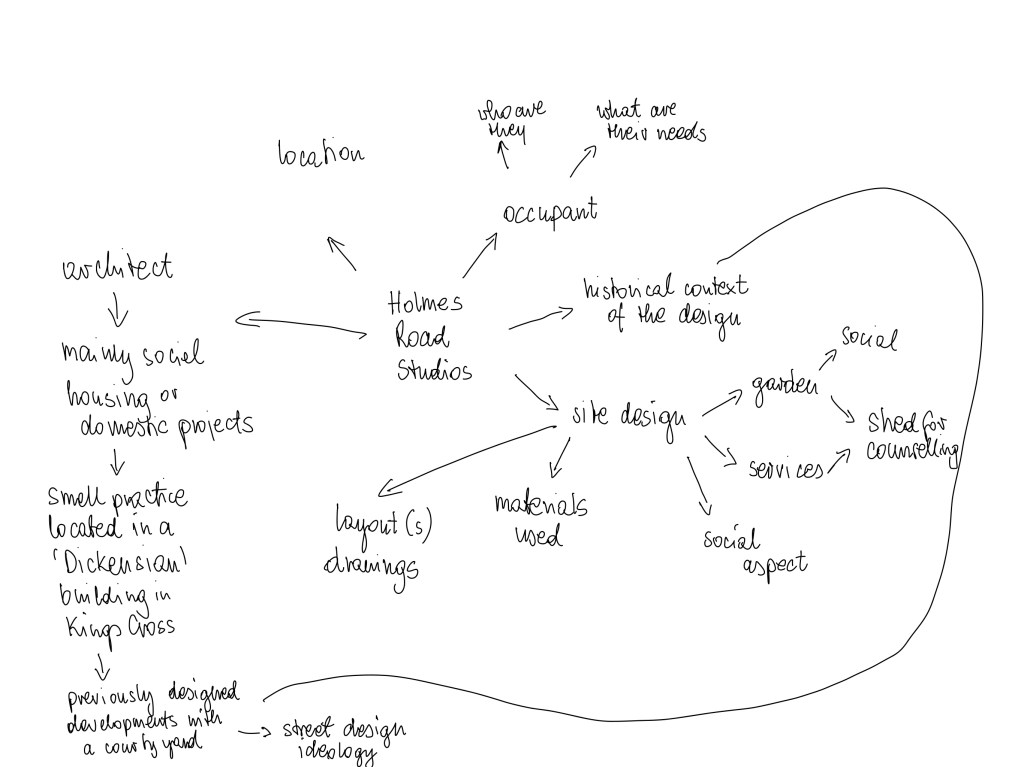
I created a rough mind map to help me get started on my document.
List Of Illustrations:
Fig. 1 Google (2022) Holmes Road Studios Location. (Screenshot, edited in photoshop) At: holmes road studios – Google Maps (Accessed 30/05/2022)
There seems to be as many ideas on what the home is as many elements (both physical and non-physical) a home contains – the list would be extensive.
According to Otto Friedrich Bollnow (author of ‘Human space’) home provides shelter and protection, gives a sense of safety. The size of the space matters can’t be too big or too small, but the dimensions are not set in stone; it is flexible depending on the occupants need. Another important aspect of homeliness is the temperature. The homeliness or cosiness seems to be about striking the right balance, not too much… not too little… And the rules are fluid, depending on who the occupants are, what are their needs, tastes, lifestyles, and histories. Comfort is needed for homeliness – be it in the form of lovingly cared for interiors and furnishings or just that ‘feel-good’ sensation when we are just content. The ability to shut off the outside world and be safe and unbothered in one’s space is the ultimate comfort. The common denominator is that home is a place where we can relax, feel safe and comfortable. And if we can’t life is difficult.
According to Edwin Heathcote (author of ‘The meaning of home’) house and its elements were at heart of language development. A home could be a ‘container of meaning’ and history.
Thinking of different forms, we use the word home in our everyday life; the feeling at home has such a special meaning – it is about ‘feeling’: safe, comfortable, confident, content. That feeling can be felt outside of one’s home.
I absolutely loved the activity of designing and presenting my folly. The whole process was easy to follow, and the elements became the bricks in my storyboarding plan.
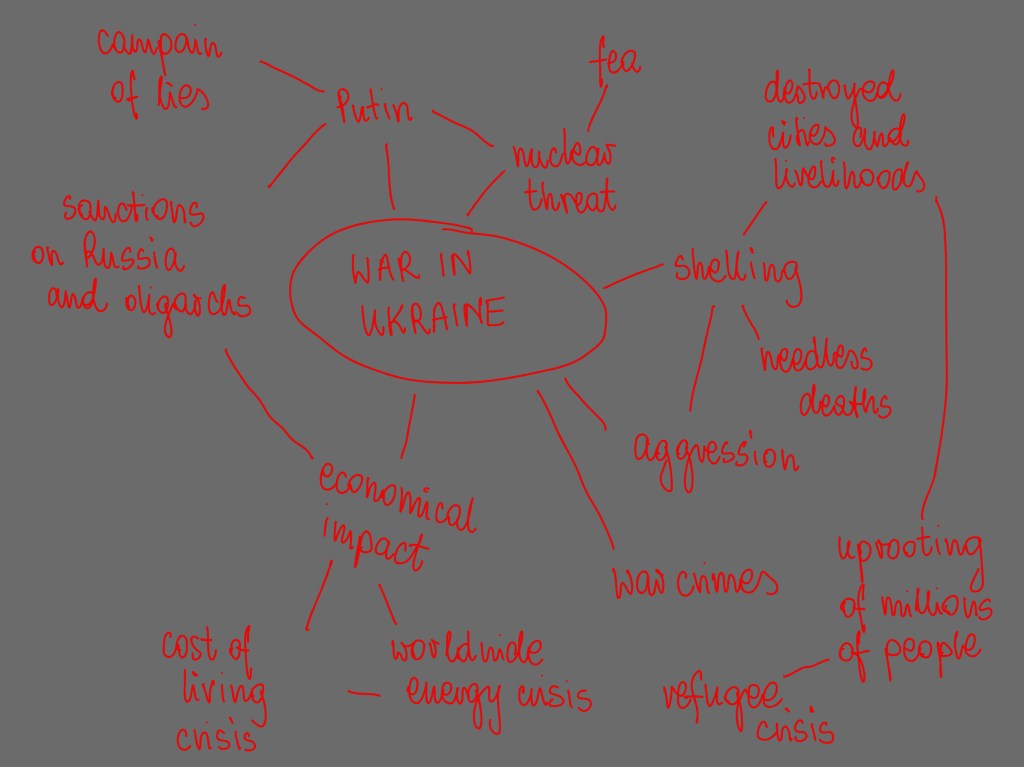
Finding the issue and creating a mind map was a very quick activity for me. At first, I created a mind map on war in Ukraine, then I realised I was supposed to concentrate on one word, so I did another one that I used in my presentation document.
Here is the mind map I did not use:
War in Ukraine mind map I haven’t used in design document.
I decided to challenge the notion of boundary as it is somehow connected to the issue of war (where borders are challenged). I challenged it by placing two walls and criss-crossing them, then piercing opening through them.
I enjoyed the design development stage, I considered how can I create something fun with such serious connection. I chose the cross plan with red roof as a protest to the bloody violence going on in the Ukraine. At the same time the public can interact with the folly with a fun way, I can imagine children climbing though the openings while the families wait for their trains, and general public just using it as a rest place in the busy station concourse.
I built the Lego model first, to see how it would look.
Technical drawing was challenging but enjoyable, as usual. I consulted the in-house carpenter on choice of materials. On his advice I chose the frame structure elements to be:
I struggled and struggled around how the frame components inside my folly will go together, I tried hard and spent a long time working this out. I ended up creating a simple SketchUp model of my folly and sliced it with a section plane to help me understand what will and what won’t be sliced by section line. This was my first time using SketchUp and I found the software easy to navigate. I realise that my CAD drawings are far from perfect and there are probably some errors, but on the other hand they communicate the design well.
This time round I created a template for title block – specifically for study projects. I also overcame difficulties with plotting in CAD – for some reason all new cad files I create have a tiny paper space, so small that a dashed line appears solid in the viewport. I resolved it and now with my template it will be an easy fix in all future drawings.
My photoshop skills are not up to scratch yet. I’m not quite happy with the final result, I need to learn better how to do realistically looking shading and render. I used Euston station image and human figures found online to bring the design to life. Here is where I found them:
The recent storyboarding tutorial I took part in helped me understand design presentation process.
I created the storyboarding template, but as seen in the image it changed as I worked. Nevertheless, having this little plan to hand helped me a lot with creating the presentation document.
Presentation story board
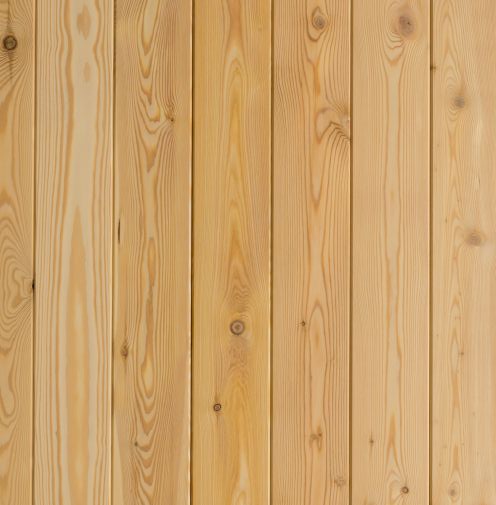
I wasn’t sure I if you can skip some annotations in presentation document. I didn’t add annotation to this image on my materials page, I thought adding writing there would ruin the look of the page.
Fig. 8 Tongue and groove cladding
I enjoyed Part 2, even though some exercises took longer than expected. I refer to the research of Serpentine Pavilion project, to which references, and list of illustrations were 7 pages long! I enjoyed getting creative with it though.
Part 2 included learning about use, boundaries, and parameters of the space. It included fun and creative activities. There were also invaluable research tasks enriching my knowledge. I am happy I found Felipe De Castro who draws fun building designs based on everyday objects.
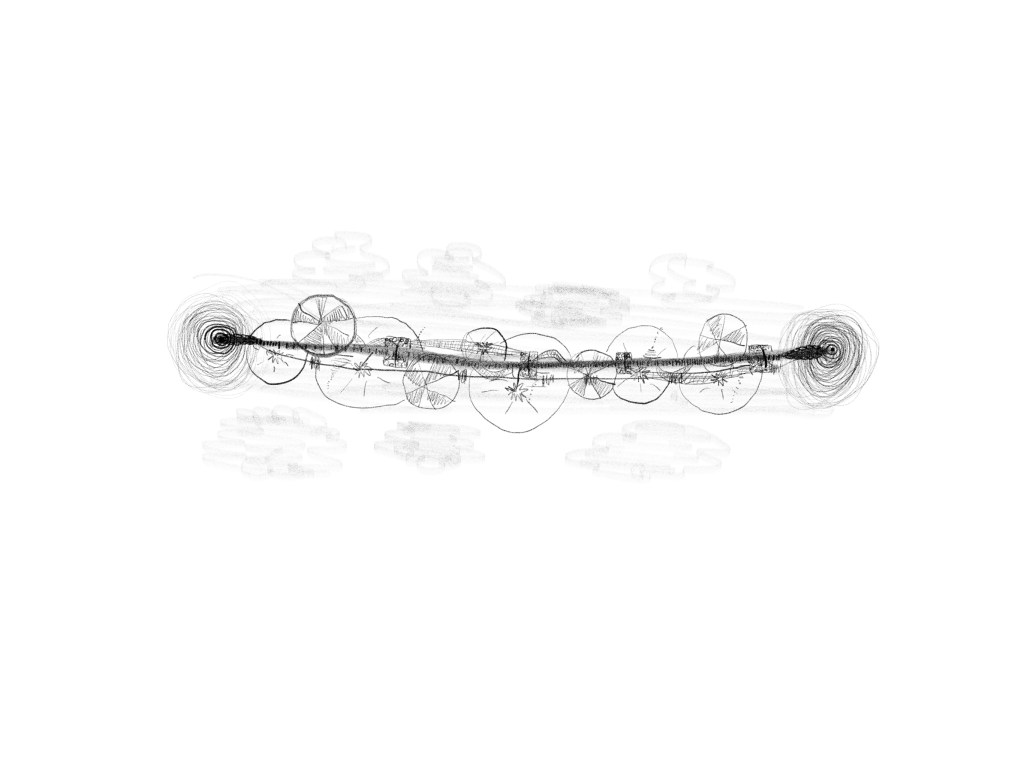
In the workshop we read and discussed couple of chapters from Italo Calvino’s ‘Invisible Cities’. We chose a chapter ‘Thin cities 5.’ about Octavia – ‘ the spider-web city’ suspended above the clouds, between two steep and extremely high mountains. We were tasked with drawing the city based on the text.
First was the masterplan, created in 15 mins:
Thin cities masterplan
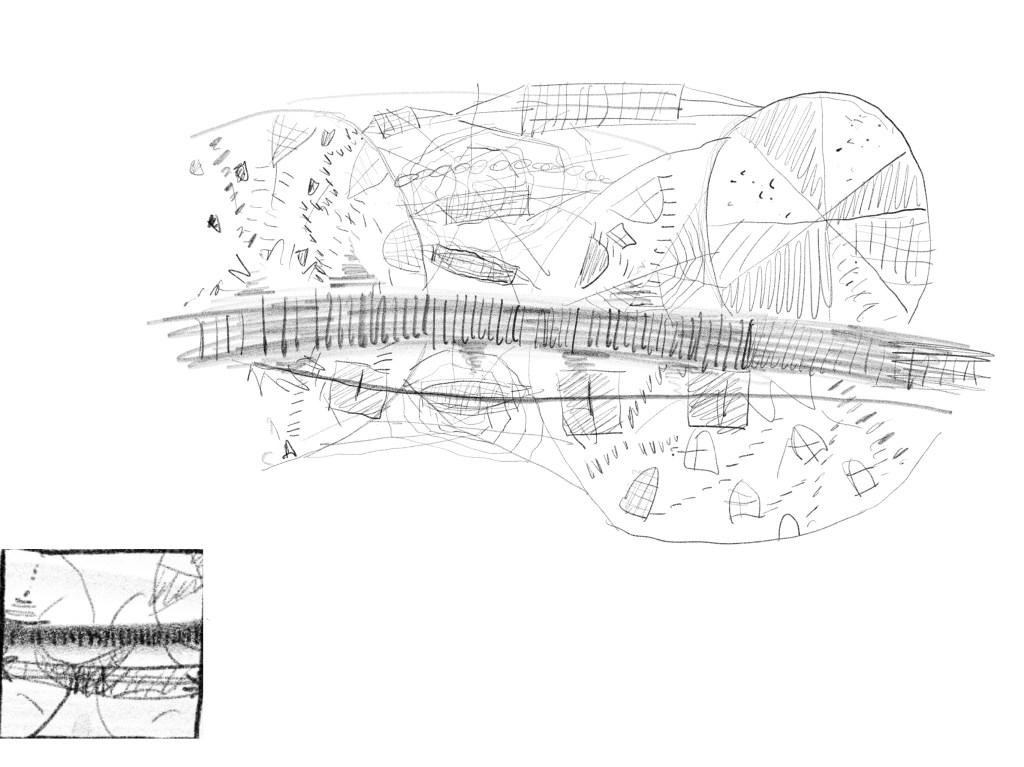
Then zoomed in view of one square of the masterplan, also created in 15 mins.
Masterplan zoomed in.
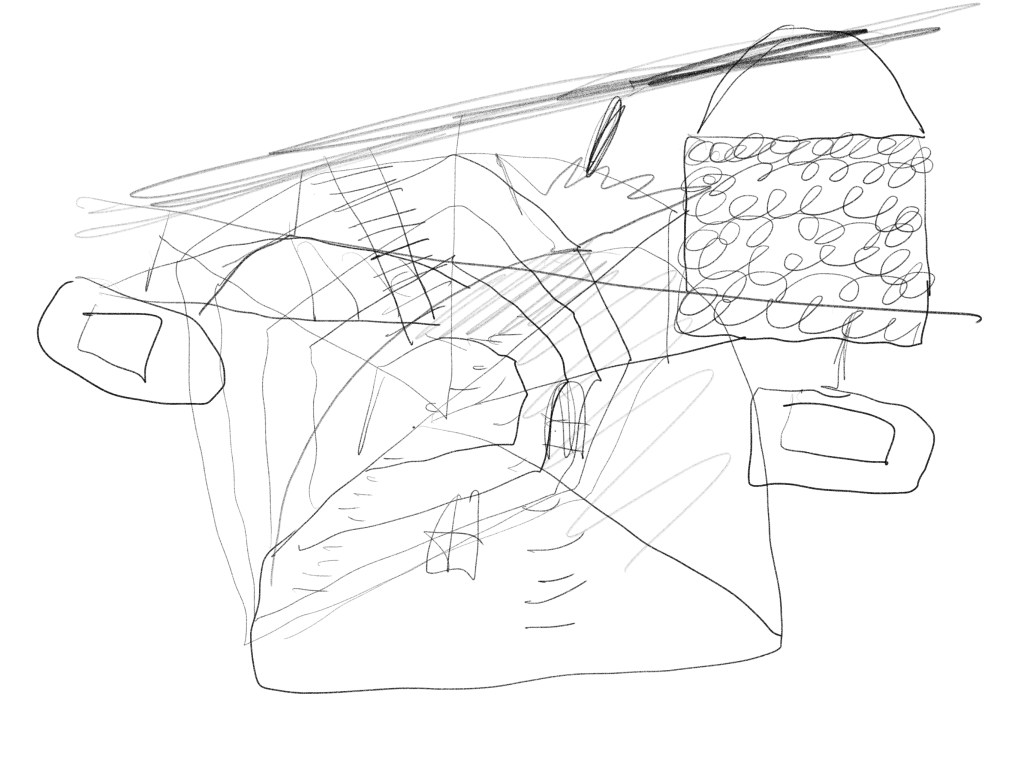
Then zoomed in, three perspective views, each drawn in about 2 minutes:
Thin cities perspective views
I drew them all using ipad (adobe fresco). Great workshop, really enjoyed it. As usual it was fascinating to see how each participant imagined the city and spaces differently, despite all coming from the same piece of text.
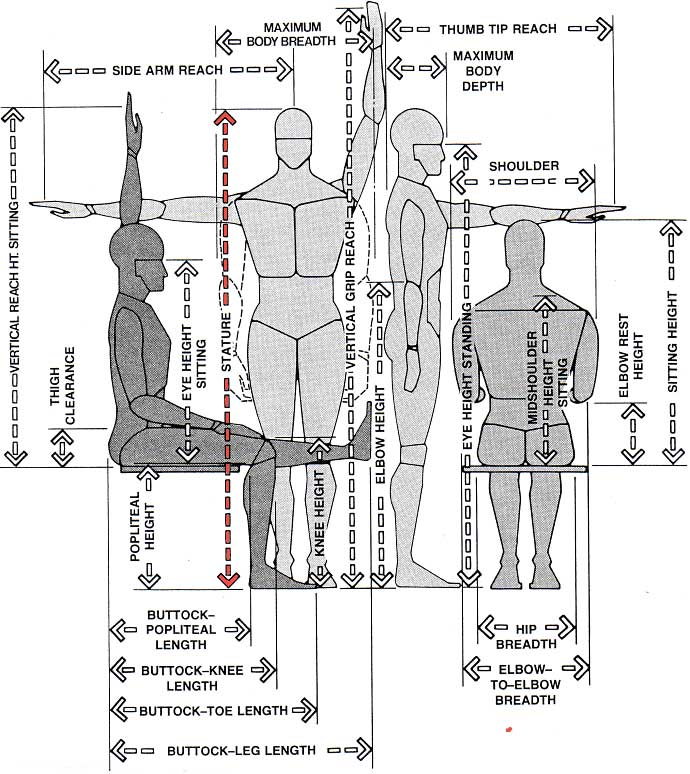
How do you think ergonomic and anthropometric design, and scale, have been explored in the 2013 project Kroppsrom (Corporeal room) at the National Museum of Architecture by Atelier Oslo? Reflect on your responses to the project in your learning log.
I think the designers explored the anthropometric data of the average human figure and designed the space around them. One of the resources mentioned that the space was supposed to make people move in a way they would not expect, and create the experience through the activity, as well as simple, peaceful and gently lit interior.
I imagine Atelier Oslo drew the human figures as pictured in the data images and made the space flow from one set of dimensions to another and so on. I can sort of see this process in my imagination, but it is quite hard to describe it, but I’ll try anyway. A 3D animation of an opening being created in the solid mass. The solid mass is surrounding (and filling) the human forms being carved out. As the corridors and caverns are created, the human figures remain – they aren’t carved out with the solid mass that they are contained within. As if the figures are in a different layer to the mass. The whole process is smooth and flows easily.
Fig. 1 Body measurements
Considering the process of creation of such an interesting, unusual space is a great activity. I wonder If I am at least a little bit correct in my guessing on how the designers idea started. Thinking about it got my imagination going. I often wonder about hows and whys, it was an enjoyable exercise.
During Part One of Unit 2 the most important things I learnt were:
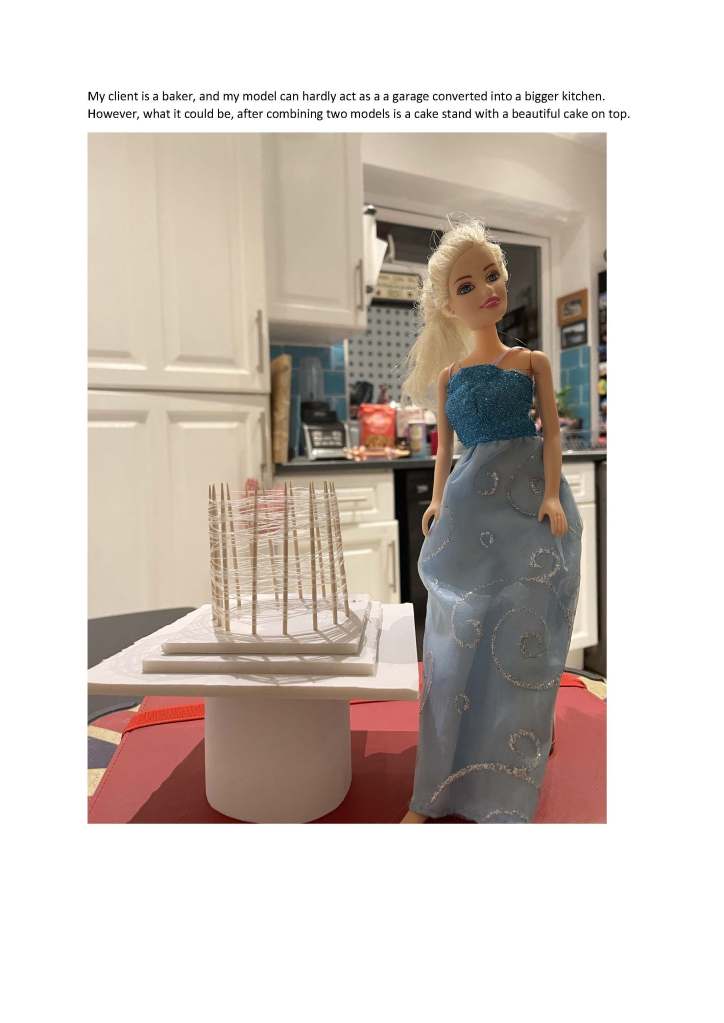
How to have fun in design process… I was actually quite stressed about this assignment as I was stuck not knowing what to do for ages. And as I was taking a photo of the barbie doll with the cake stand in my kitchen (context for baking) I felt joy. And not only because this was last task or this very difficult assignment, I enjoyed placing it in this conext and seeing how it works.
Talking to other students and tutors/ designers helps to get your creative juices flowing.
Looking back I enjoyed the model making and lego building most. The latter was especially ‘freeing’ as I just built, not knowing what will come out of it. It was just really hard to come up with a function of my model and then creating a story. Something I need to develop – abstract creativity with a goal.
I watched ‘Sketches of Frank Gehry’ and ‘Manifesto by Frank Gehry’.
I observed that Frank Gehry’s creative process is a bit like mine. I have previously noted that the hardest is to start, therefore I procrastinate. And once I start it is all much easier. Gehry made a similar observation about his own process. Perhaps it is like that for most people.
Mr Gehry mixes art with architecture – I would dare to say he is an ‘art-chitect’. He takes risk with his creations, wants them to be unusual – the ‘weirder’ the better. He is a visionary who often seems to be setting the precedent rather than look for one. Interestingly he did not fit amongst other architects but found a support group amongst artists.
He makes models, then changes them. After that, he does not like what he created. He continues to look and contemplate. He wants to find out what exactly needs changing to make him like it more. His model making process uses trial and error, but a slow and carefully considered one. Putting model together makes him discover the next step or a different feature. He believes accidents are sometimes failures, but they are important step in the design process. He spends time to find something good in them. Frank believes project drawings and models are lifeless, but once the built is complete, the intended energy shows. Some of his model shapes look like they could be built using Lego bricks – yet very original, complicated shapes.
Like Charles Eames, Frank Gehry is a problem solver.
He involves his team in looking and contemplating and implementing changes. A lot of the design process is looking together and having constant conversations about the model. Frank relies on his team, they have long standing relationships, communicate well, and understand one another.
He is great materials researcher.
Introducing CAD technology into model making and design process allowed Frank to design more freely and gave him more artistic flexibility, while being clearer to the contractors and leaving less room for their interpretation. Sketch models are still important for him to understand and see how the elements work together.
As a child Frank played ‘master planning’ with his grandmother – building entire cities using toy blocks. He also loved drawing as a child and was considered talented by his teacher. Perhaps this is when it all started.
Being a painter is Frank’s dream. Despite being so artistic he never tried it, he said he would not know how to. He believes painting and architecture have something in common – surface.
Function is always at the heart of his designs. Whether its art, education, leisure etc. the design must fulfil this priority, his ideas come second.
When creating he thinks outside of the box – for example he looked at a painting (‘Christ mocked’ by H. Bosh) as a composition and fed this composition into the design. He understands light and its effect on the spaces. When the process is too easy, he thinks it is wrong – he believes design process has to be difficult to be exciting.
Brief is sanctity for Frank, meeting the brief is the priority for him. Frank absorbs what client says – not only the words, but also the atmosphere around them and the whole mood in the room, the smell, the light… Then he comes up with the model.
He also looks at the context, the surroundings and decides how the new design will act in response to pre-existing buildings. For example, Walt Disney Concert Hall’s shapes relate to those of Chandler buildings next door. Disney Hall structure is ‘broken into smaller pieces’ to give it own identity.
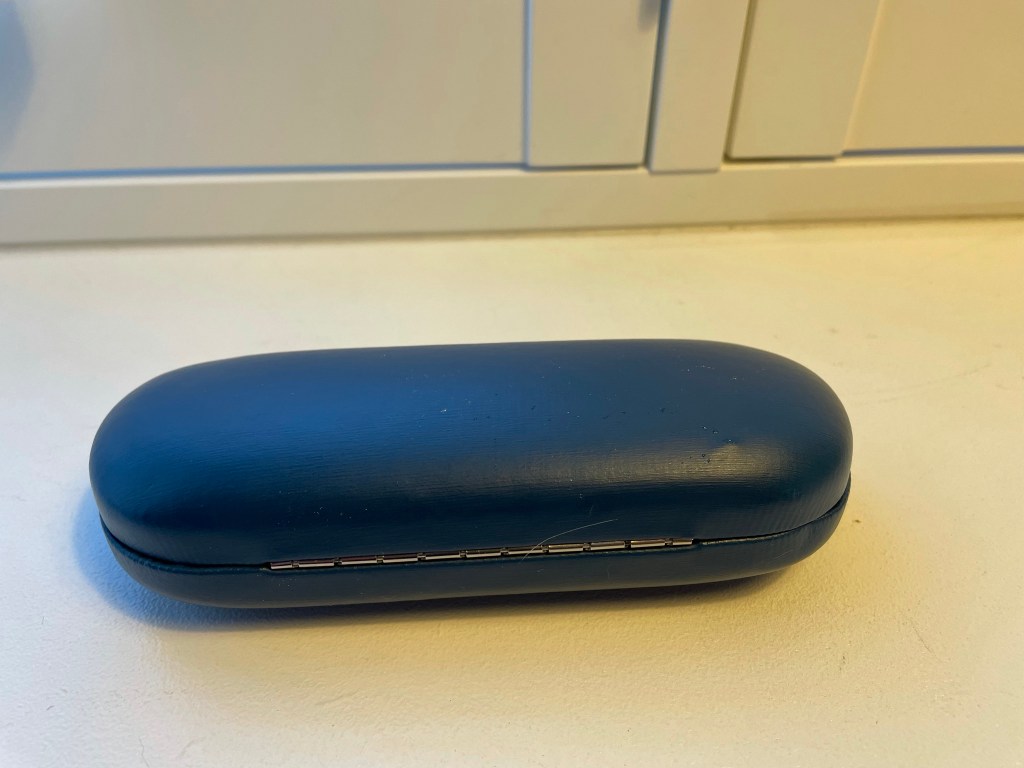
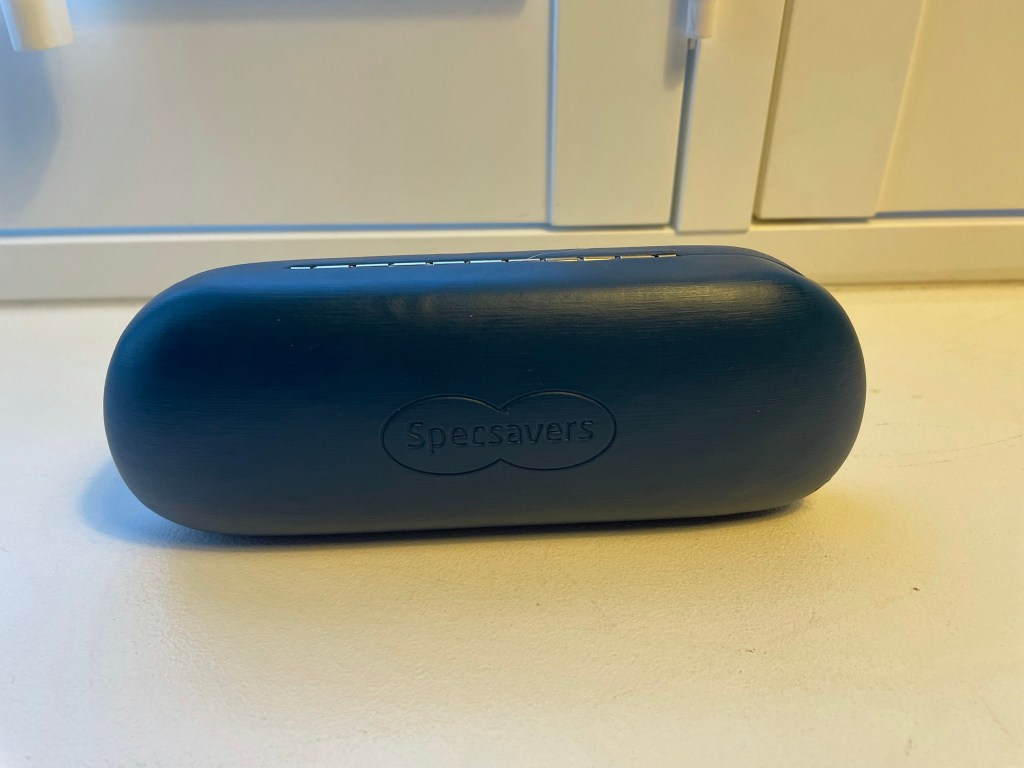
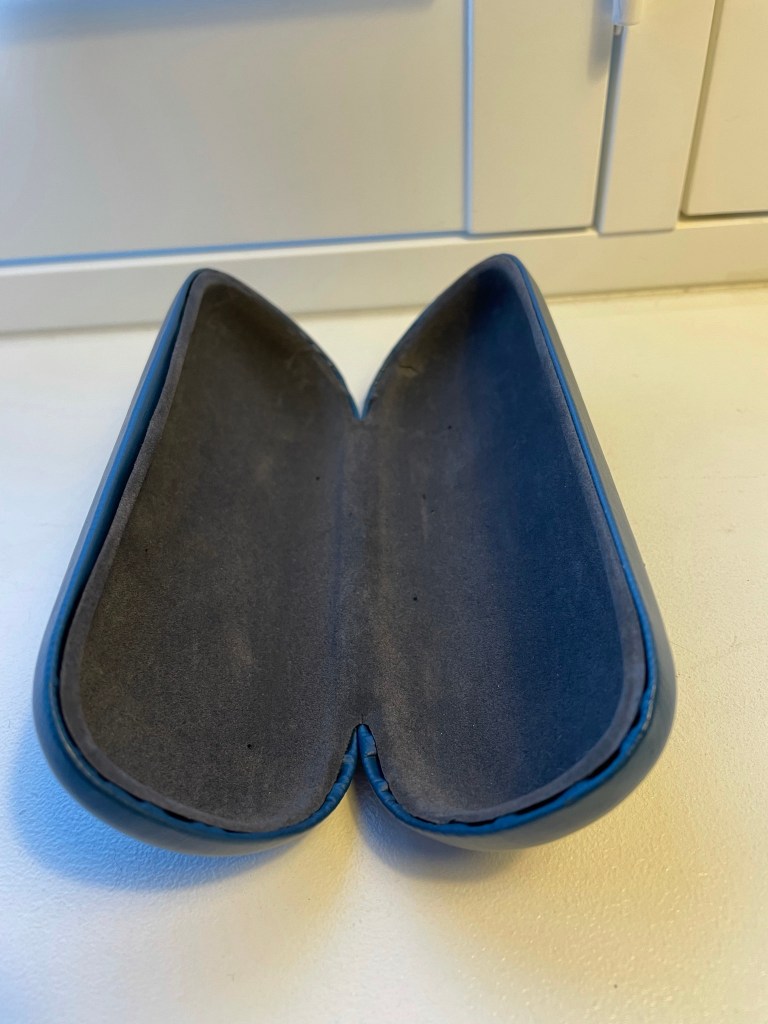
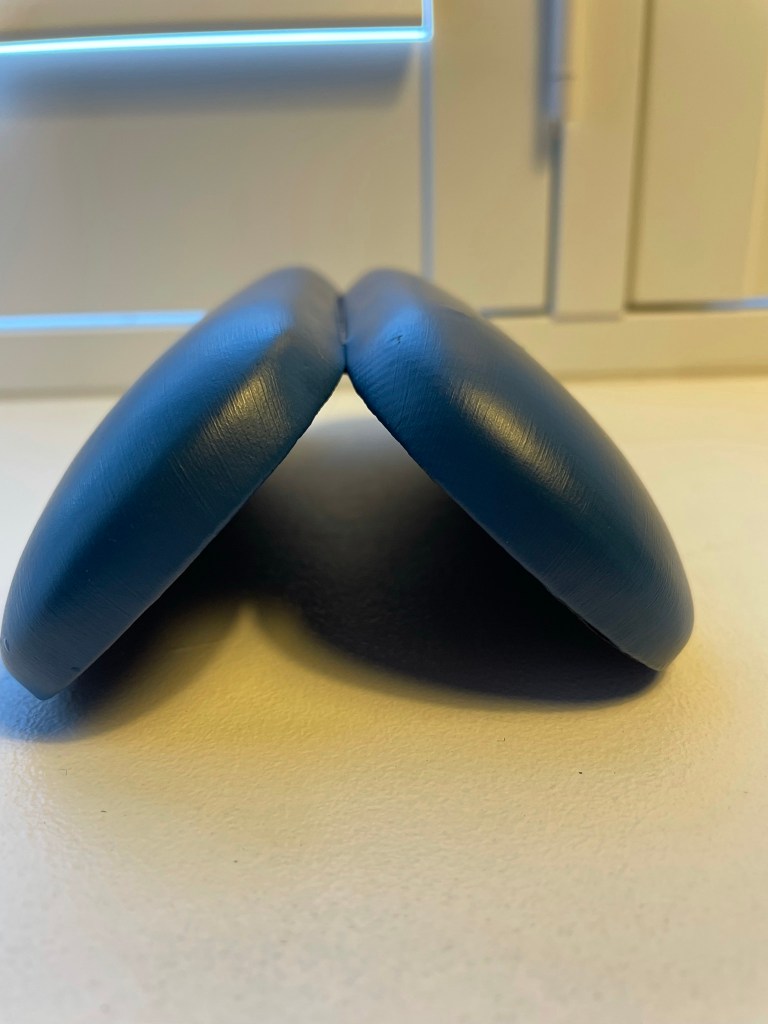
I chose spectacles case from the previous exercise.
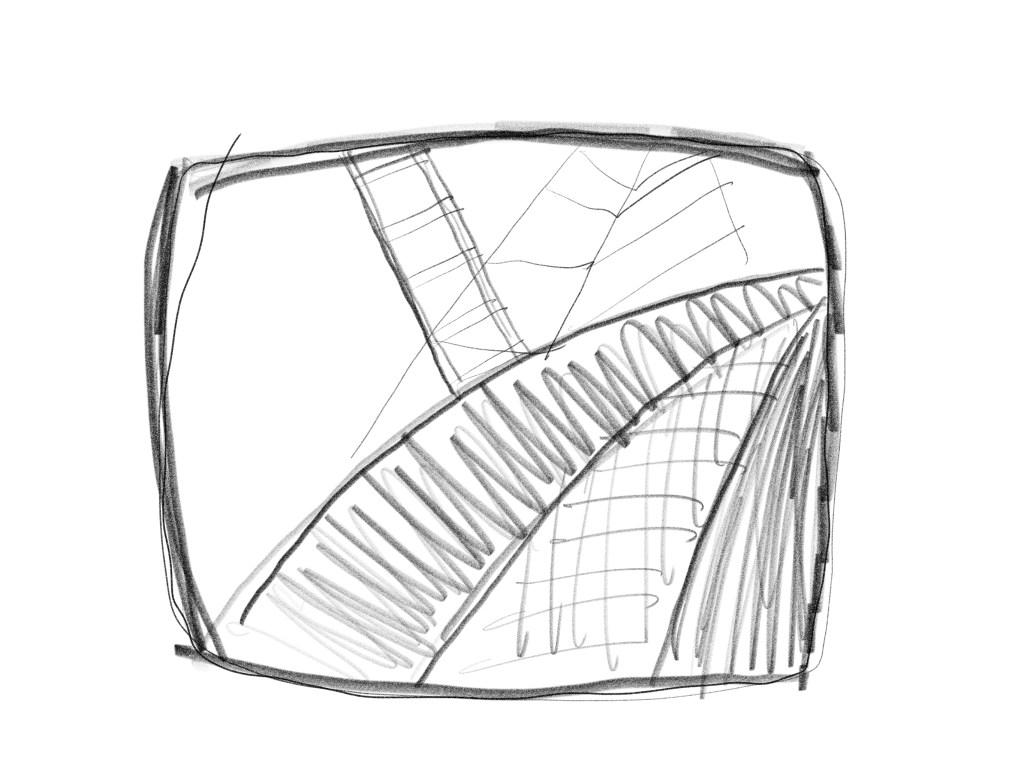
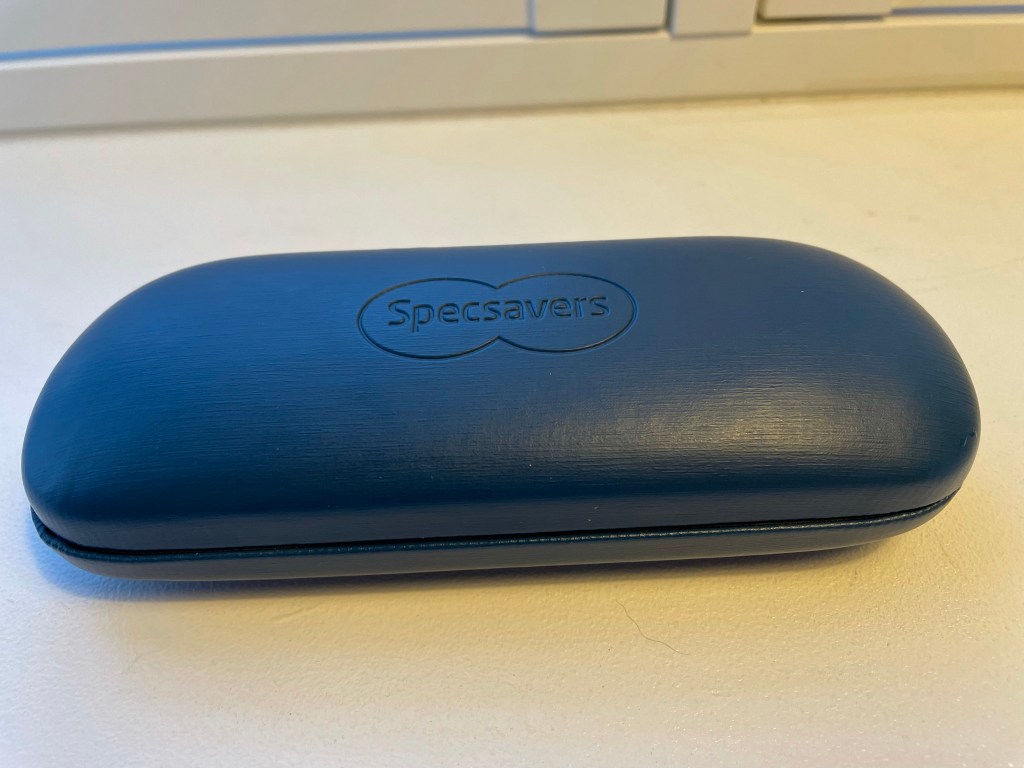
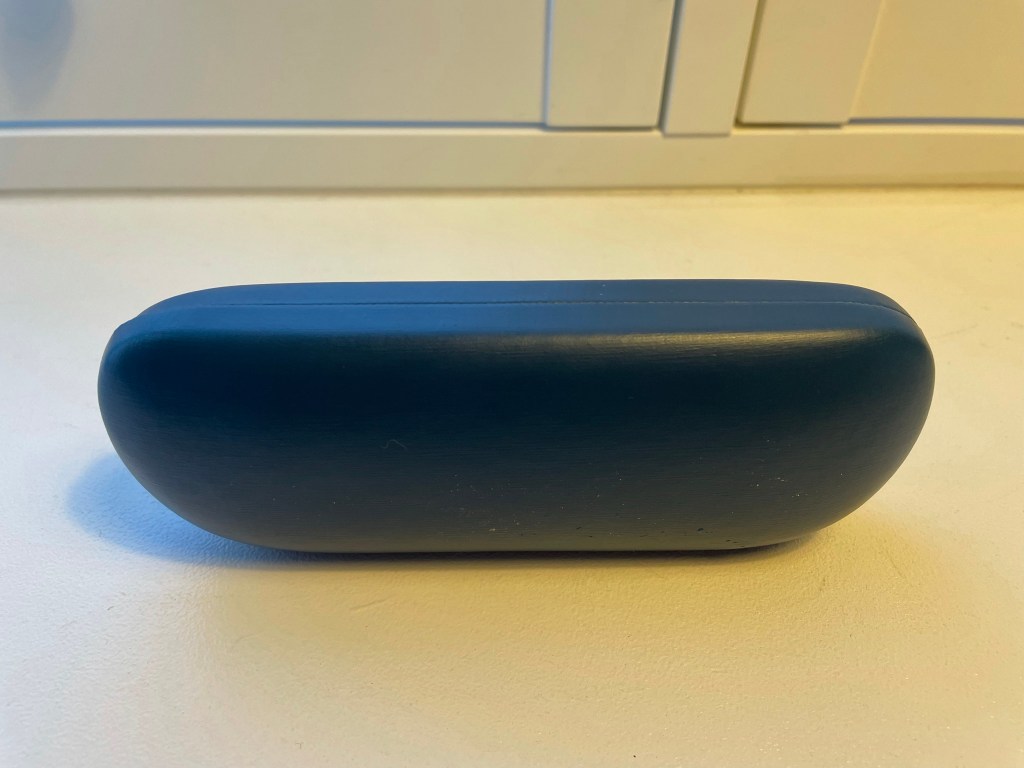
Fig. 1 – Fig. 4 shows my object laying or standing on side. It occupies space, defines the windowsill below it by simply sitting on it and casting a shadow. It also contains space that is invisible in this setup, nevertheless I know it is there. Also, space contained between the windowsill and curved / lifted of the ground edges is worth mentioning.
Fig. 1 Laying on the bottom.
Fig. 2 Standing on the back.
Fig. 3 Laying on the top.
Fig. 4 Standing on the front.
Fig. 5 and 6 show the open case. Here the items are containing the space and defining it in similar but more obvious way than in fig. 1-4. The ways are more visible because the angles are sharper. Fig. 5 is 50/50 containing and defining the space. Fig. 6 is more containing that defining but still does both. The inside is containing, the outside is defining.
Fig. 5 Open Upwards.
Fig. 6 Open Downwards.
Reflection on the task:
It was another first for me. Perhaps that is one of the ways to look for inspiration. Play with everyday objects, position, manipulate them to enhance imagination. Fig. 6 could be a tent or a pitched roof, Fig. 1 could be a low bench, maybe even with storage. I think any object could contain or define the space, depending how we look at it. A house obviously contains space, but if you look at the exterior, the walls and roof define the space within it.
Unit 2, Part 1, Exercise 5.2: Person – SPACE – Context
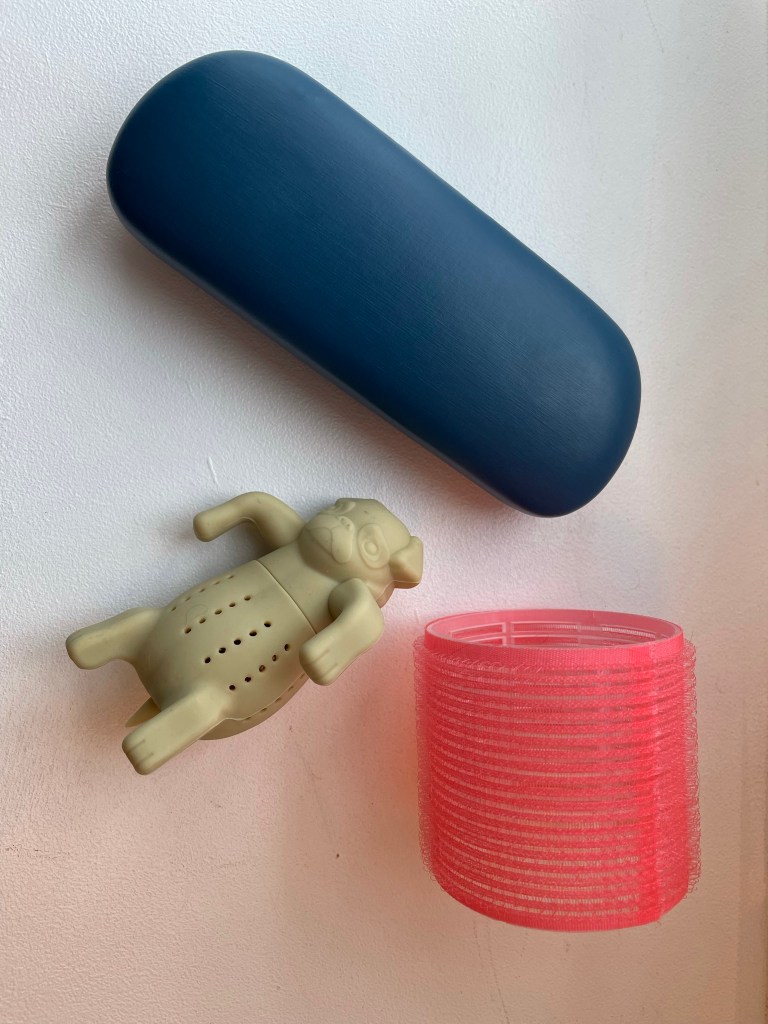
Fig 1. Three Objects
Spectacles Case:
Hard and smooth, very slightly ribbed on the outside.
Hard, durable material (plastic) covered in leather (or leatherette) on the outside.
The leather is creasing on the internal edges.
Small surface imperfection on the bottom of the case, hidden by the leather, but the bump visible in the shape of the surface
Thin layer of padding and soft, velvet on the inside
Etched logo on one side
Dark blue on outside and charcoal on the inside
Silver coloured, metal hinge on one of longer sides
If let to close freely the case makes a clapping noise
Fits on straight hand
The padding on the inside of the case can be lifted slightly.
Tea Infuser
Pug shaped, with tea infusing holes around the ‘abdomen’ area.
Silicone of varying thickness – thinner and flexible where the holes are, thicker and firmer in all other places.
Tea compartment would fit up to three teaspoons of dry tea
Cream in colour
The square design of outstretched front paws allows it to be hung on the inside of a mug.
Warm to touch
Fits in palm of hand
Hair Roller
Tube Shape
Pink, loop design nylon thread on the outside, sicks out about 3mm
The thread is thin and strong
Thread pattern grips to the hair
Outside makes soft noise when rubbed.
White, semi translucent plastic the inside
Ribbed design, that follows the perimeter of the circle to allow the thread attachment, interconnected by perpendicular elements that connect bot ends of the tube.
Slightly soft, bendable by hand
This item would fit in a cube with side length of index finger, height width and length seem equal.
Reflection on the task:
Interesting task it reminds me of the quote by Vicco Magistretti ‘Look at usual things with unusual eyes.’ I struggled not to describe the ‘feel’ of the objects, perhaps because I am so used to having feelings and opinions in response to objects and anything else. Also, some elements of the design were hard to describe with words, annotated drawing would have been easier.
List of illustrations:
Fig. 1 Shuttleworth, A (2021) Three Objects. [Photograph] In possession of: the author: Epsom
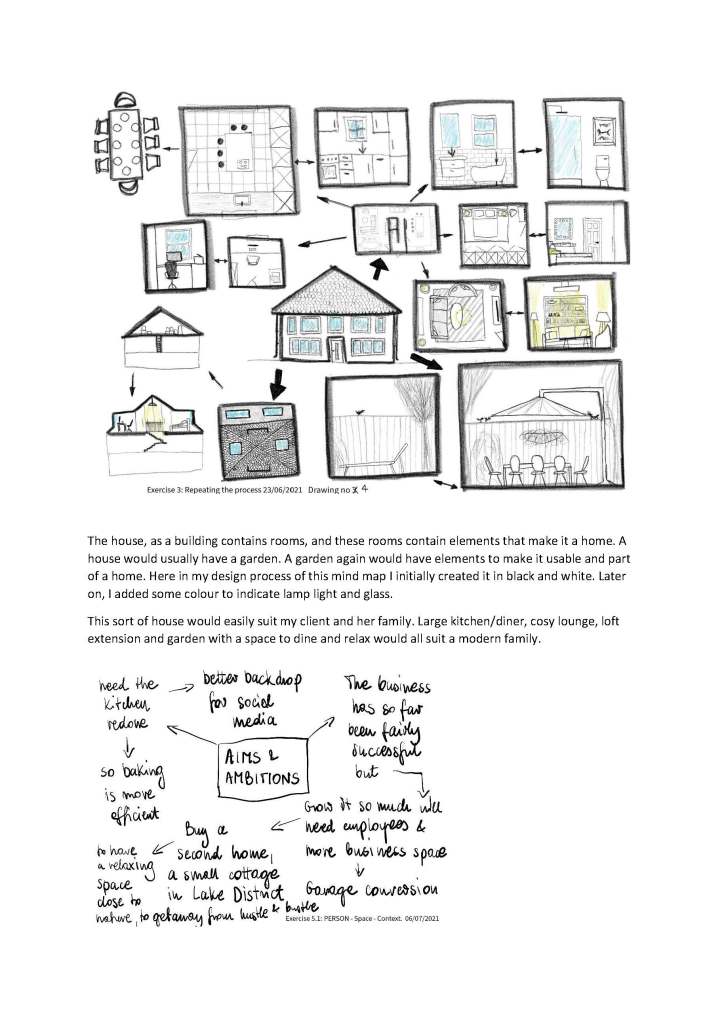
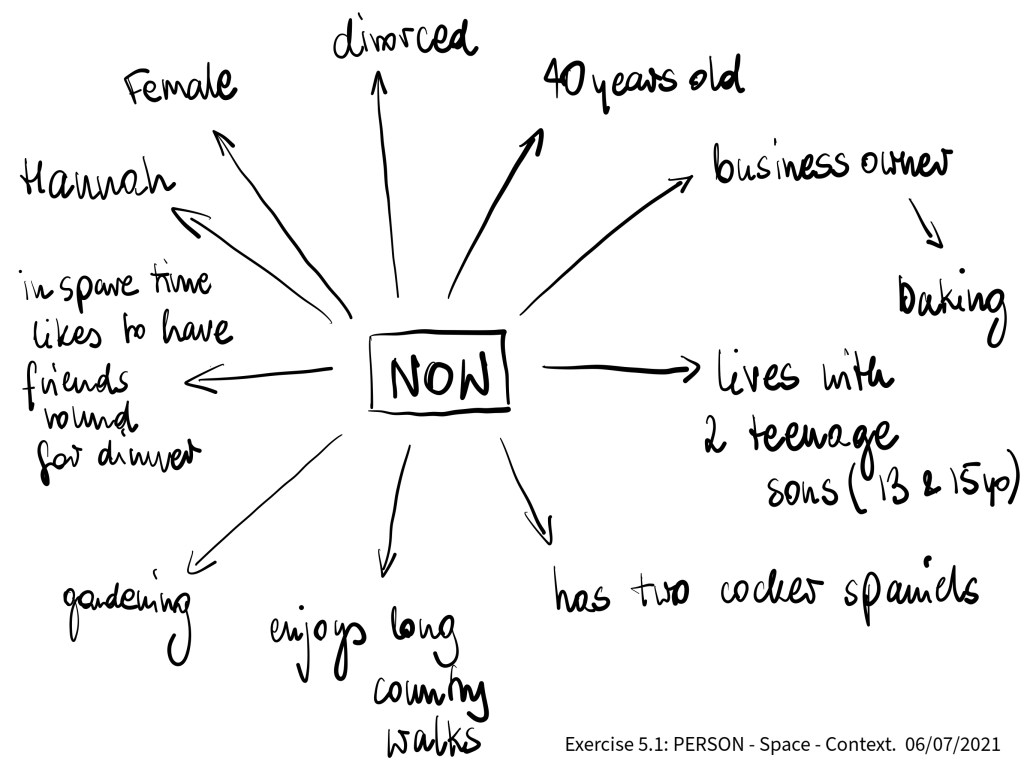
Hannah is a 40-year-old professional baker who runs her business from home in Manchester. She is divorced and lives with two teenage sons and two cocker spaniels. She enjoys long country walks. On the weekends that her boys spend time with their dad (and the time allows) she likes to go for a day trip or a weekend in the Lake District. She is a talented baker who creates beautiful and personalised cakes and cupcakes to order. In her spare time, she tends to her garden which is her pride and joy. Whenever she can she hosts dinner parties for her close friends.
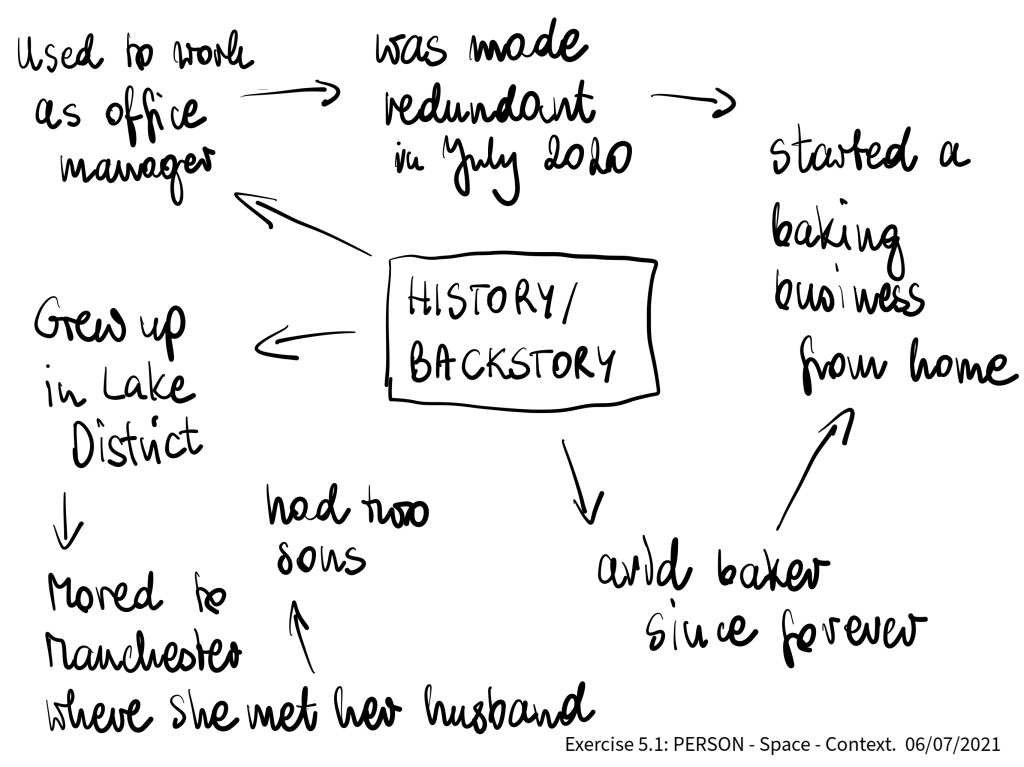
Hannah grew up in the Lake District and only moved out to Manchester as an adult. She met her husband there; they started a family and bought a house together. They got divorced in 2016 but remained on good terms. Hannah got to keep their family home located in northern suburbs. Hannah always had a passion for baking and used to work as an office manager in Manchester City Centre. When COVID-19 pandemic hit she was made redundant. She decided to use her redundancy pay to invest in a baking business. She already had all the skills – baking and business management.
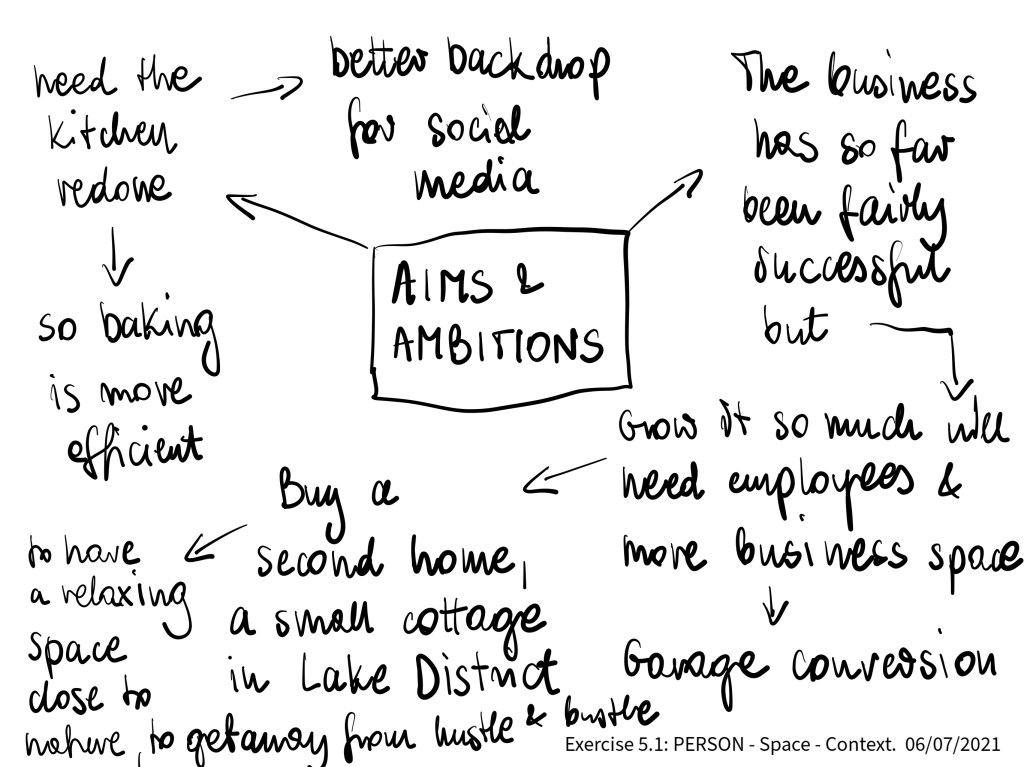
In near future she would like her house extended to fit a larger kitchen and utility space. Extra space, supplies, storage, and appliances will have their space and she will have a nice family kitchen once she is finished with work for the day. Nice, new kitchen will also be a perfect backdrop for her social media material – essential for growing this type of business. Once the business has grown to a point of employing help, she would like to convert her garage to become new business premises. Later on in life, she would like to buy a second home in the Lake District – somewhere she could unwind and go for those long country walks.
Reflection on the task:
That was quite an unexpected exercise. To ‘create’ a person. At first, I created three mind maps to help me organise my ideas. Once I came up with those ‘facts’ about Hannah, I just typed it all out in the matter of minutes. It was very easy. I wonder if creative writers also draw mind maps to help them organise their ideas before sitting down to writing. It definitely helped me!
Fig 1 Now
Fig. 2 History
Fig. 3 Aims
List of illustrations:
Fig. 1 Shuttleworth, A. (2021) Now. [Digital MindMap] In possession of: the author: Epsom.
Fig. 2 Shuttleworth, A. (2021) History. [Digital MindMap] In possession of: the author: Epsom.
Fig. 3 Shuttleworth, A. (2021) Aims. [Digital MindMap] In possession of: the author: Epsom.
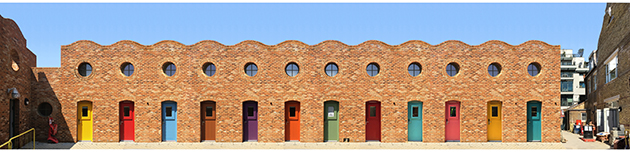
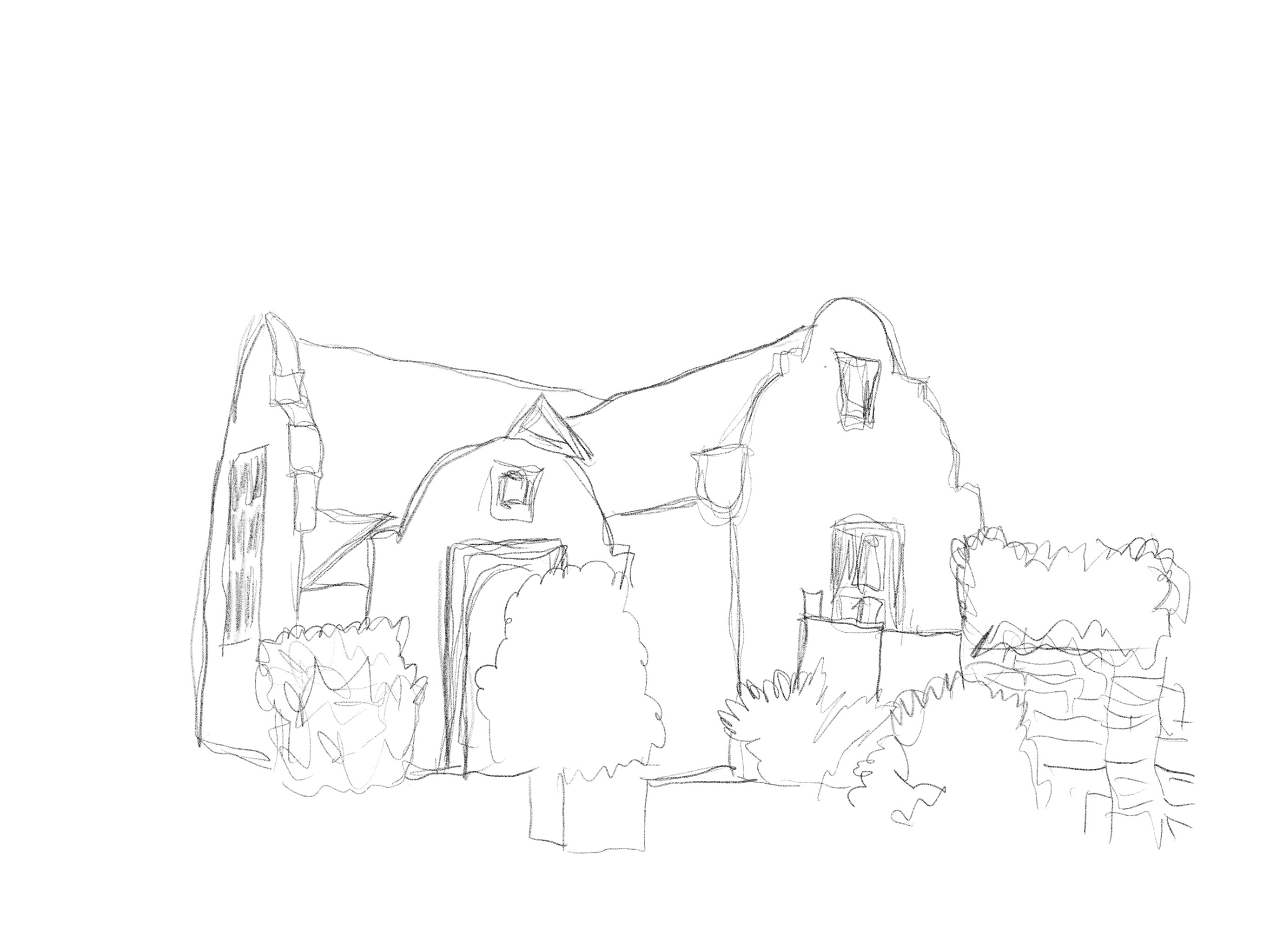
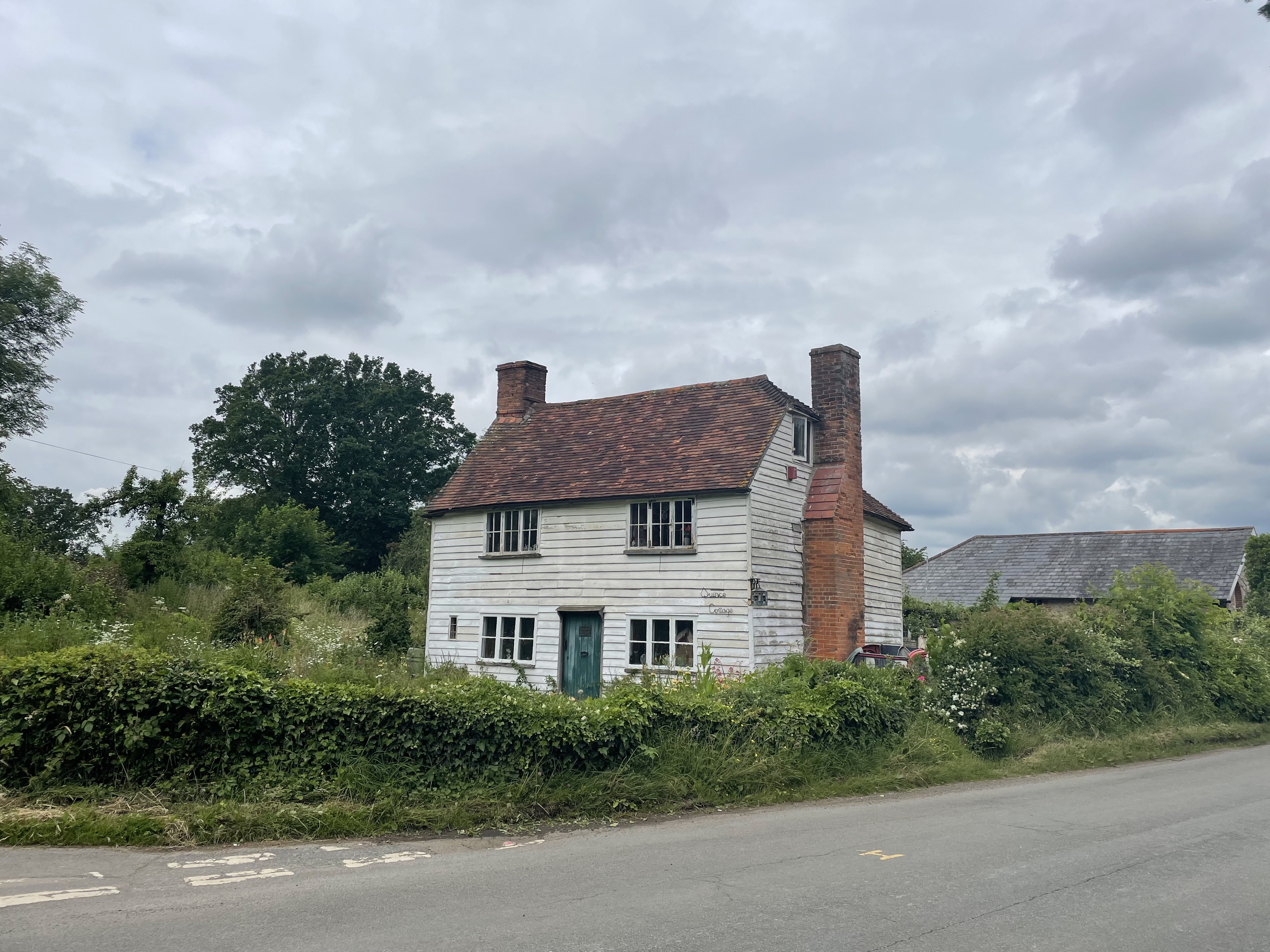
I visited Shadoxhurst in Kent this weekend. A lot of hoses here are new built, but I saw some characterful old buildings such us the one adjacent to old church’s grounds. It has interesting shape expressed in rounded gables.
I also saw what I thought was vernacular to my area. Perhaps weather boarded houses were a trend across England at some point.
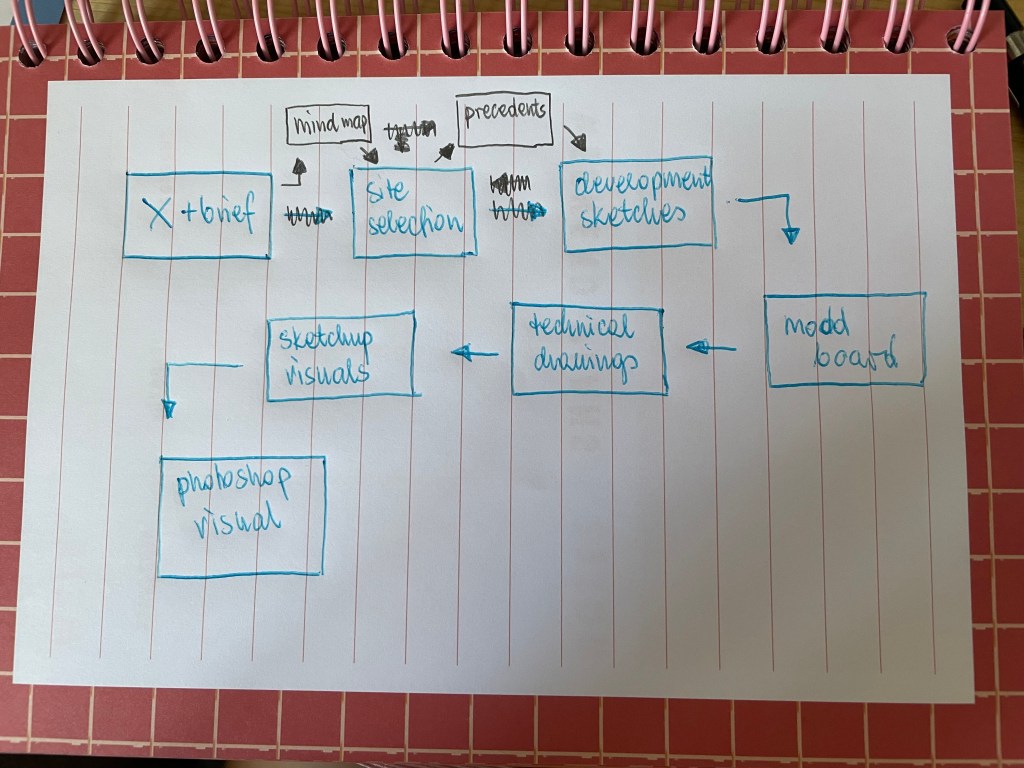
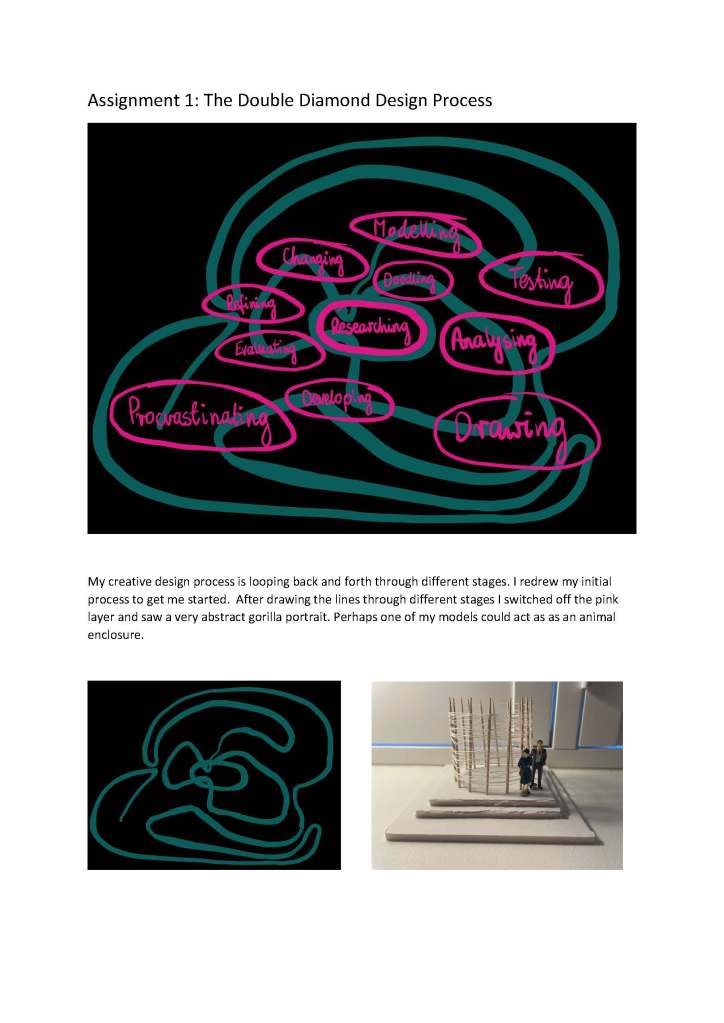
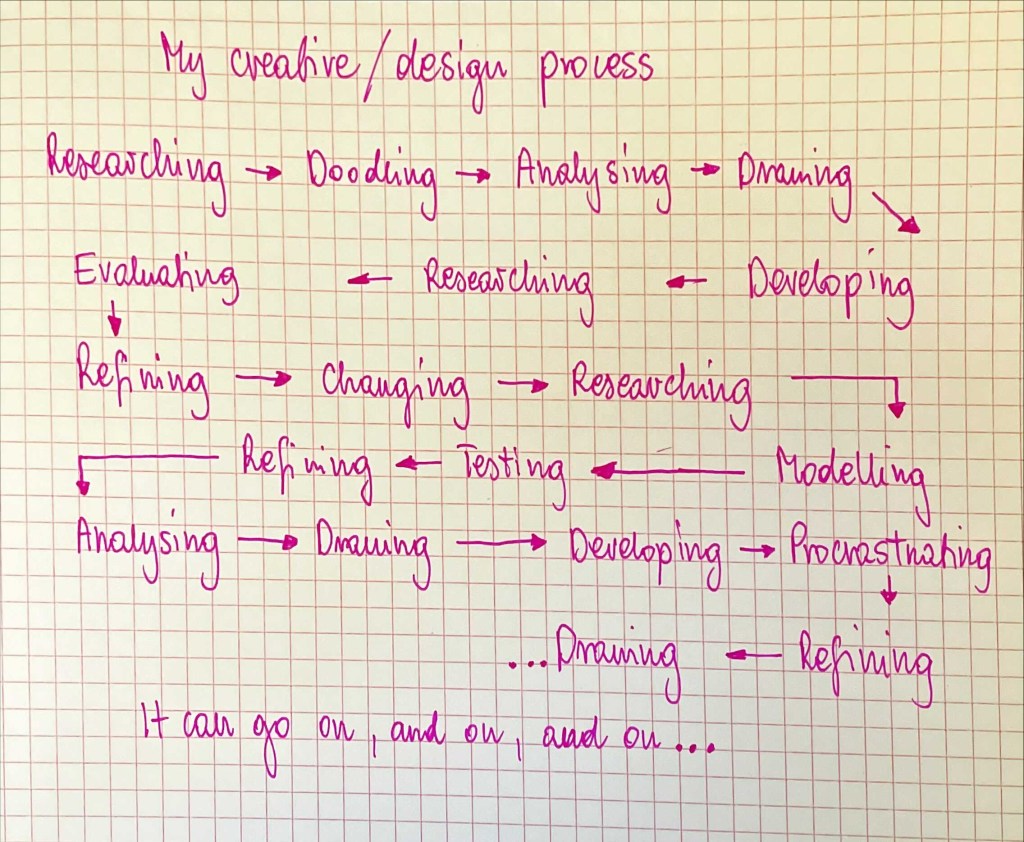
Exercise 1: What is your creative or design process?
It is really hard to get the process written down since I haven’t been through a creative process much yet.
It is a linear process, but it goes back to certain tasks, many of them are repeated multiple times. I believe it would be an infinite process if not for a deadline. Also, I think the process can change depending on the project, if I have done something using similar materials, or same area, type of building then I would add drawing from my own work there too… The most important in my opinion fact is that you go back to previous tasks as needed, sometimes you need to take a step backwards to be able to move forward…
It is really hard to get the process written down since I haven’t been through a creative process much yet.
It is a linear process, but it goes back to certain tasks, many of them are repeated multiple times. I believe it would be an infinite process if not for a deadline. Also, I think the process can change depending on the project, if I have done something using similar materials, or same area, type of building then I would add drawing from my own work there too… The most important in my opinion fact is that you go back to previous tasks as needed, sometimes you need to take a step backwards to be able to move forward…
 Aggie's interior design journey