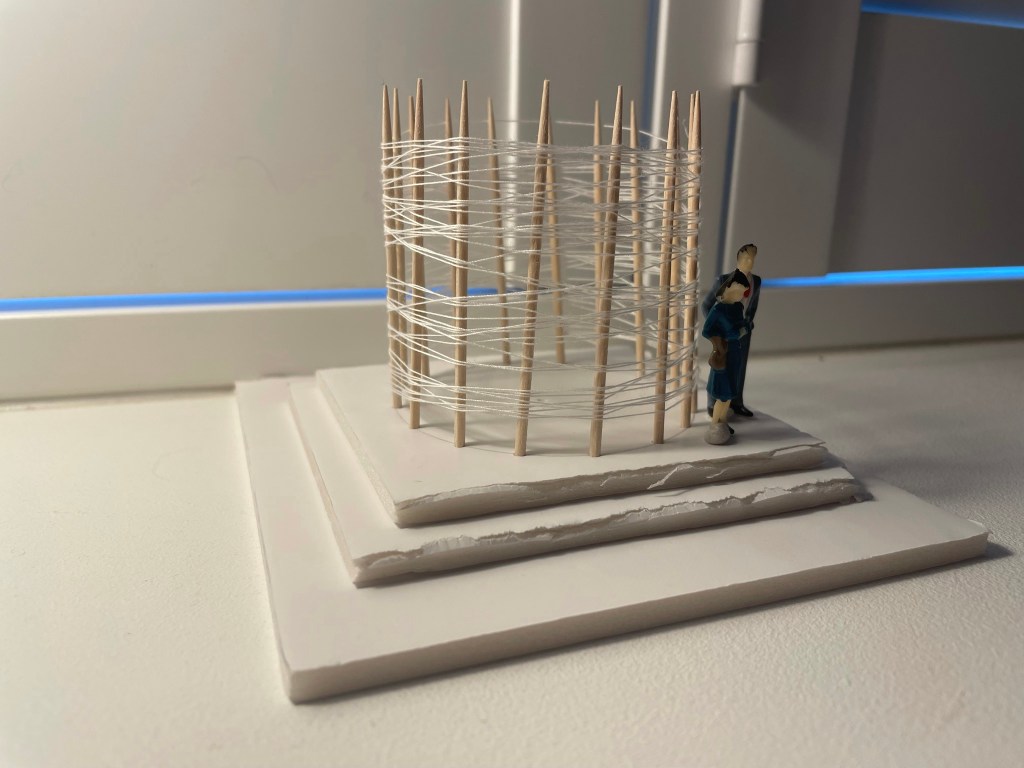
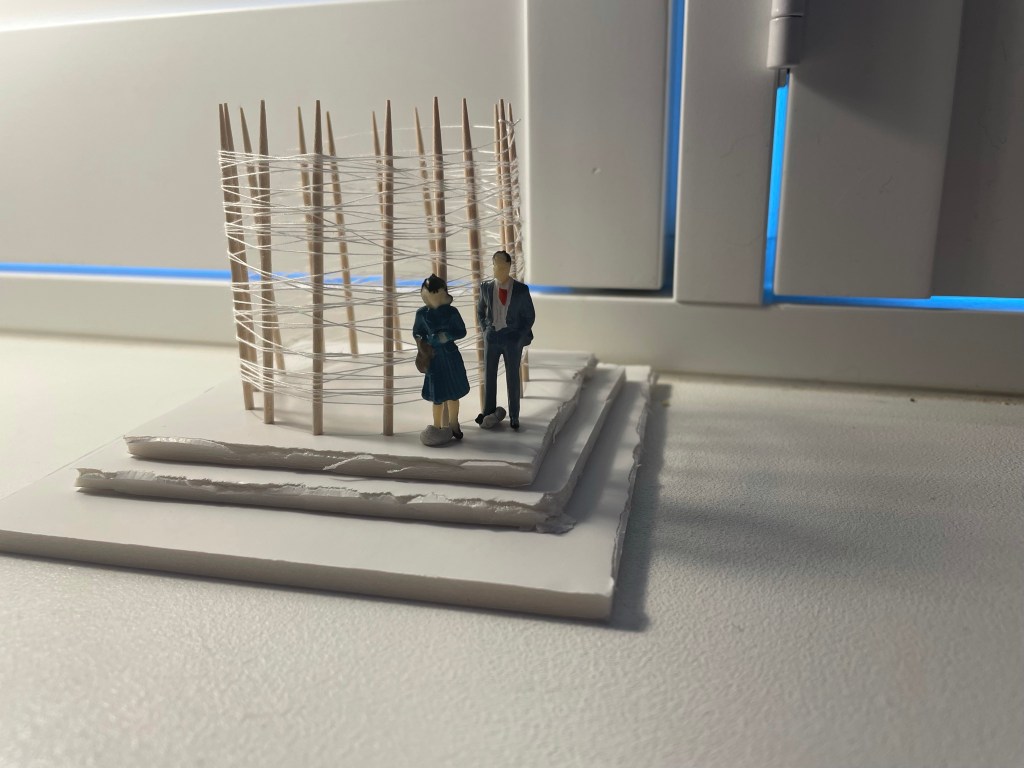
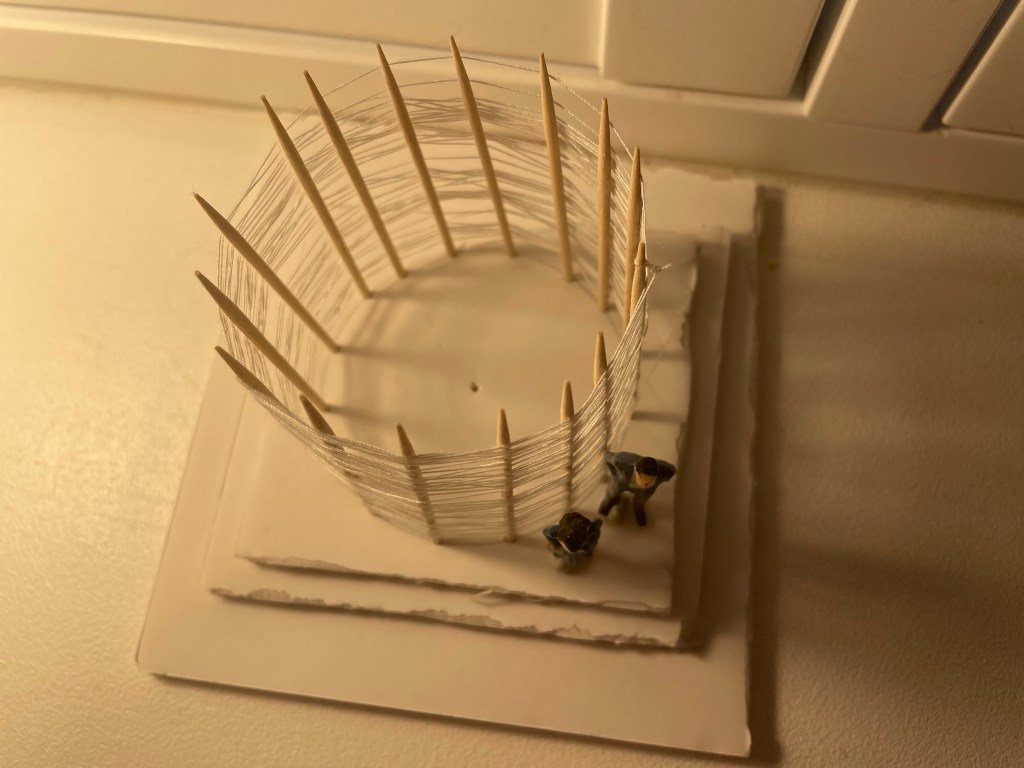
Exercise 5: Inhabiting and occupying space.

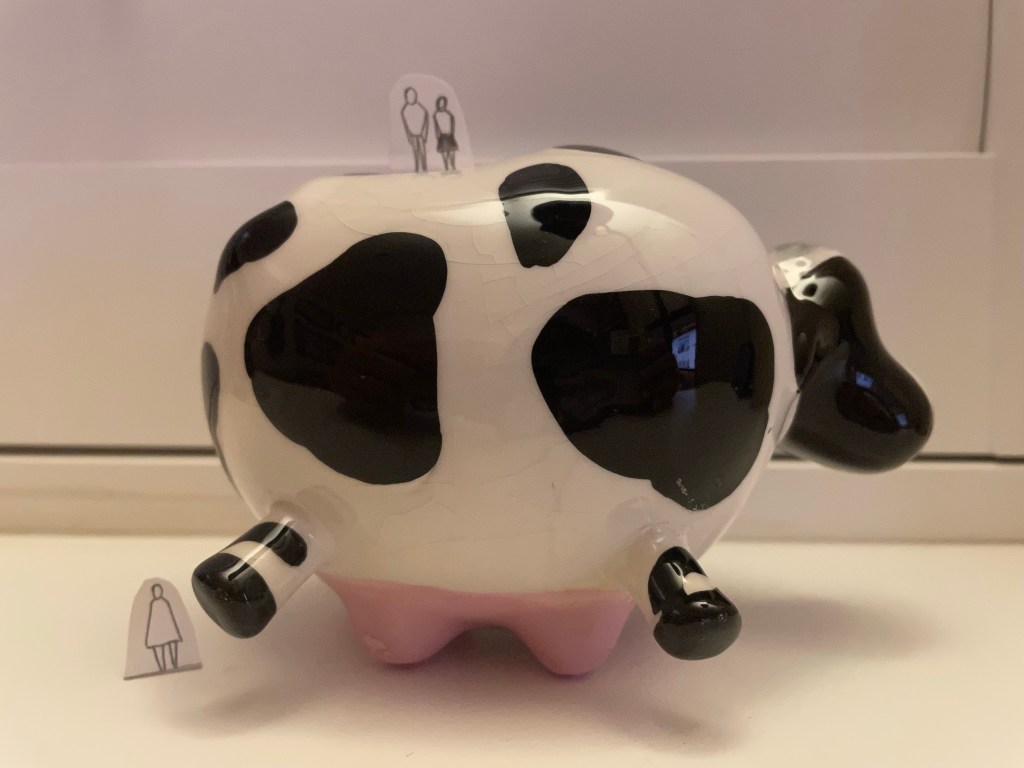
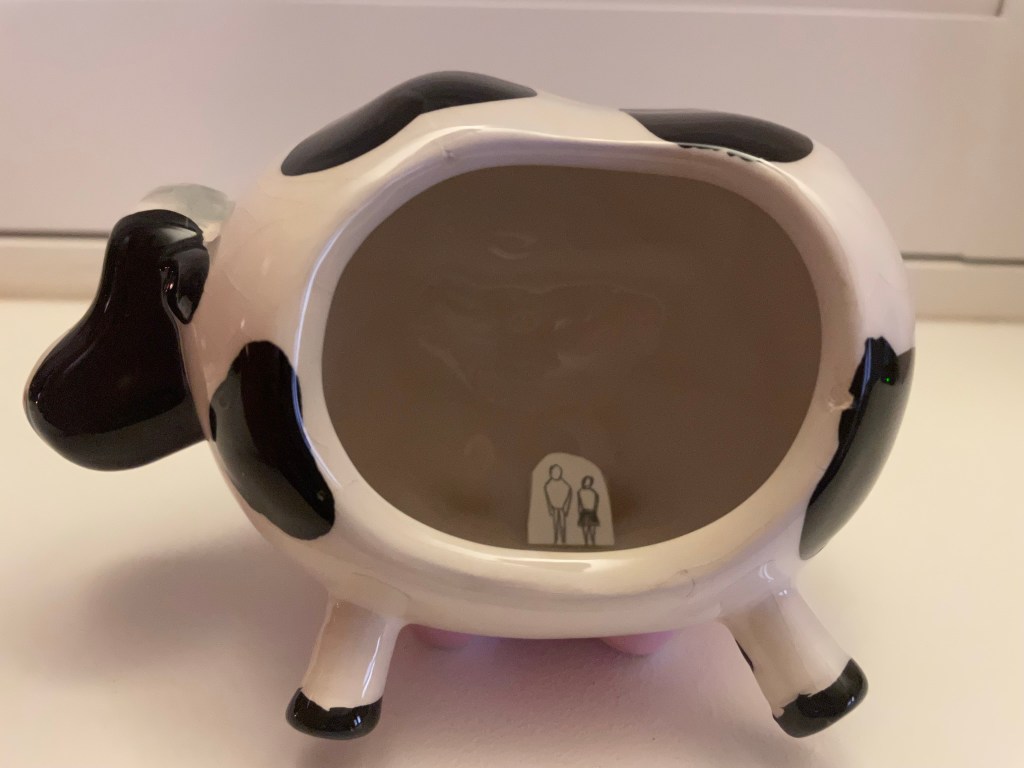
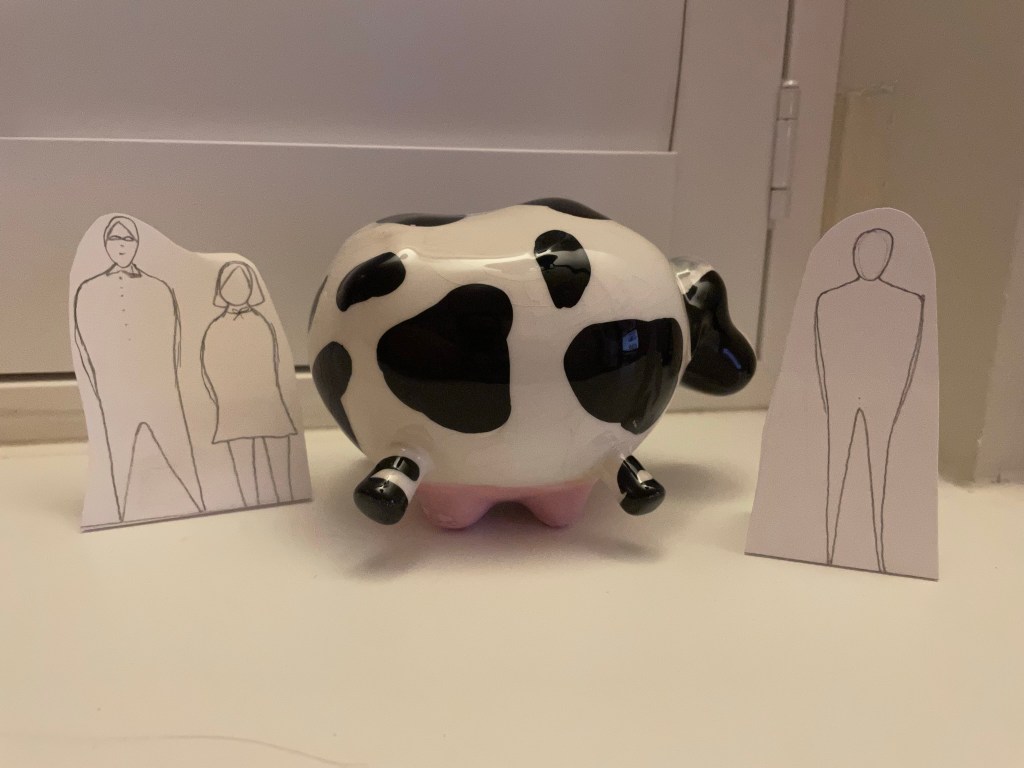
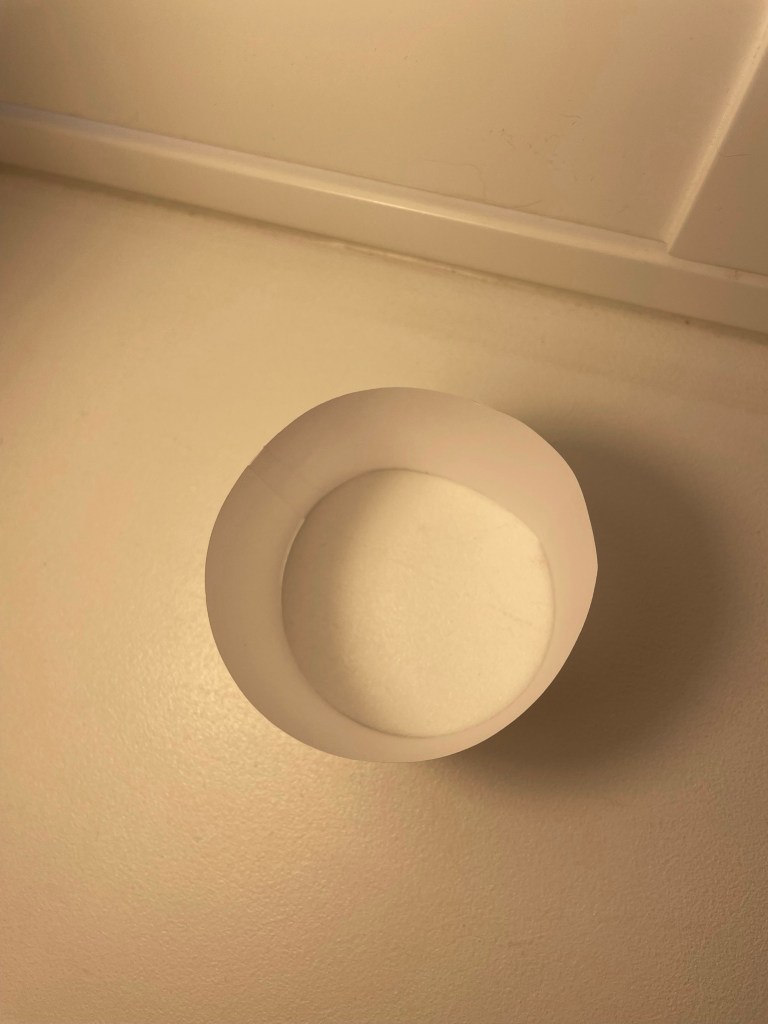
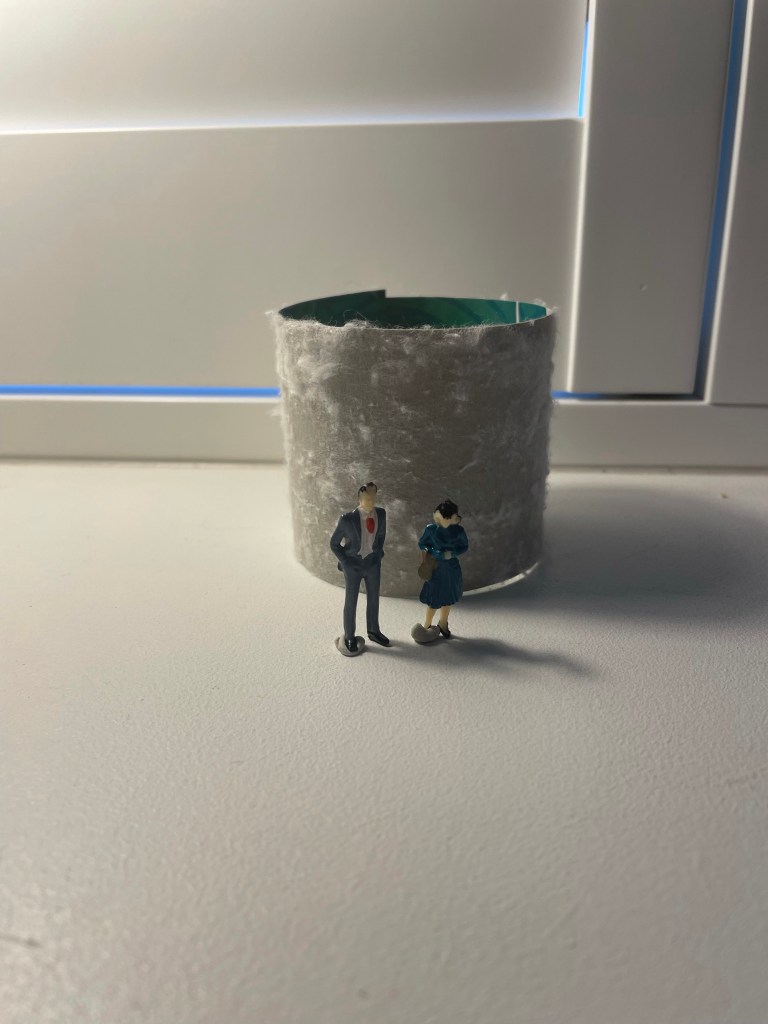
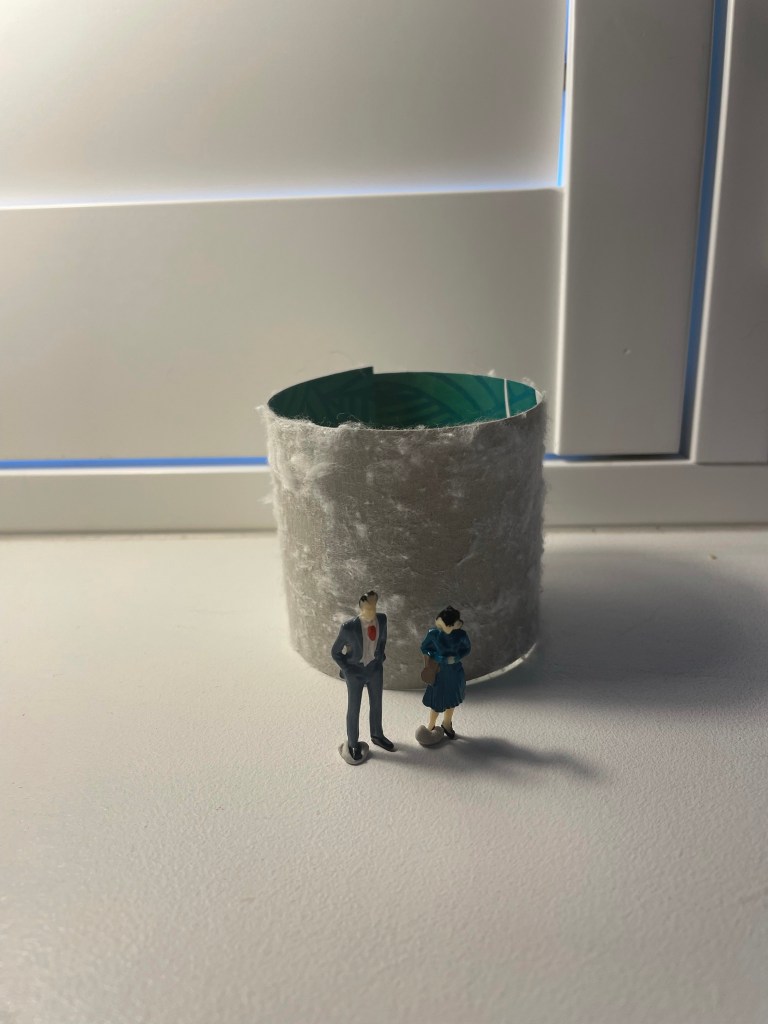
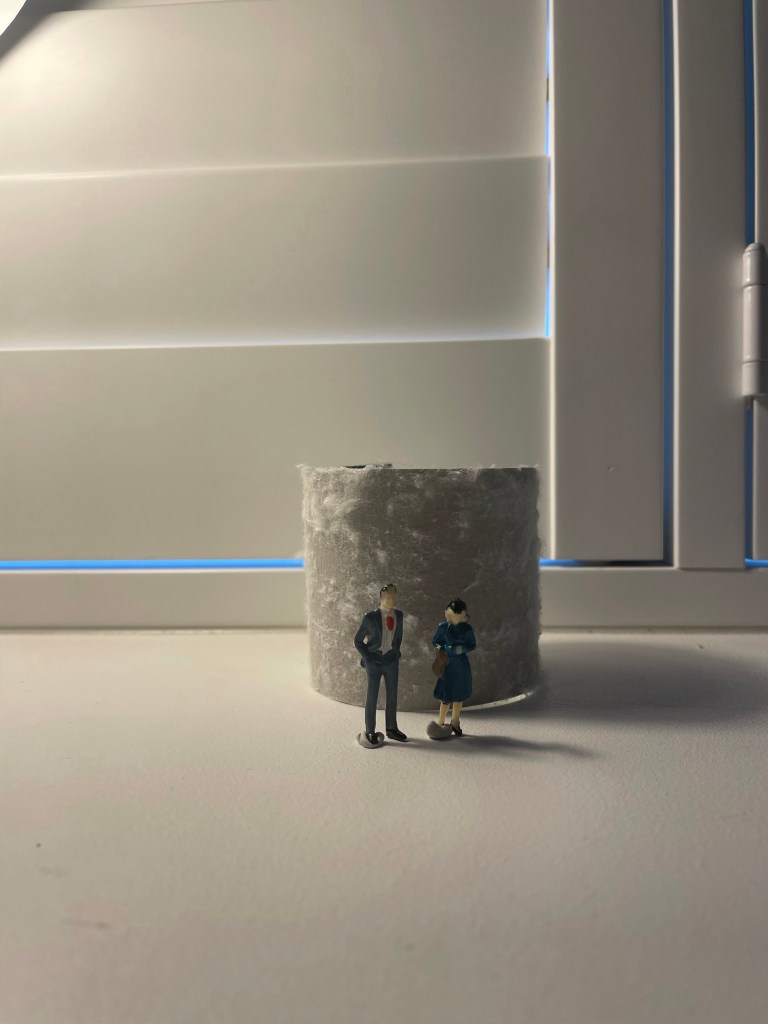
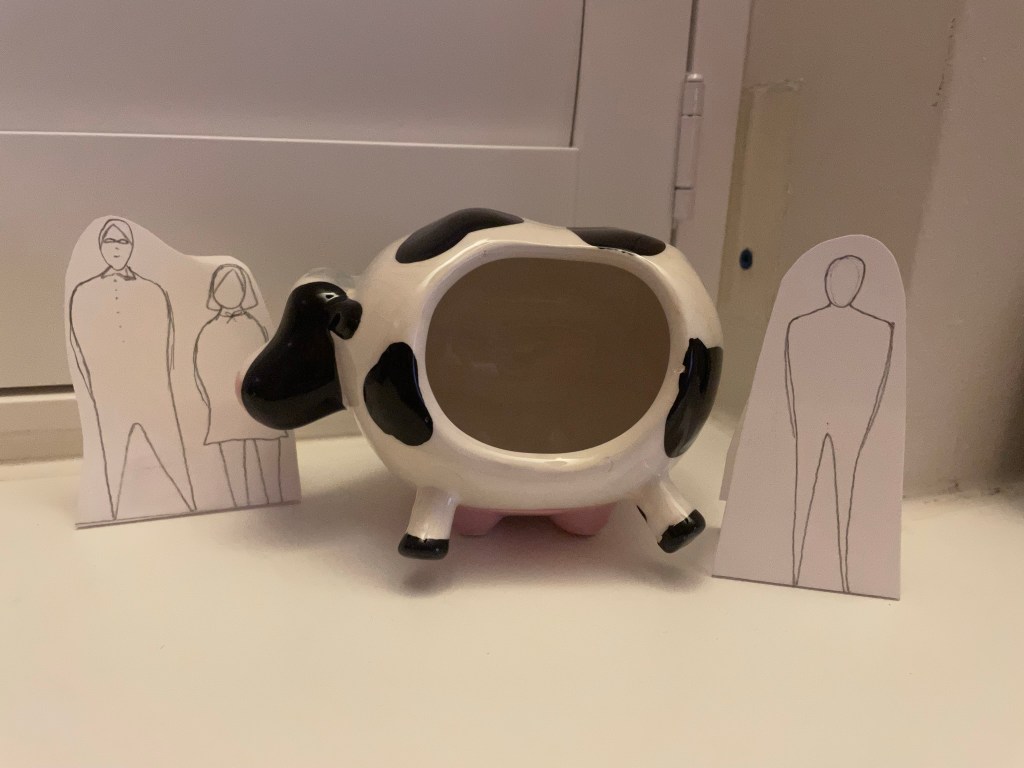
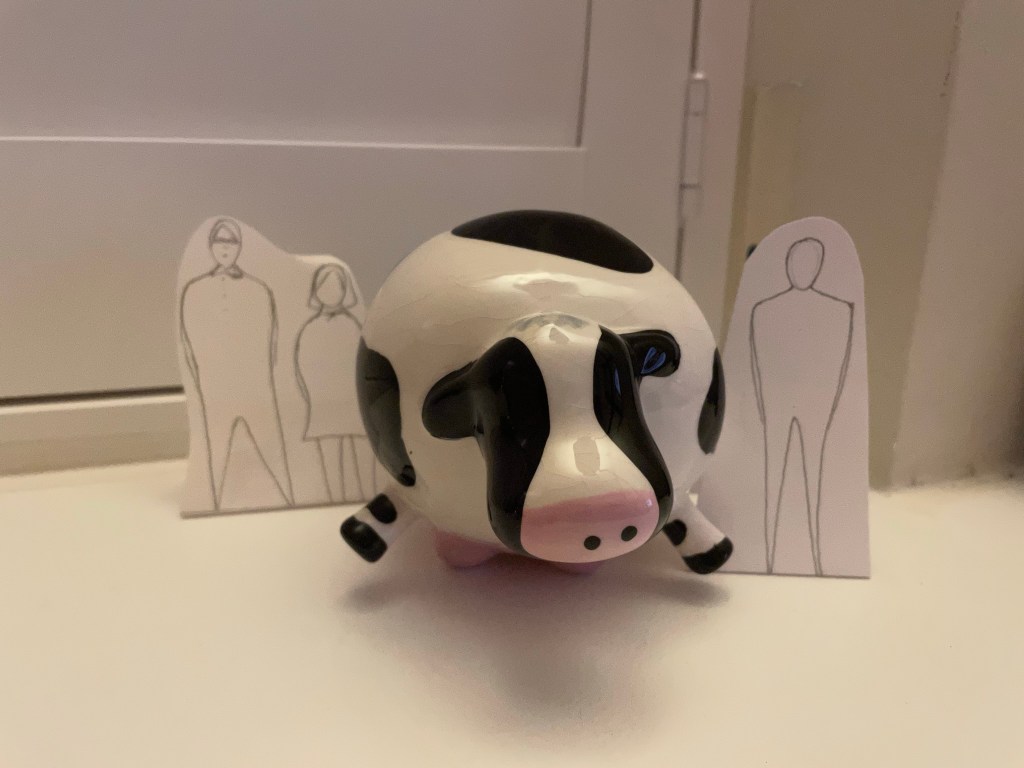
First I used a porcelain salt pig.

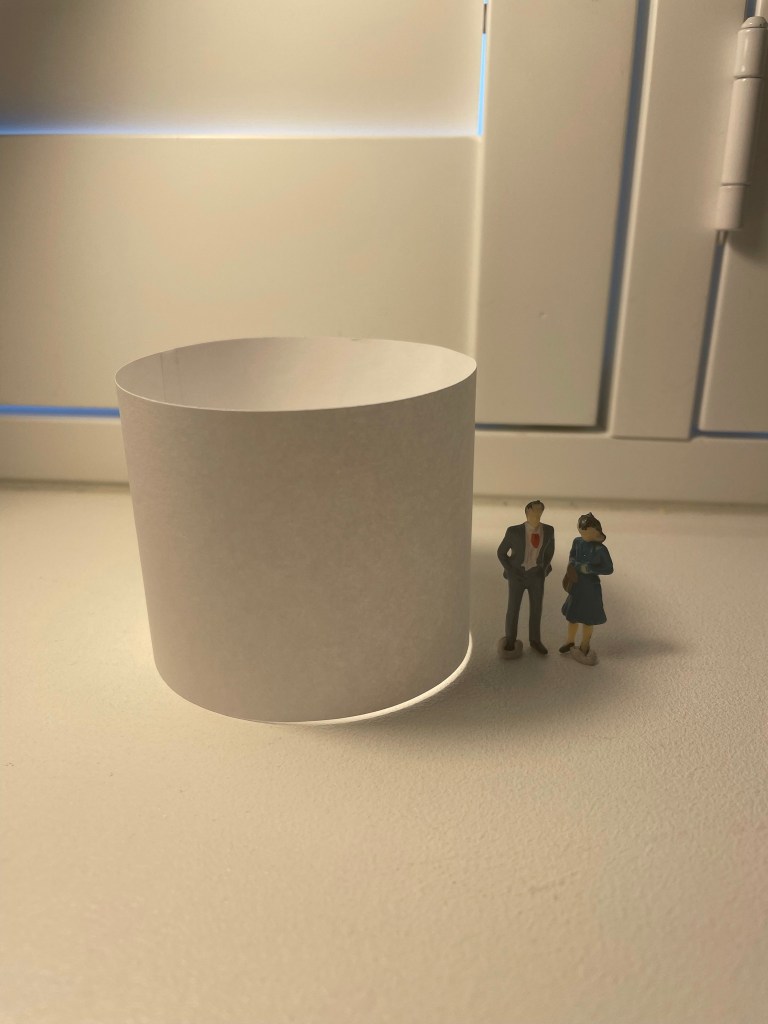
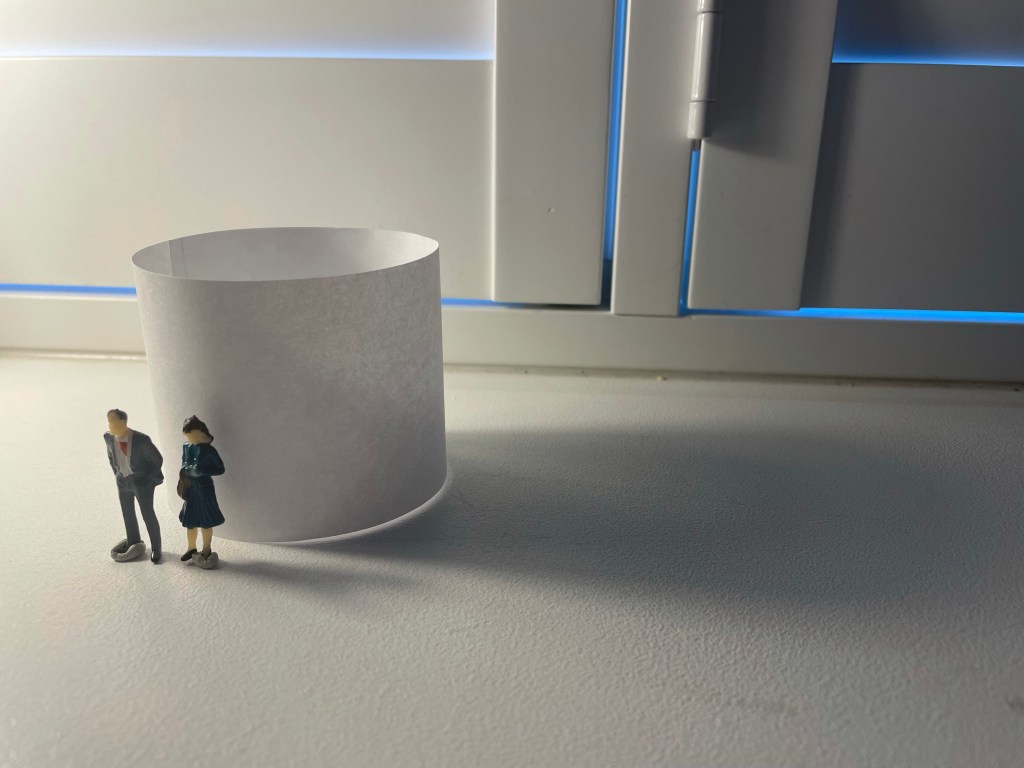
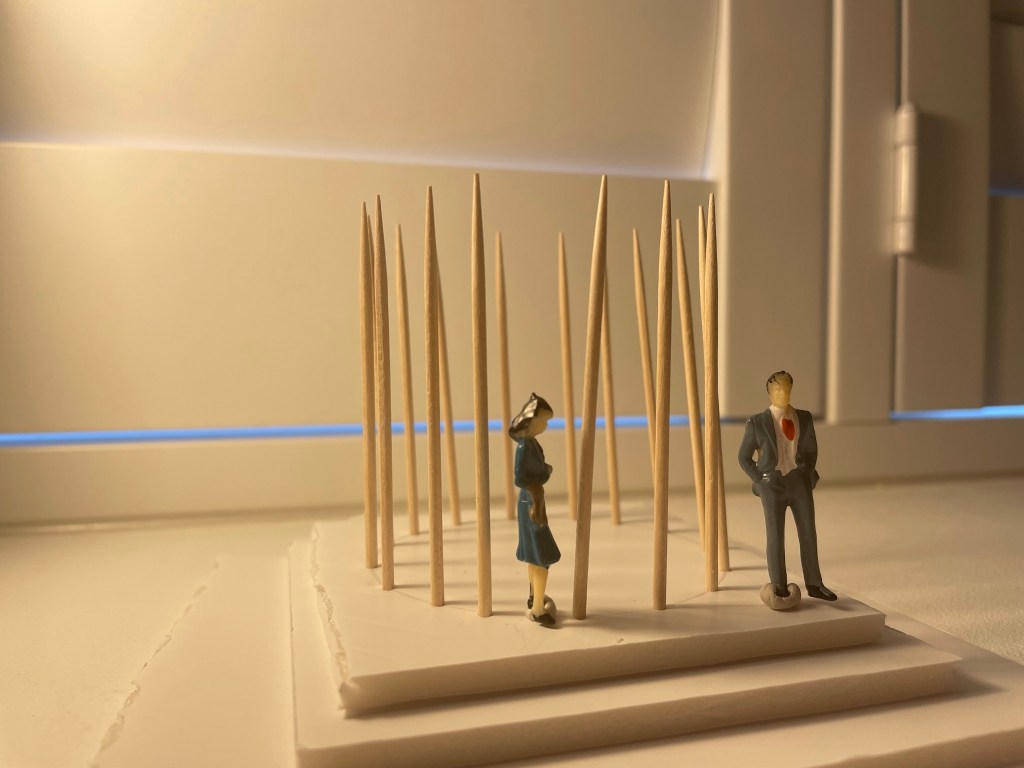
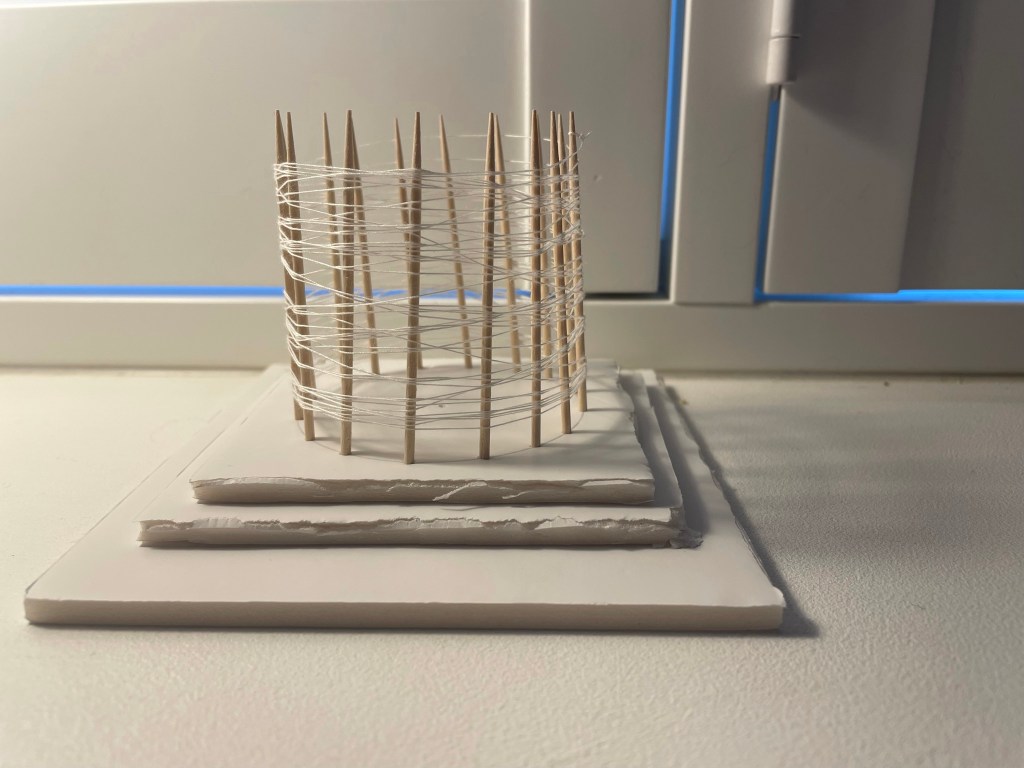
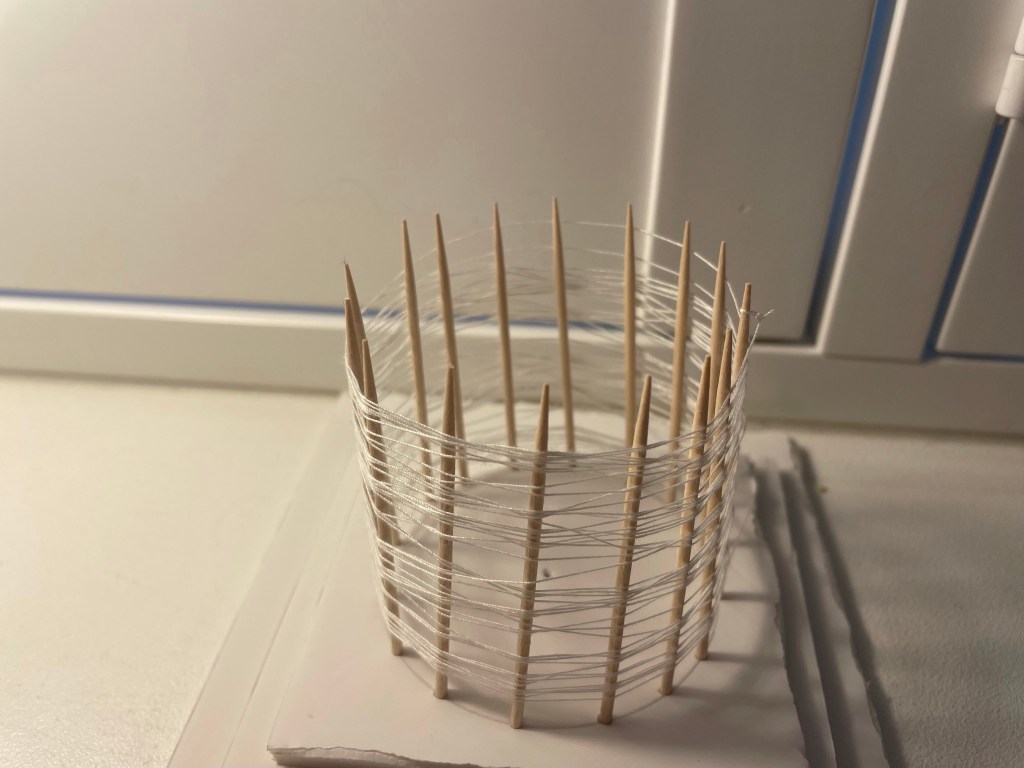
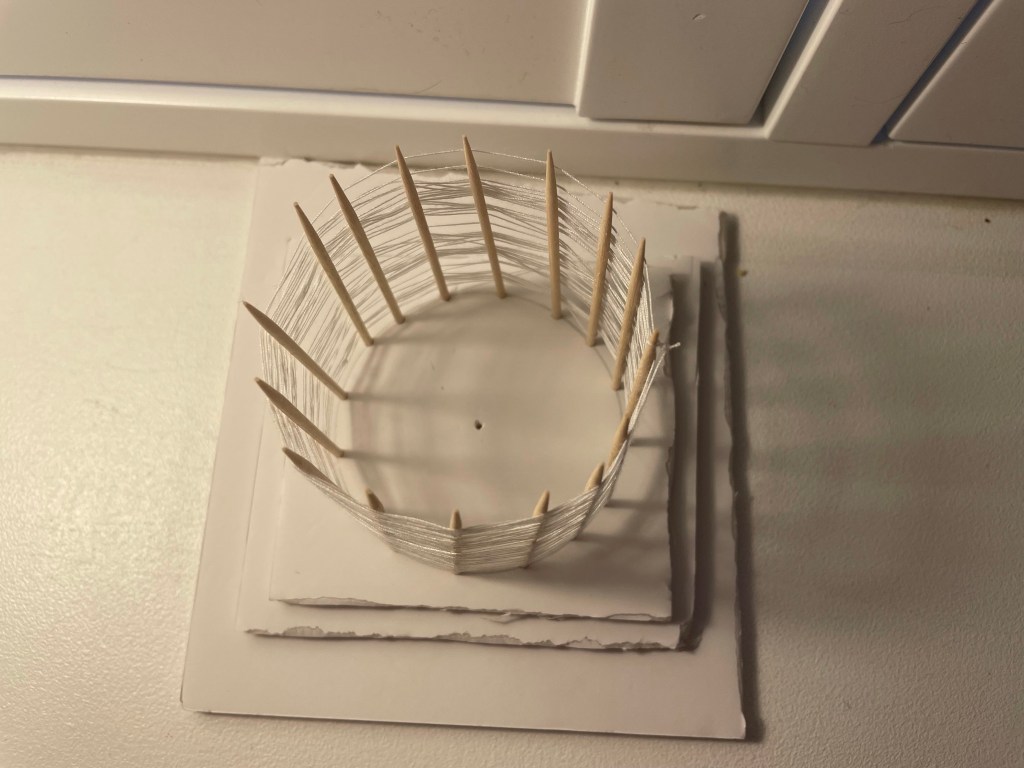
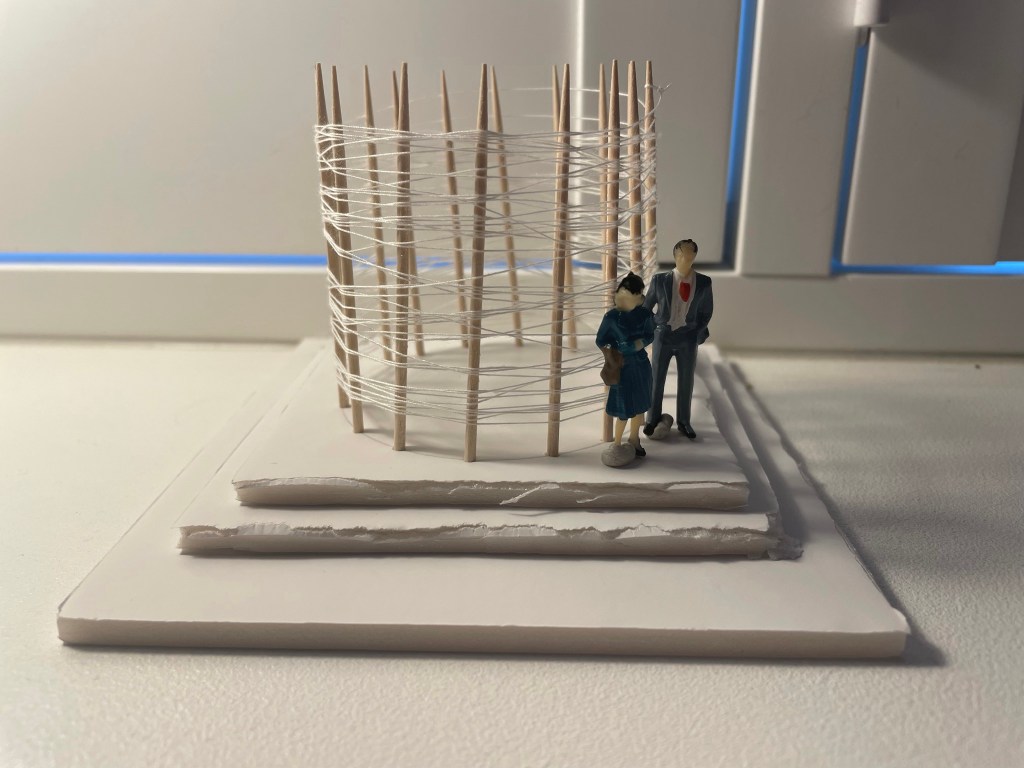
Figures in scale 1:100 made it look and feel enormous. The interior floor level is higher that eye level of the figures. The room is spacious and very tall. It could have a function of a pavilion, a building (perhaps commercial) with a viewing point on the ‘roof’. It has semi enclosed interior, but we could imagine the opening is glazed and we could then have a cavernous, grand and bright interior space inside.
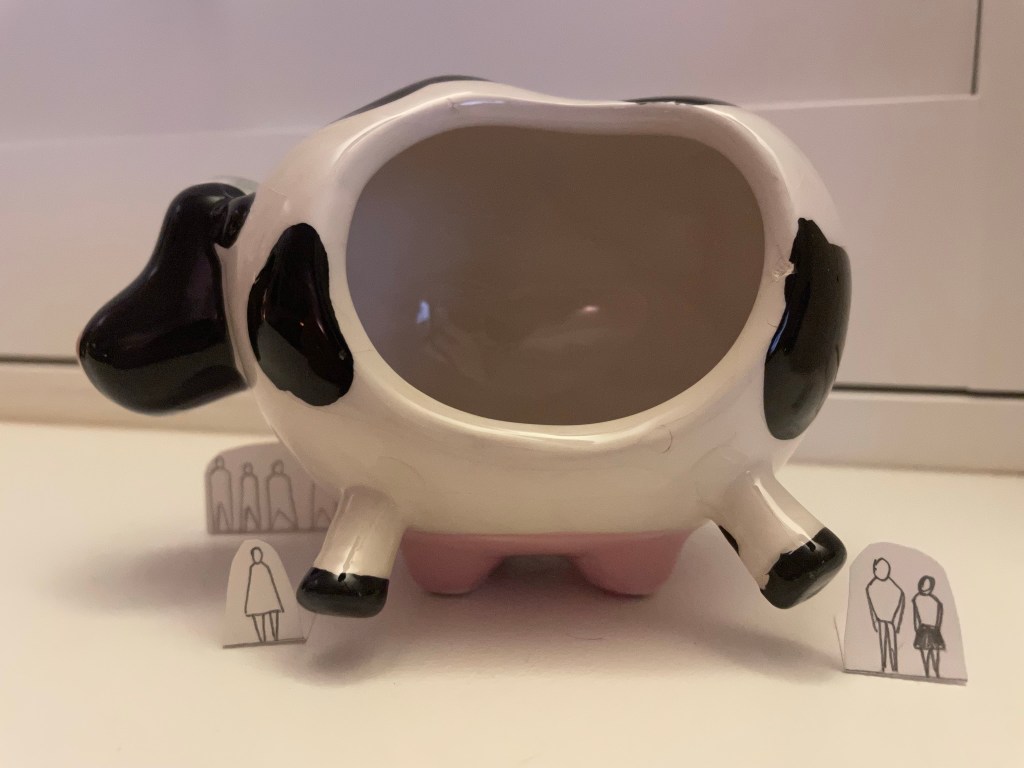
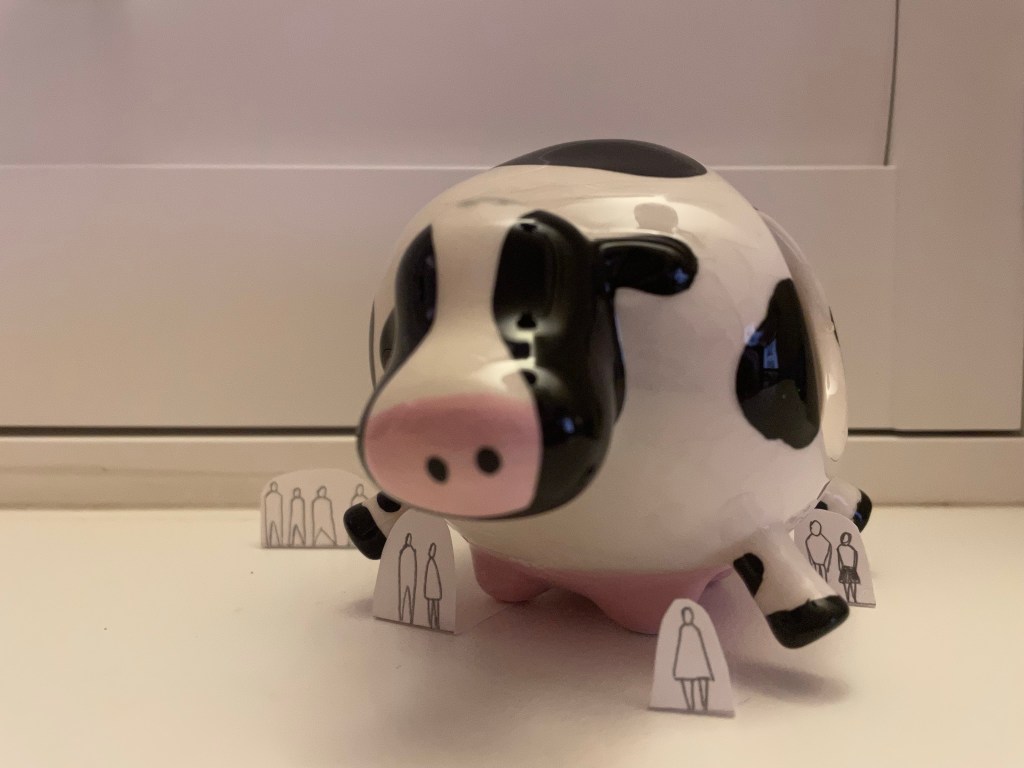
Figures scale 1:50 make the inside of the salt pig feel more enclosed and cosier. The function as presented in this scale could be a smaller pavilion or a garden structure providing a semi open shelter. If we add glazing on the opening it could be a really cool garden office or she shed.
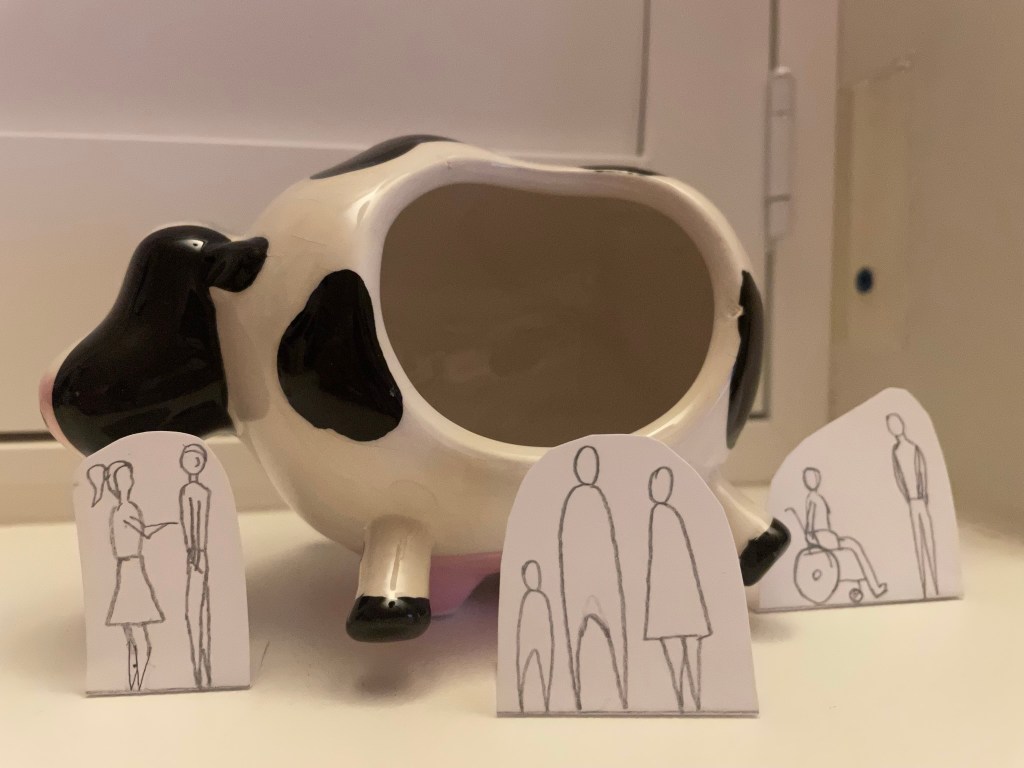
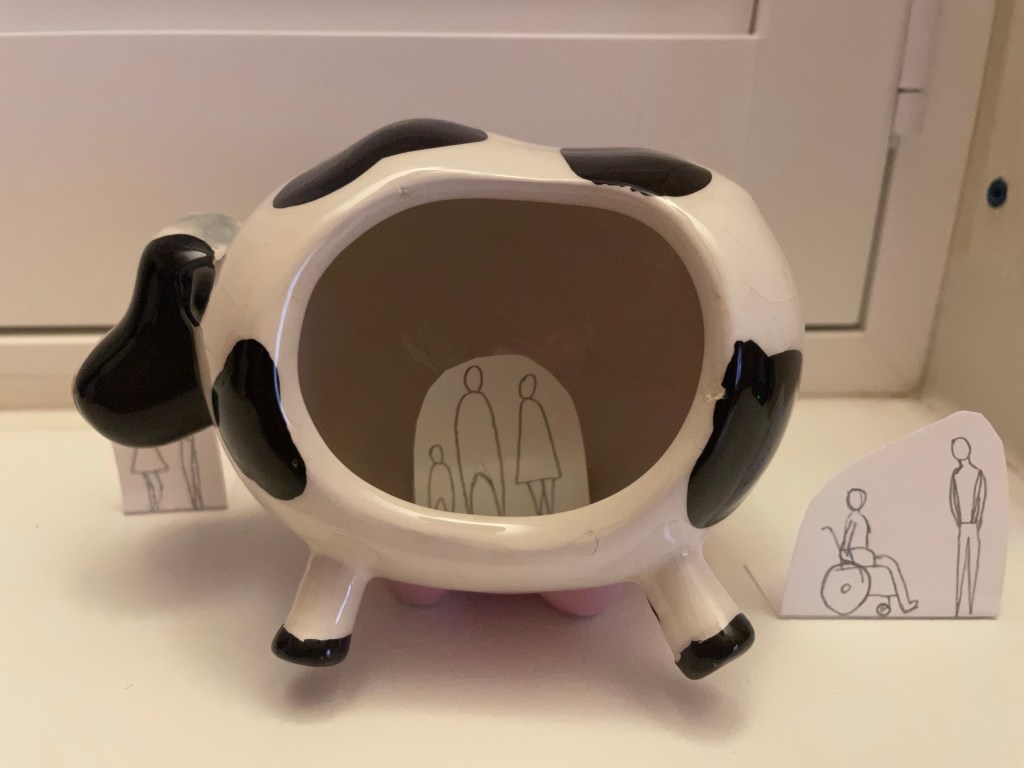
Figures in scale 1:20 make this object seem smaller than in previous examples. It could still provide a shelter but for 1-2 people. With some mattress and cushions it could be comfortable garden bed / relax area that provides shelter from rain and sunshine. It could also be a cupboard or a wood fired pizza oven.
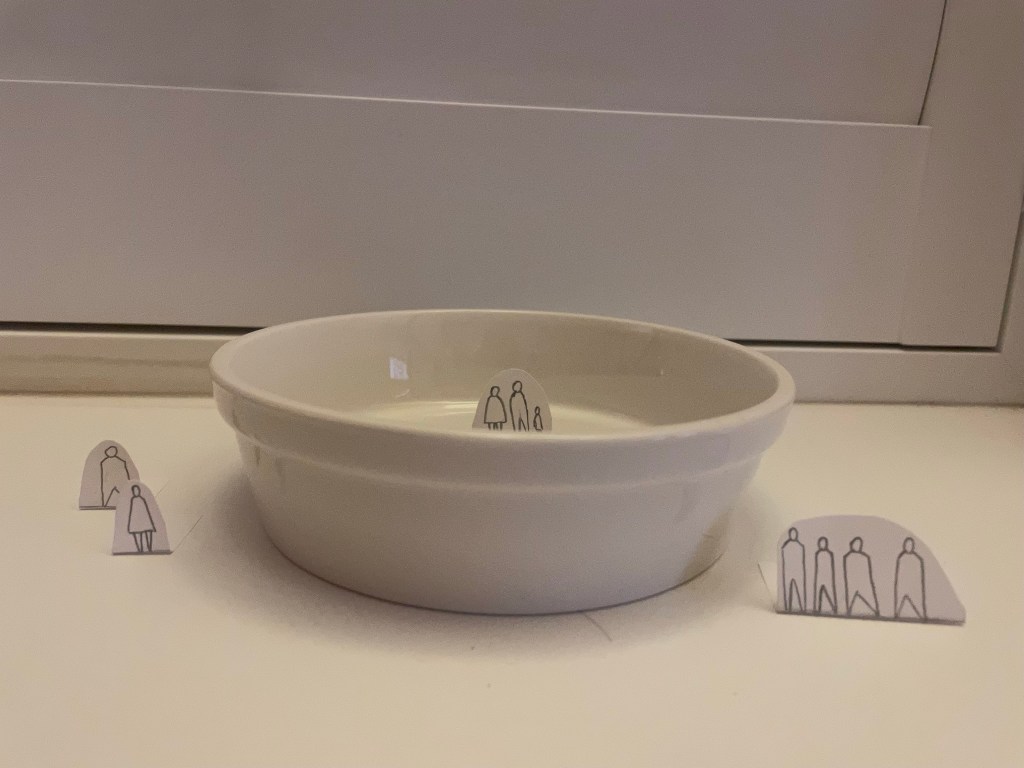
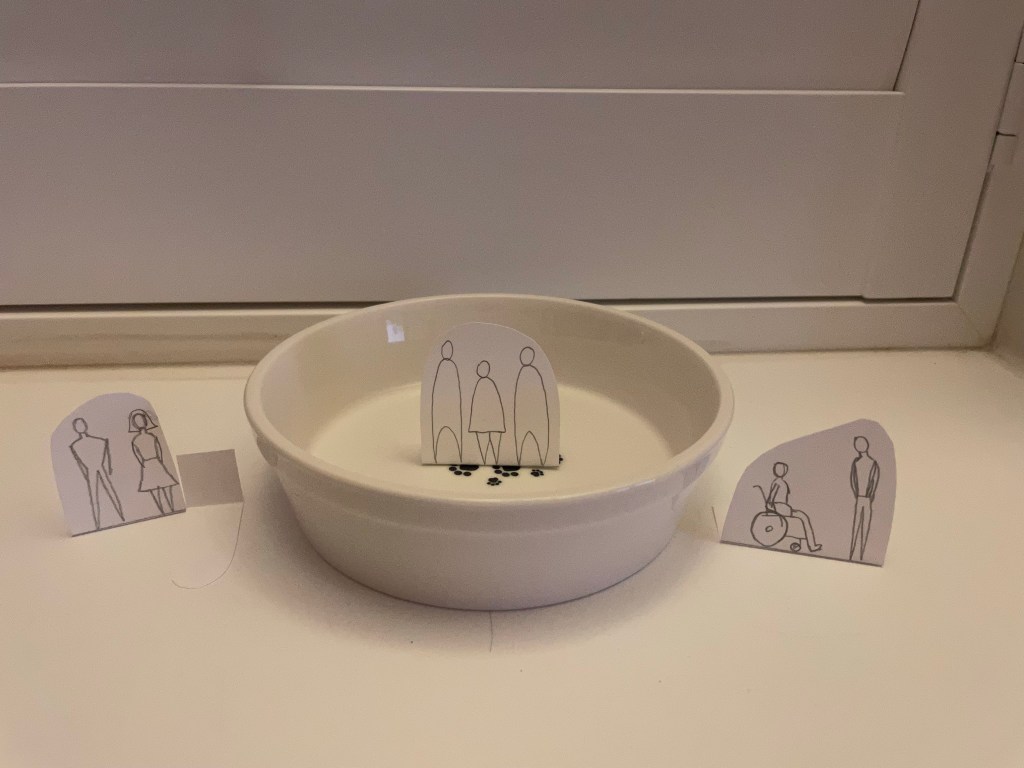
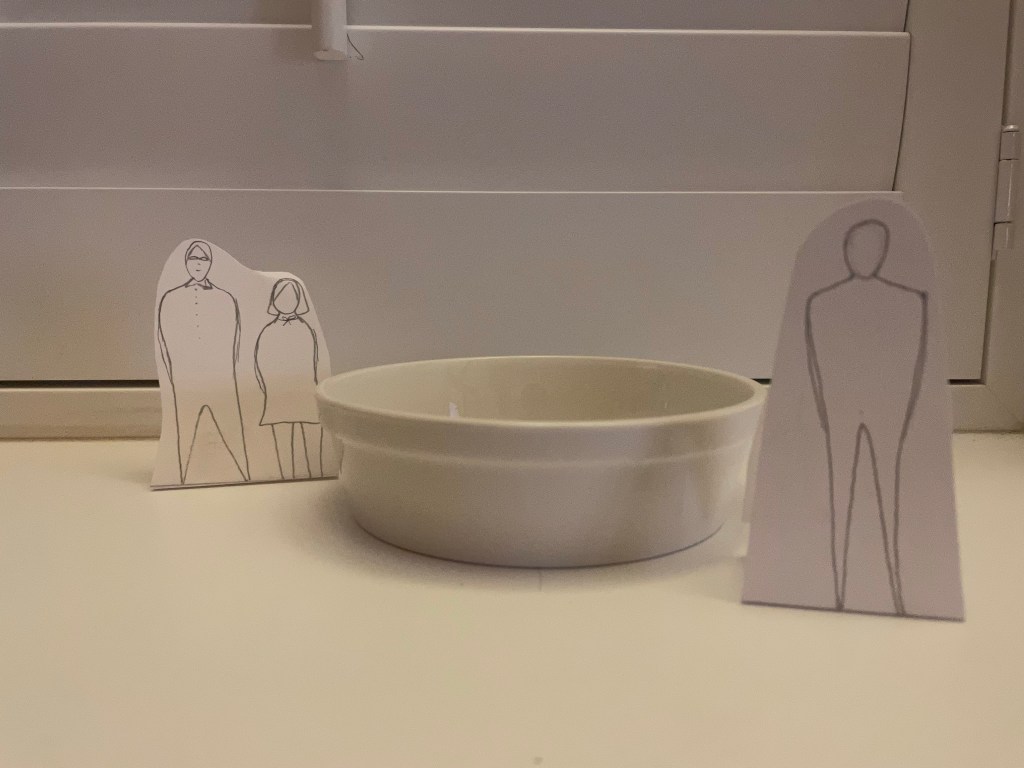
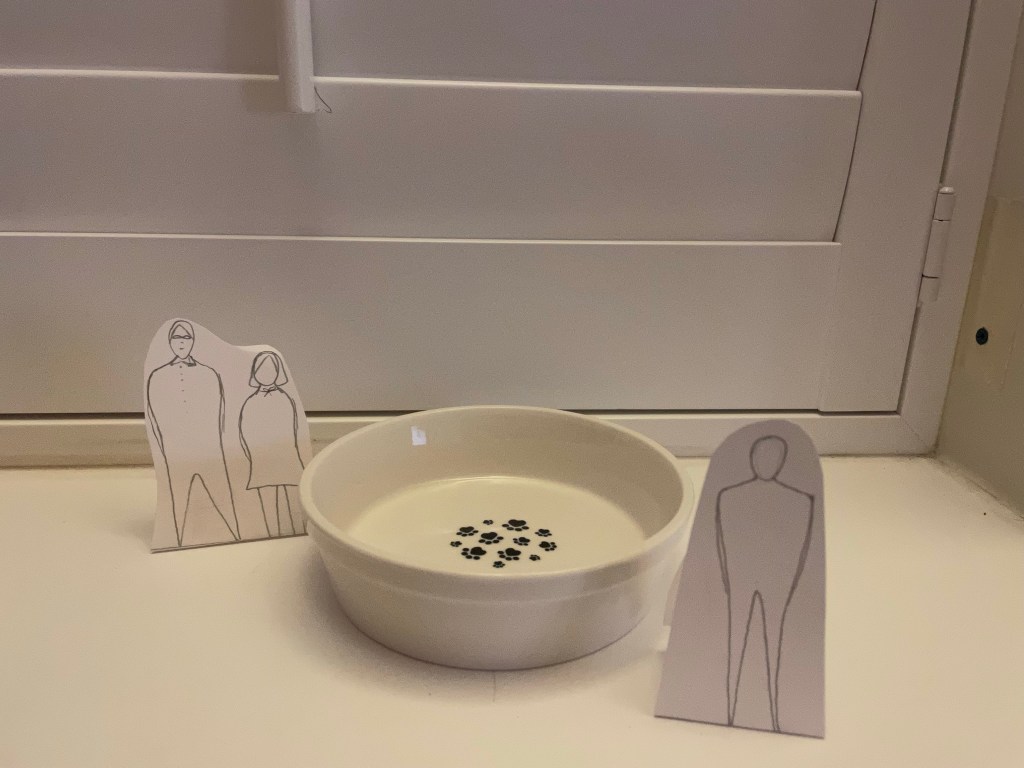
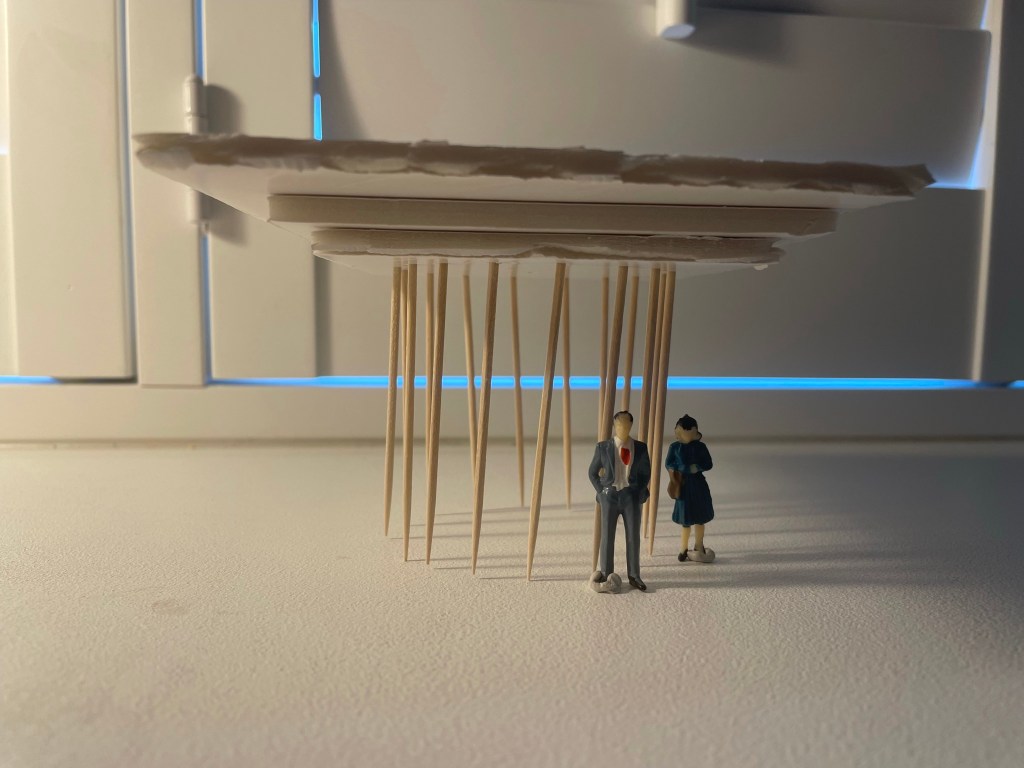
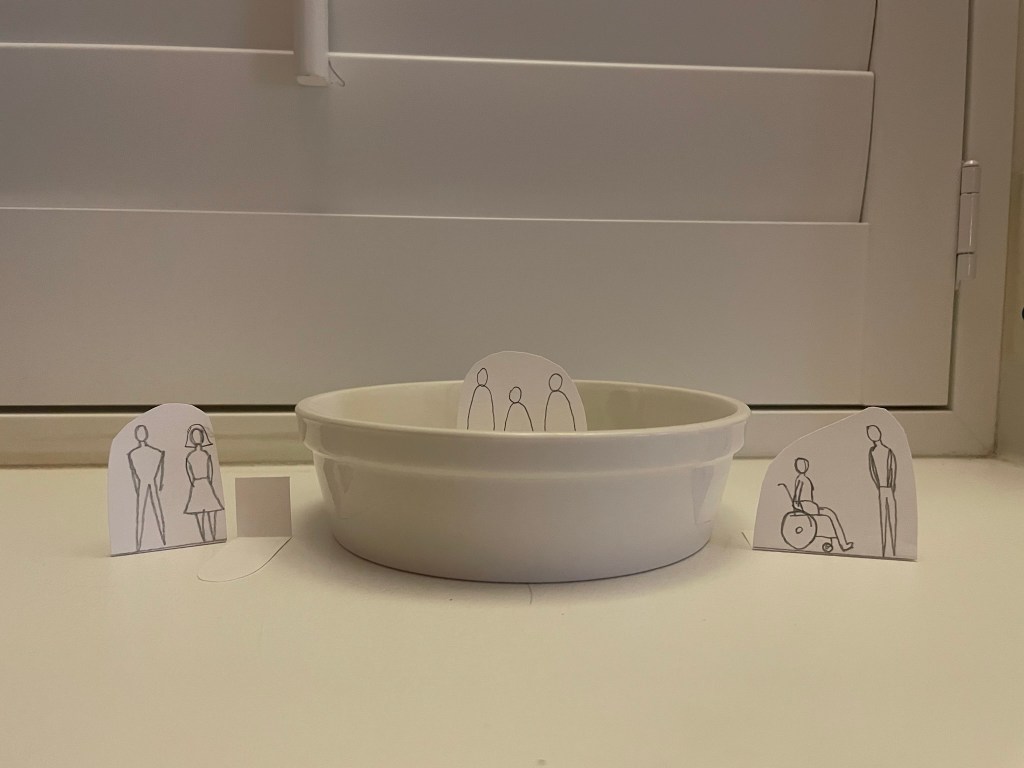
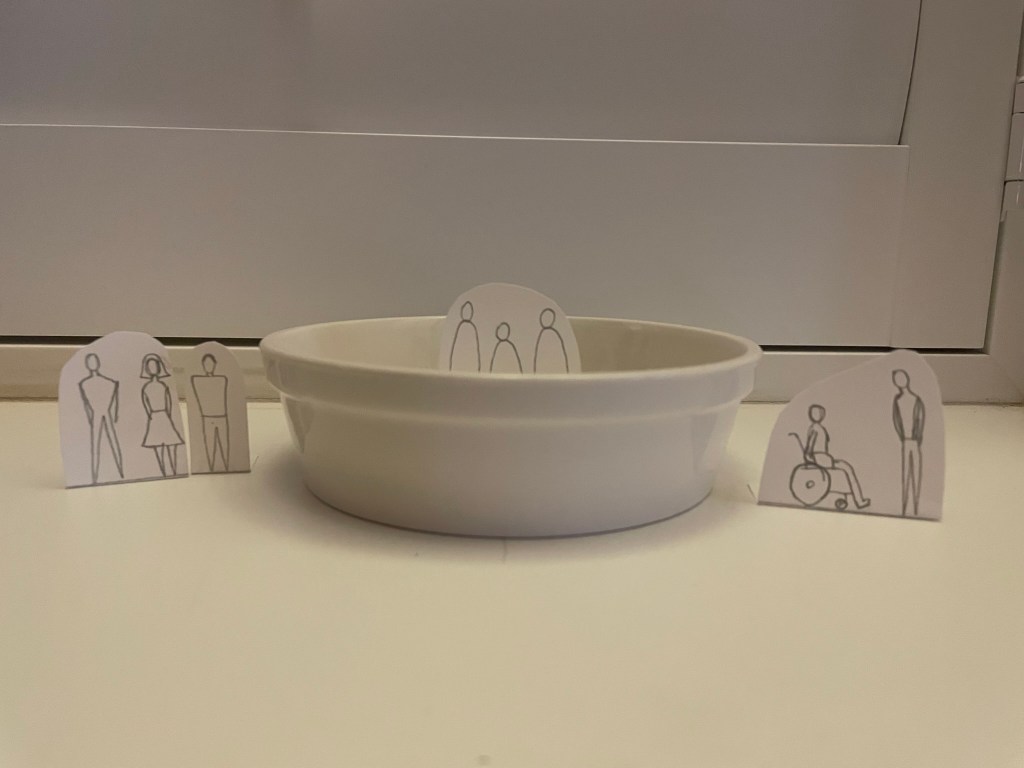
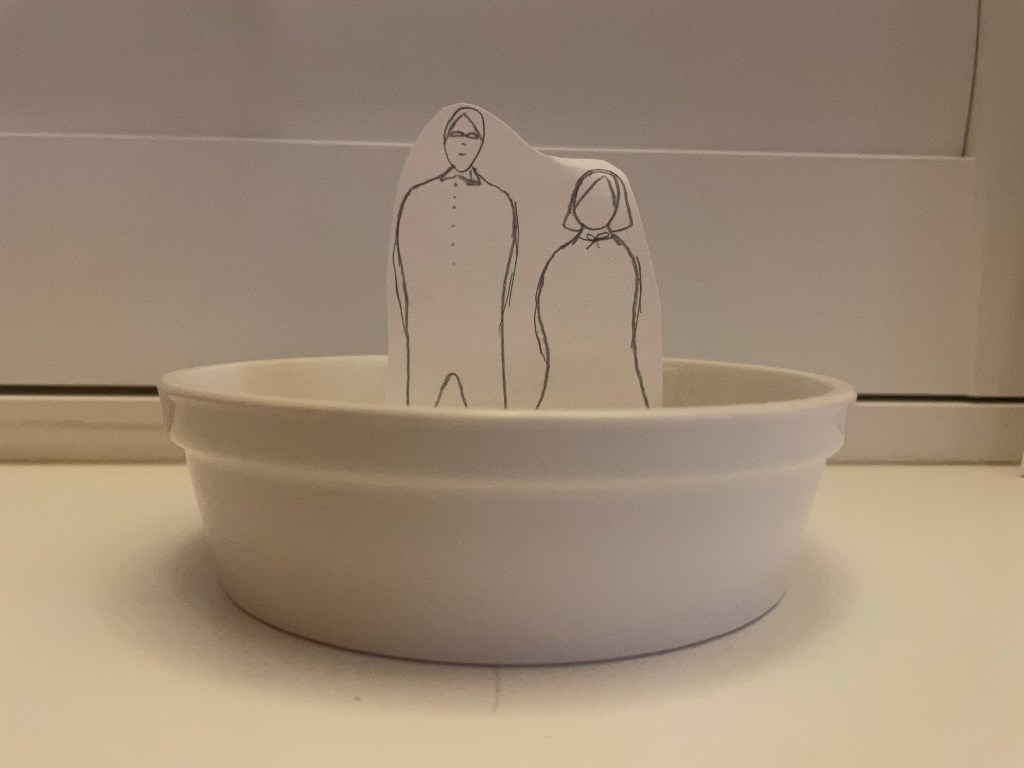
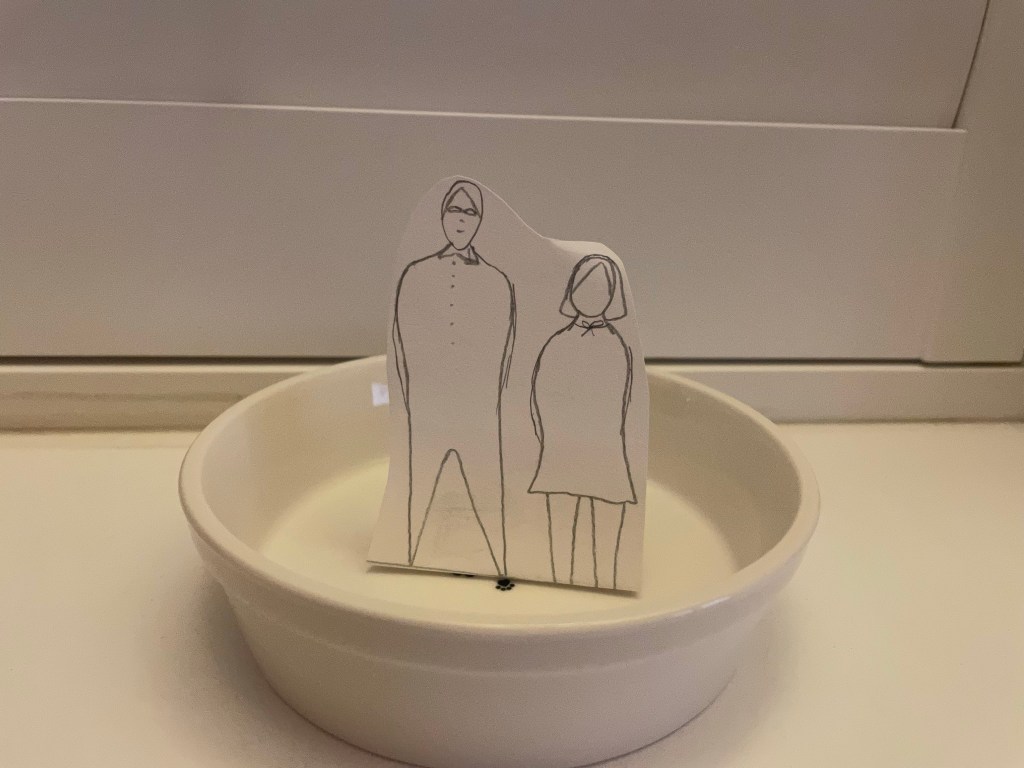
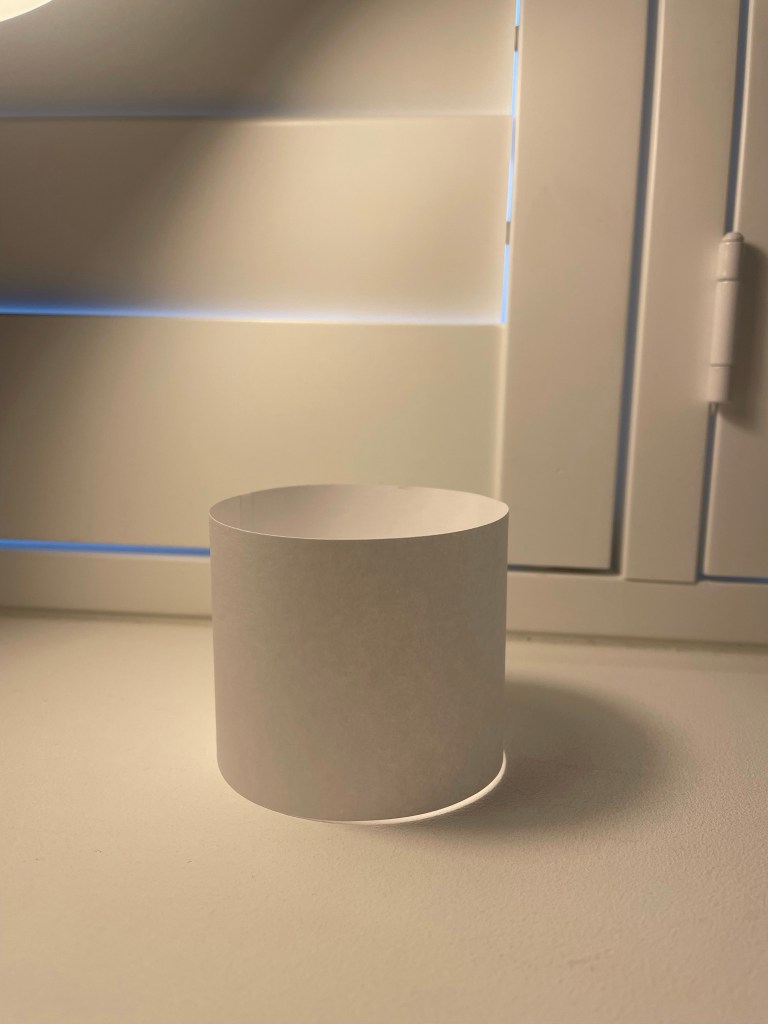
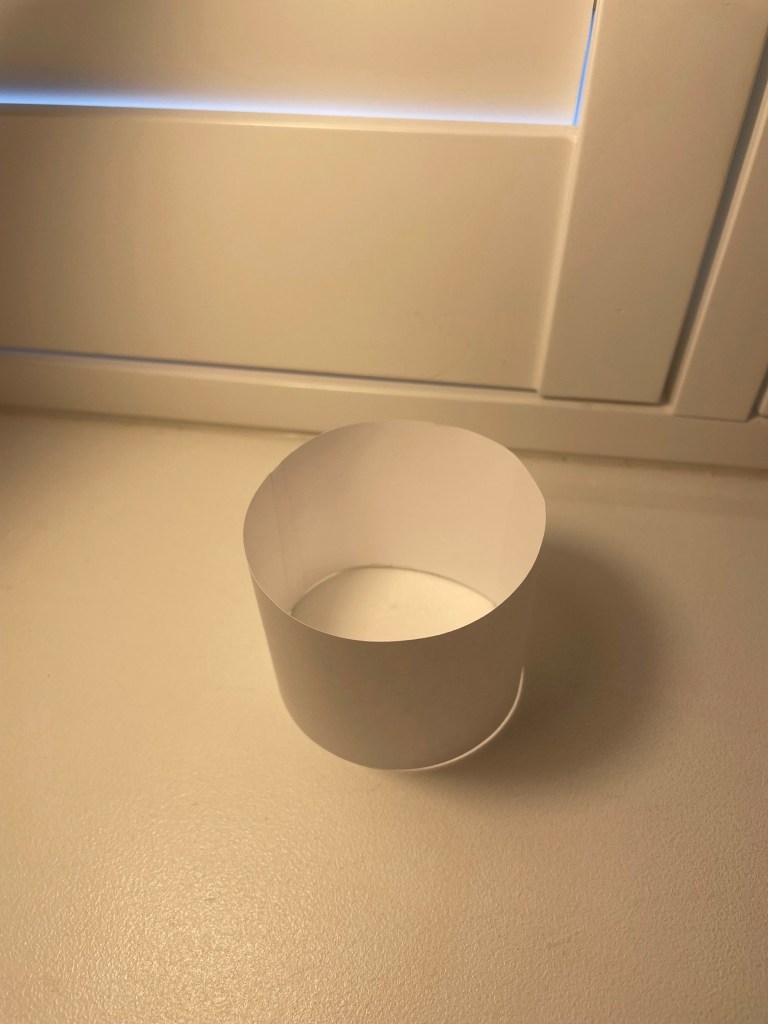
The I found a cat bowl

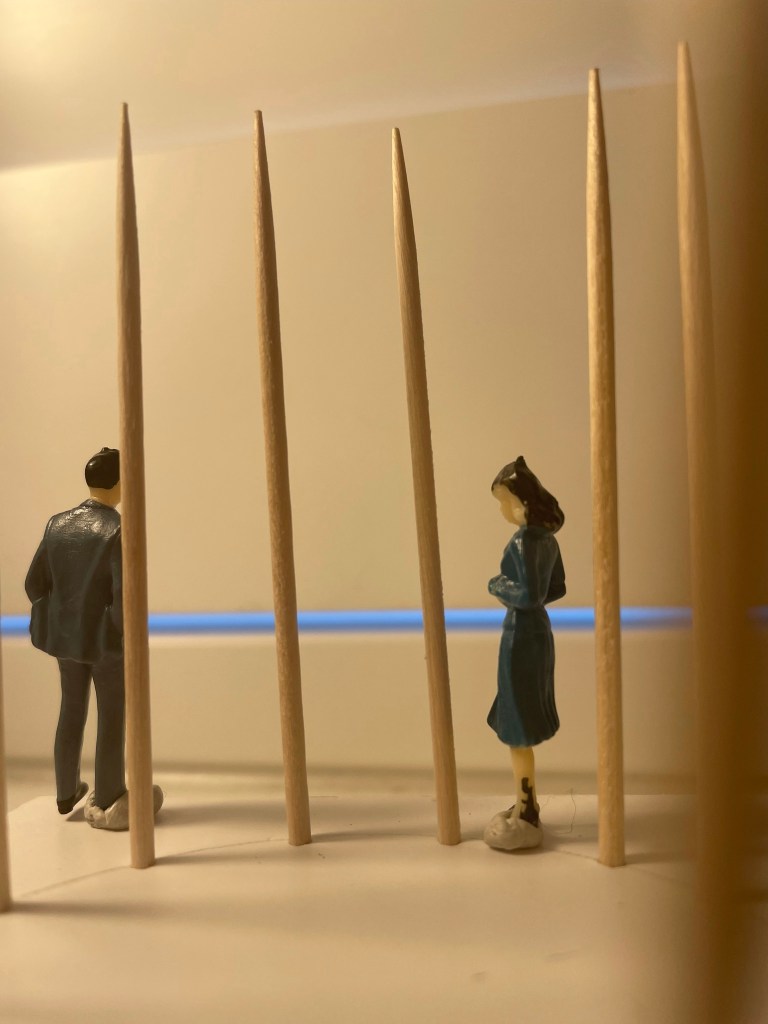
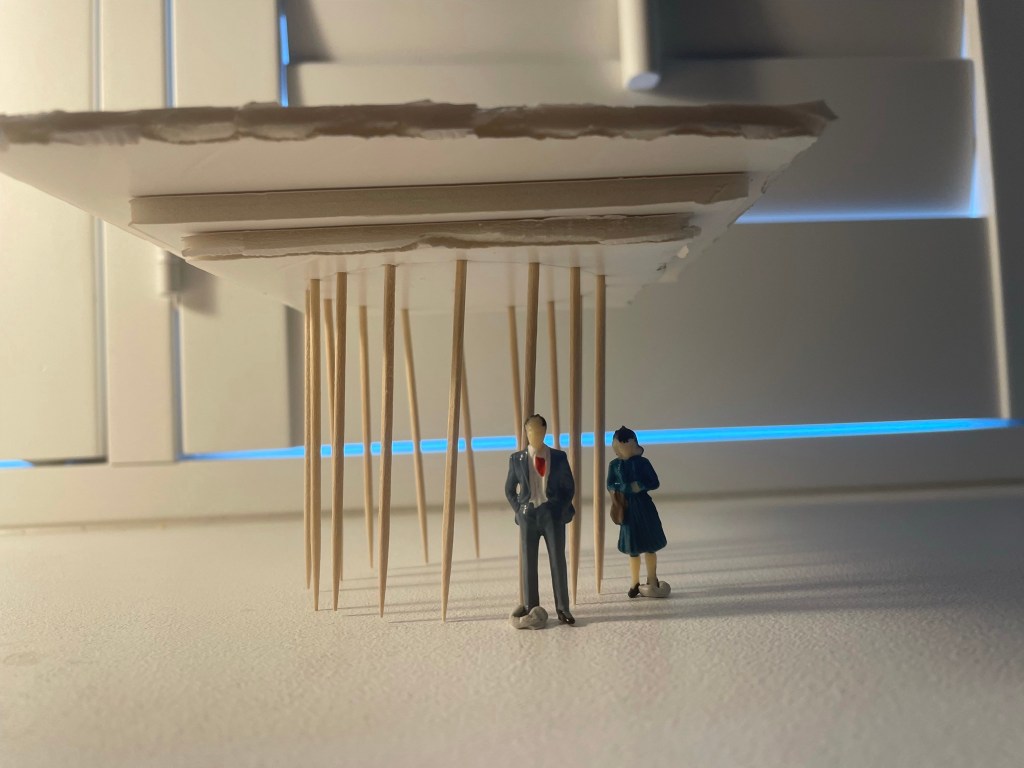
Figures in scale 1:100 make this object look very large, it could be a building when place upside down, or perhaps a manmade hill with a view point. It reminds me a little bit if Table Mountain in Cape Town with its steep edges and flat top, although the scale is very much off for this object to be table mountain. When placed with opening up the bowl could be a big and deep pool. It doesn’t provide shelter when placed right way up but it can contain a lot of people or water.
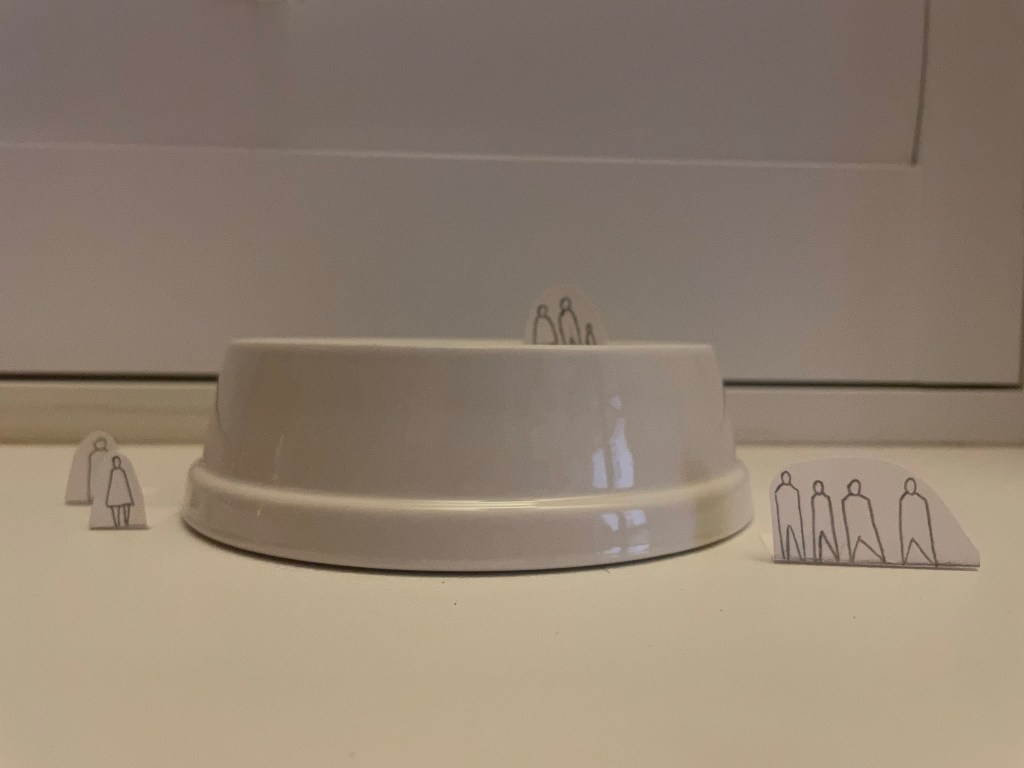
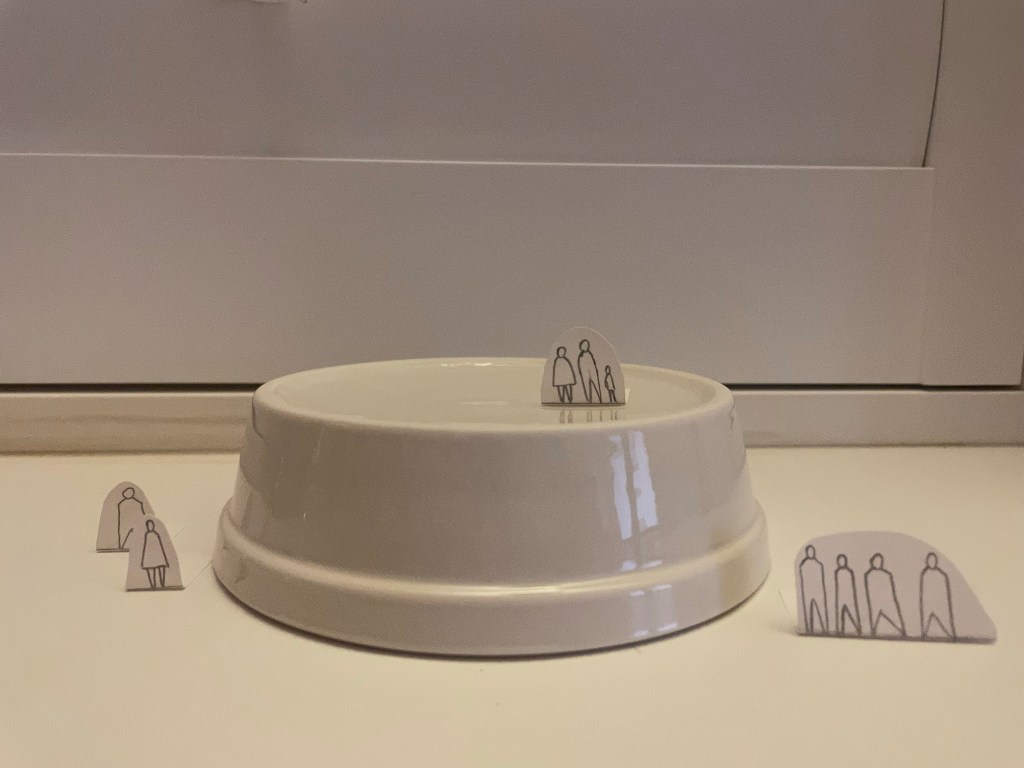
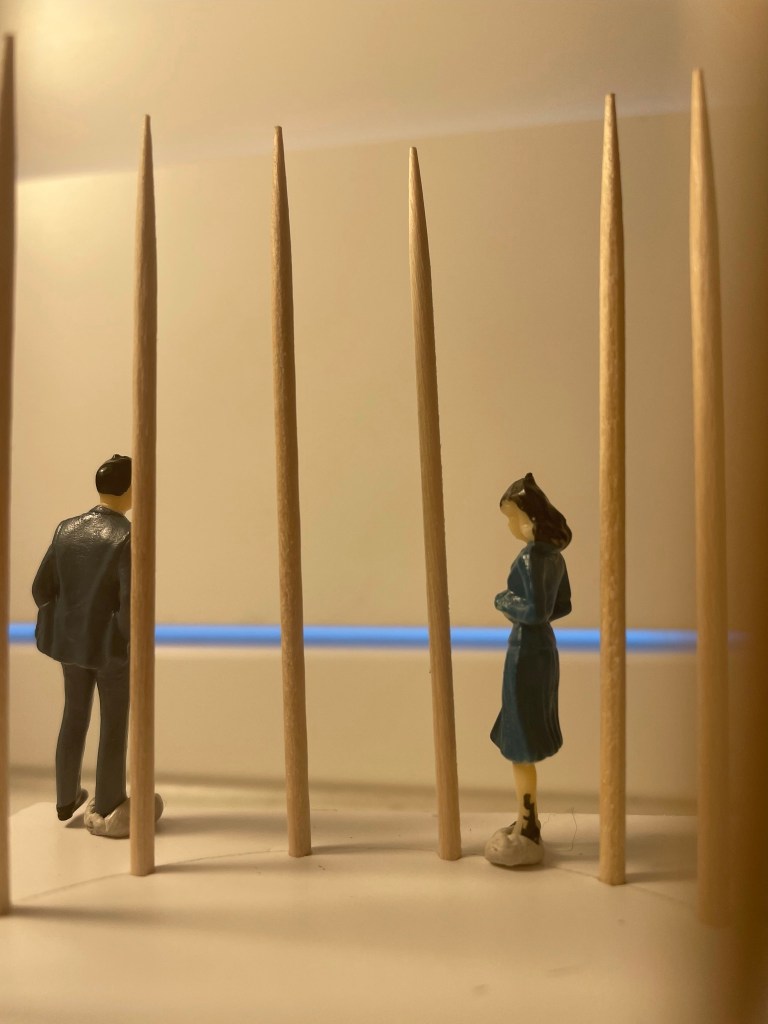
Figures in scale 1:50 indicate more ‘individual’ use, especially when placed as in the photos below, with the opening up. It could be a garden pool – the kind available in the shops but deep enough to need a ladder to get in and out of it. It could also be a stage or a raised patio. It could elevate (when placed upside down).
Figures in scale 1:20 indicate a different object with even more personal use. I think it could be used as a hot tub or a large fire pit. It seems low enough to be able to limb in it and the sides are at nice angle to provide comfortable back rest.
Reflection on the task:

It was a nice exercise, to start with I had no idea what function these objects could have. Only when I looked at the photos, seeing my figures next to it, ideas for use started flowing. Having scale figures definitely helps imagination and presentation…
Unit 2, Part 1, Research task: Frank Gehry

I watched ‘Sketches of Frank Gehry’ and ‘Manifesto by Frank Gehry’.

I observed that Frank Gehry’s creative process is a bit like mine. I have previously noted that the hardest is to start, therefore I procrastinate. And once I start it is all much easier. Gehry made a similar observation about his own process. Perhaps it is like that for most people.

Mr Gehry mixes art with architecture – I would dare to say he is an ‘art-chitect’. He takes risk with his creations, wants them to be unusual – the ‘weirder’ the better. He is a visionary who often seems to be setting the precedent rather than look for one. Interestingly he did not fit amongst other architects but found a support group amongst artists.

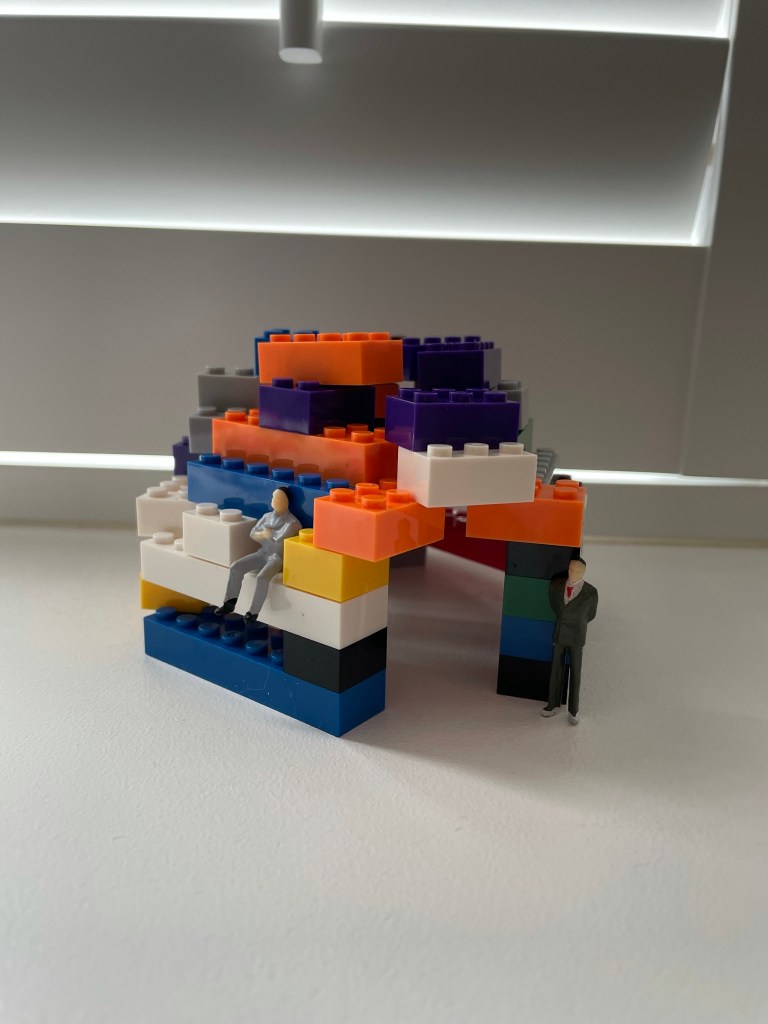
He makes models, then changes them. After that, he does not like what he created. He continues to look and contemplate. He wants to find out what exactly needs changing to make him like it more. His model making process uses trial and error, but a slow and carefully considered one. Putting model together makes him discover the next step or a different feature. He believes accidents are sometimes failures, but they are important step in the design process. He spends time to find something good in them. Frank believes project drawings and models are lifeless, but once the built is complete, the intended energy shows. Some of his model shapes look like they could be built using Lego bricks – yet very original, complicated shapes.

Like Charles Eames, Frank Gehry is a problem solver.

He involves his team in looking and contemplating and implementing changes. A lot of the design process is looking together and having constant conversations about the model. Frank relies on his team, they have long standing relationships, communicate well, and understand one another.

He is great materials researcher.

Introducing CAD technology into model making and design process allowed Frank to design more freely and gave him more artistic flexibility, while being clearer to the contractors and leaving less room for their interpretation. Sketch models are still important for him to understand and see how the elements work together.

As a child Frank played ‘master planning’ with his grandmother – building entire cities using toy blocks. He also loved drawing as a child and was considered talented by his teacher. Perhaps this is when it all started.

Being a painter is Frank’s dream. Despite being so artistic he never tried it, he said he would not know how to. He believes painting and architecture have something in common – surface.

Function is always at the heart of his designs. Whether its art, education, leisure etc. the design must fulfil this priority, his ideas come second.

When creating he thinks outside of the box – for example he looked at a painting (‘Christ mocked’ by H. Bosh) as a composition and fed this composition into the design. He understands light and its effect on the spaces. When the process is too easy, he thinks it is wrong – he believes design process has to be difficult to be exciting.

Brief is sanctity for Frank, meeting the brief is the priority for him. Frank absorbs what client says – not only the words, but also the atmosphere around them and the whole mood in the room, the smell, the light… Then he comes up with the model.
He also looks at the context, the surroundings and decides how the new design will act in response to pre-existing buildings. For example, Walt Disney Concert Hall’s shapes relate to those of Chandler buildings next door. Disney Hall structure is ‘broken into smaller pieces’ to give it own identity.

References:

Sketches of Frank Gehry. (2005) Directed by Pollack, S. [YouTube] At:  https://www.youtube.com/watch?v=prdug_iuiFQ (Accessed 07/07/2021)

Manifesto by Frank Gehry (2017) [Online Video] At: Manifesto by Frank Gehry on Vimeo (Accessed 07/07/2021)

Unit 2, Part 1, Exercise 5.3: Person – Space – CONTEXT

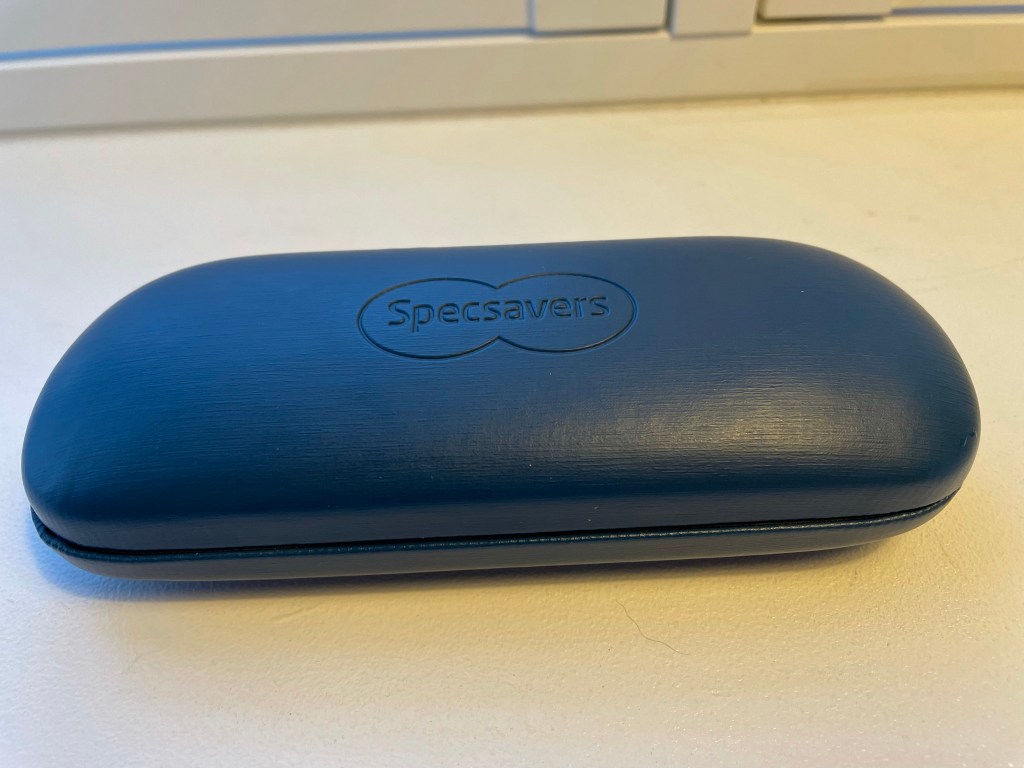
I chose spectacles case from the previous exercise.

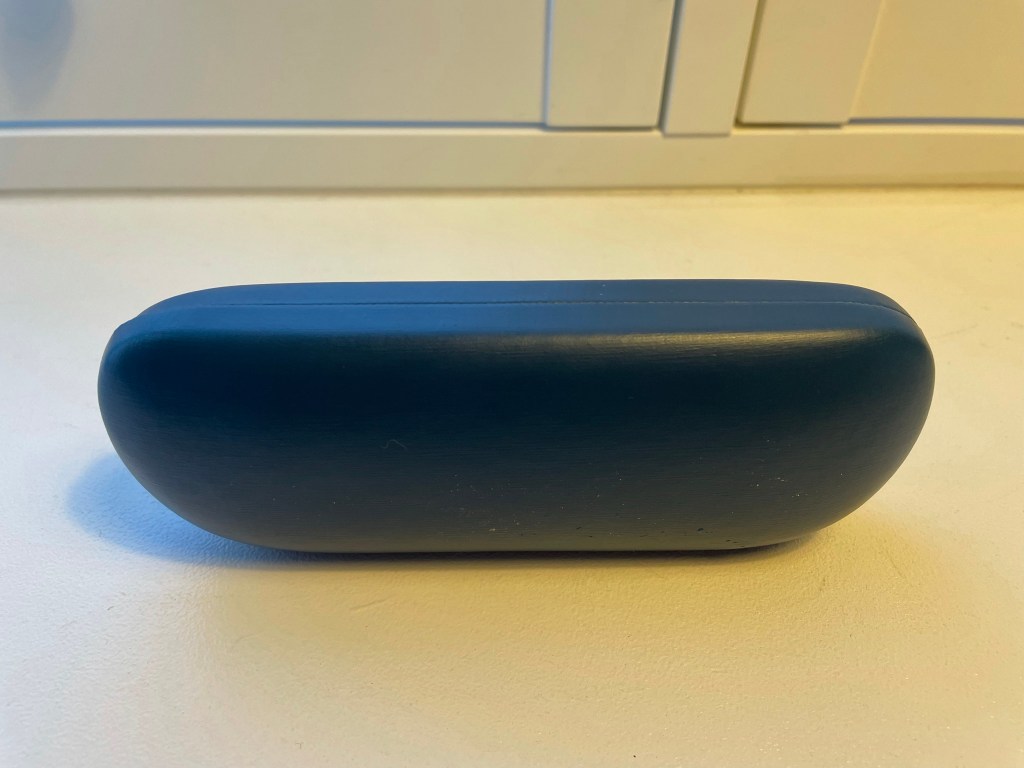
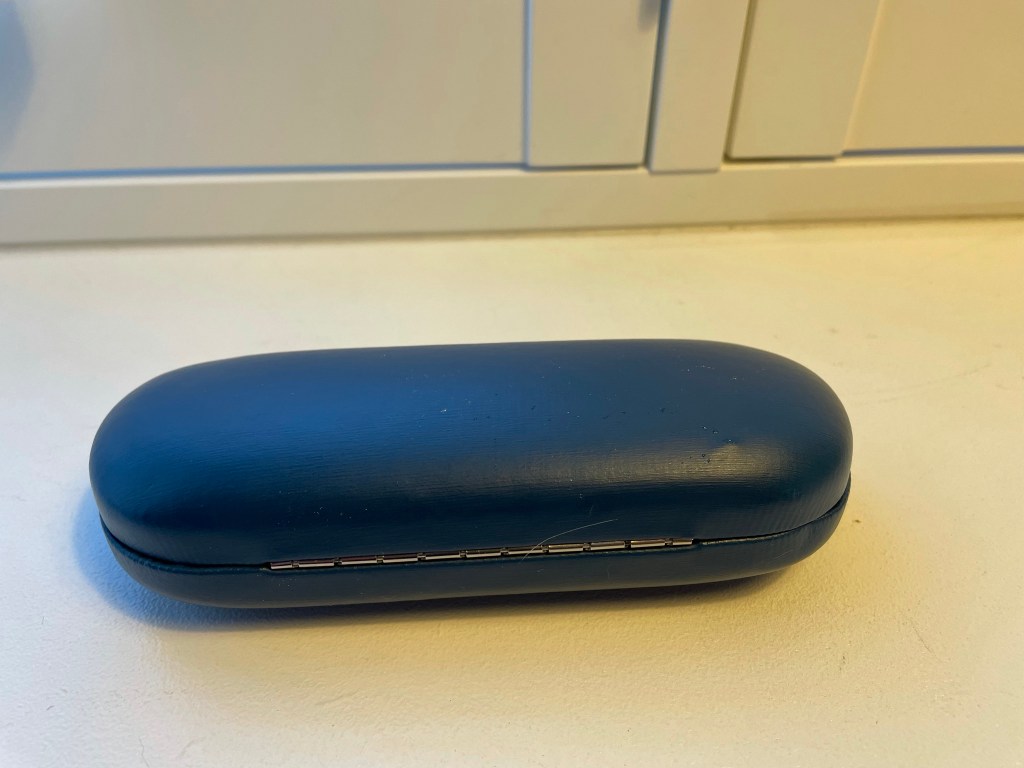
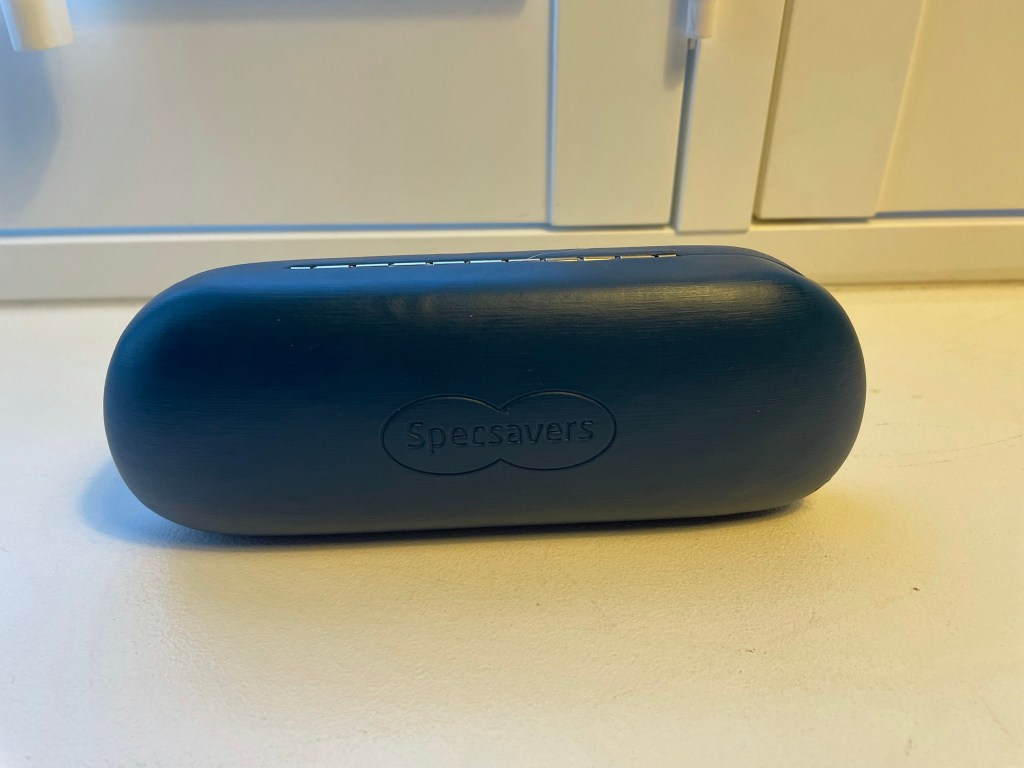
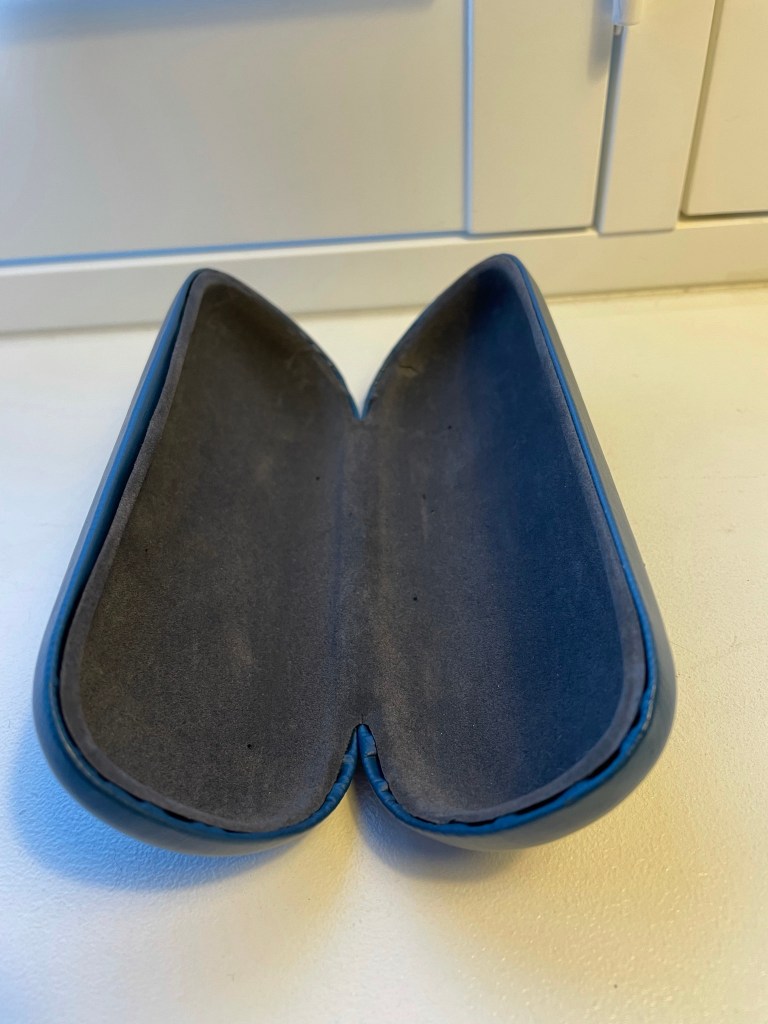
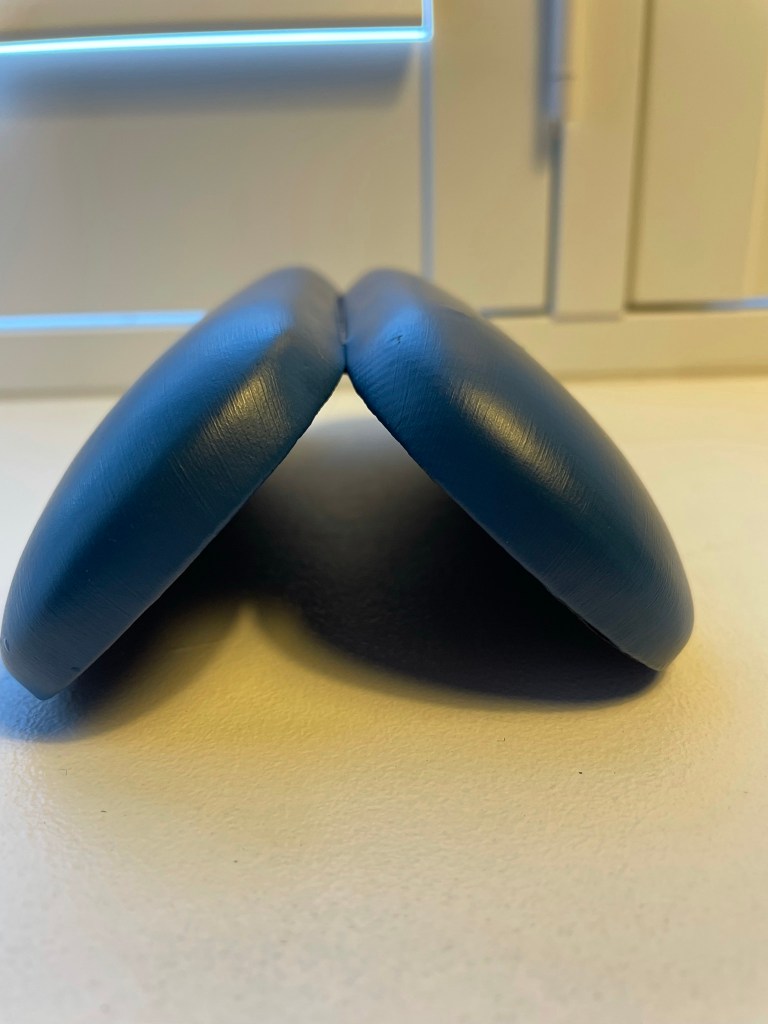
Fig. 1 – Fig. 4 shows my object laying or standing on side. It occupies space, defines the windowsill below it by simply sitting on it and casting a shadow. It also contains space that is invisible in this setup, nevertheless I know it is there. Also, space contained between the windowsill and curved / lifted of the ground edges is worth mentioning.

Fig. 1 Laying on the bottom.
Fig. 2 Standing on the back.
Fig. 3 Laying on the top.
Fig. 4 Standing on the front.

Fig. 5 and 6 show the open case. Here the items are containing the space and defining it in similar but more obvious way than in fig. 1-4. The ways are more visible because the angles are sharper. Fig. 5 is 50/50 containing and defining the space. Fig. 6 is more containing that defining but still does both. The inside is containing, the outside is defining.

Fig. 5 Open Upwards.
Fig. 6 Open Downwards.

Reflection on the task:

It was another first for me. Perhaps that is one of the ways to look for inspiration. Play with everyday objects, position, manipulate them to enhance imagination. Fig. 6 could be a tent or a pitched roof, Fig. 1 could be a low bench, maybe even with storage. I think any object could contain or define the space, depending how we look at it. A house obviously contains space, but if you look at the exterior, the walls and roof define the space within it.

List of illustrations:

Fig. 1 Shuttleworth, A. (2021) Laying on the bottom. [Photograph] In possession of: the author: Epsom.

Fig. 2 Shuttleworth, A. (2021) Standing on the back. [Photograph] In possession of: the author: Epsom.

Fig. 3 Shuttleworth, A. (2021) Laying on the top. [Photograph] In possession of: the author: Epsom.

Fig. 4 Shuttleworth, A. (2021) Standing on the front. [Photograph] In possession of: the author: Epsom.

Fig. 5 Shuttleworth, A. (2021) Open Upwards. [Photograph] In possession of: the author: Epsom.

Fig. 6 Shuttleworth, A. (2021) Open Downwards. [Photograph] In possession of: the author: Epsom.

Unit 2, Part 1, Exercise 5.2: Person – SPACE – Context

Unit 2, Part 1, Exercise 5.2: Person – SPACE – Context

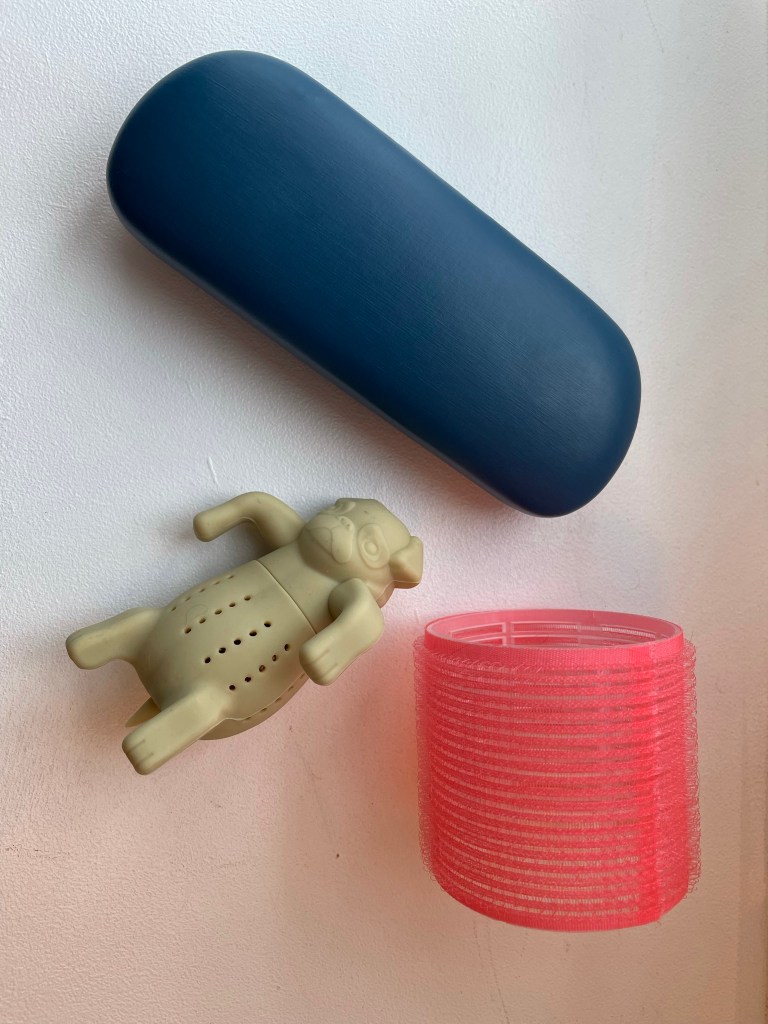
Fig 1. Three Objects

Spectacles Case:

  • Hard and smooth, very slightly ribbed on the outside.
  • Hard, durable material (plastic) covered in leather (or leatherette) on the outside.
  • The leather is creasing on the internal edges.
  • Small surface imperfection on the bottom of the case, hidden by the leather, but the bump visible in the shape of the surface
  • Thin layer of padding and soft, velvet on the inside
  • Etched logo on one side
  • Dark blue on outside and charcoal on the inside
  • Silver coloured, metal hinge on one of longer sides
  • If let to close freely the case makes a clapping noise
  • Fits on straight hand
  • The padding on the inside of the case can be lifted slightly.

Tea Infuser

  • Pug shaped, with tea infusing holes around the ‘abdomen’ area.
  • Silicone of varying thickness – thinner and flexible where the holes are, thicker and firmer in all other places.
  • Tea compartment would fit up to three teaspoons of dry tea
  • Cream in colour
  • The square design of outstretched front paws allows it to be hung on the inside of a mug.
  • Warm to touch
  • Fits in palm of hand

Hair Roller

  • Tube Shape
  • Pink, loop design nylon thread on the outside, sicks out about 3mm
  • The thread is thin and strong
  • Thread pattern grips to the hair
  • Outside makes soft noise when rubbed.
  • White, semi translucent plastic the inside
  • Ribbed design, that follows the perimeter of the circle to allow the thread attachment, interconnected by perpendicular elements that connect bot ends of the tube.
  • Slightly soft, bendable by hand
  • This item would fit in a cube with side length of index finger, height width and length seem equal.

Reflection on the task:

Interesting task it reminds me of the quote by Vicco Magistretti ‘Look at usual things with unusual eyes.’ I struggled not to describe the ‘feel’ of the objects, perhaps because I am so used to having feelings and opinions in response to objects and anything else. Also, some elements of the design were hard to describe with words, annotated drawing would have been easier.

List of illustrations:

Fig. 1 Shuttleworth, A (2021) Three Objects. [Photograph] In possession of: the author: Epsom

Unit 2, Part 1, Exercise 5.1: PERSON – Space – Context

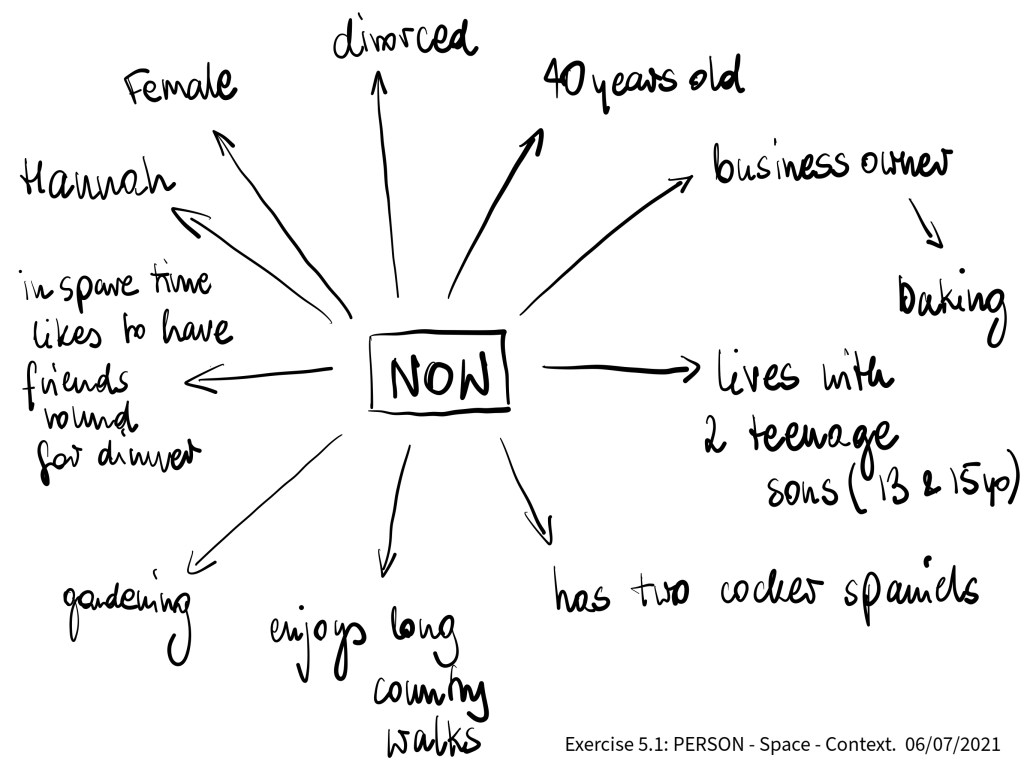
Hannah is a 40-year-old professional baker who runs her business from home in Manchester. She is divorced and lives with two teenage sons and two cocker spaniels. She enjoys long country walks. On the weekends that her boys spend time with their dad (and the time allows) she likes to go for a day trip or a weekend in the Lake District. She is a talented baker who creates beautiful and personalised cakes and cupcakes to order. In her spare time, she tends to her garden which is her pride and joy. Whenever she can she hosts dinner parties for her close friends.

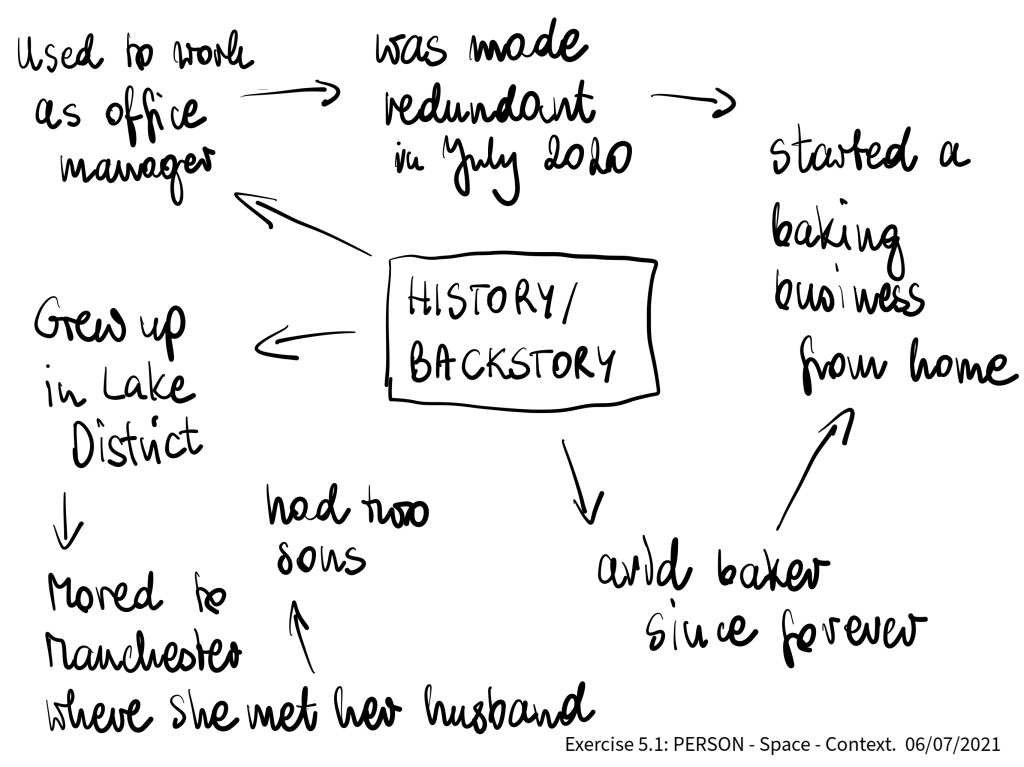
Hannah grew up in the Lake District and only moved out to Manchester as an adult. She met her husband there; they started a family and bought a house together. They got divorced in 2016 but remained on good terms. Hannah got to keep their family home located in northern suburbs. Hannah always had a passion for baking and used to work as an office manager in Manchester City Centre. When COVID-19 pandemic hit she was made redundant. She decided to use her redundancy pay to invest in a baking business. She already had all the skills – baking and business management.

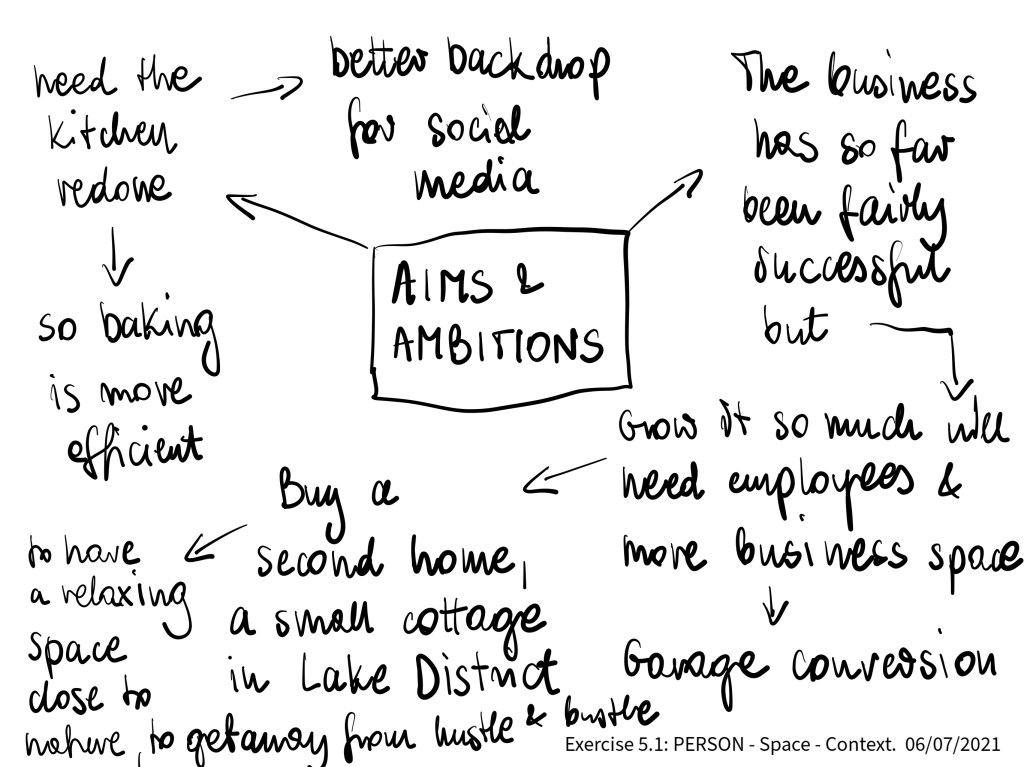
In near future she would like her house extended to fit a larger kitchen and utility space. Extra space, supplies, storage, and appliances will have their space and she will have a nice family kitchen once she is finished with work for the day. Nice, new kitchen will also be a perfect backdrop for her social media material – essential for growing this type of business. Once the business has grown to a point of employing help, she would like to convert her garage to become new business premises. Later on in life, she would like to buy a second home in the Lake District – somewhere she could unwind and go for those long country walks.

Reflection on the task:

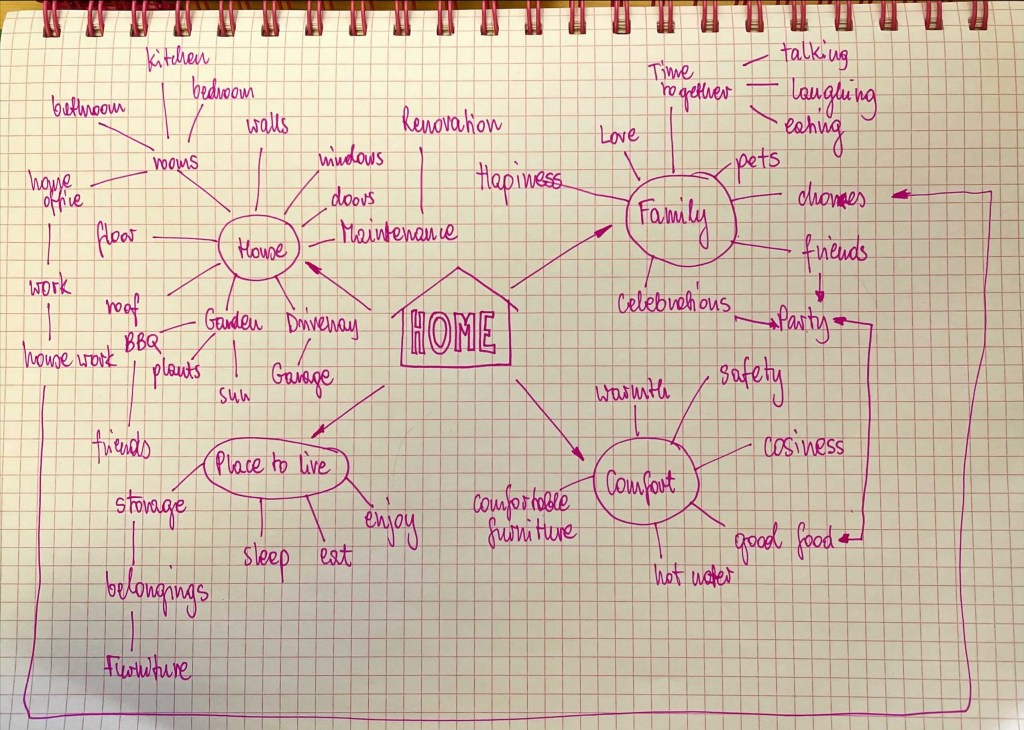
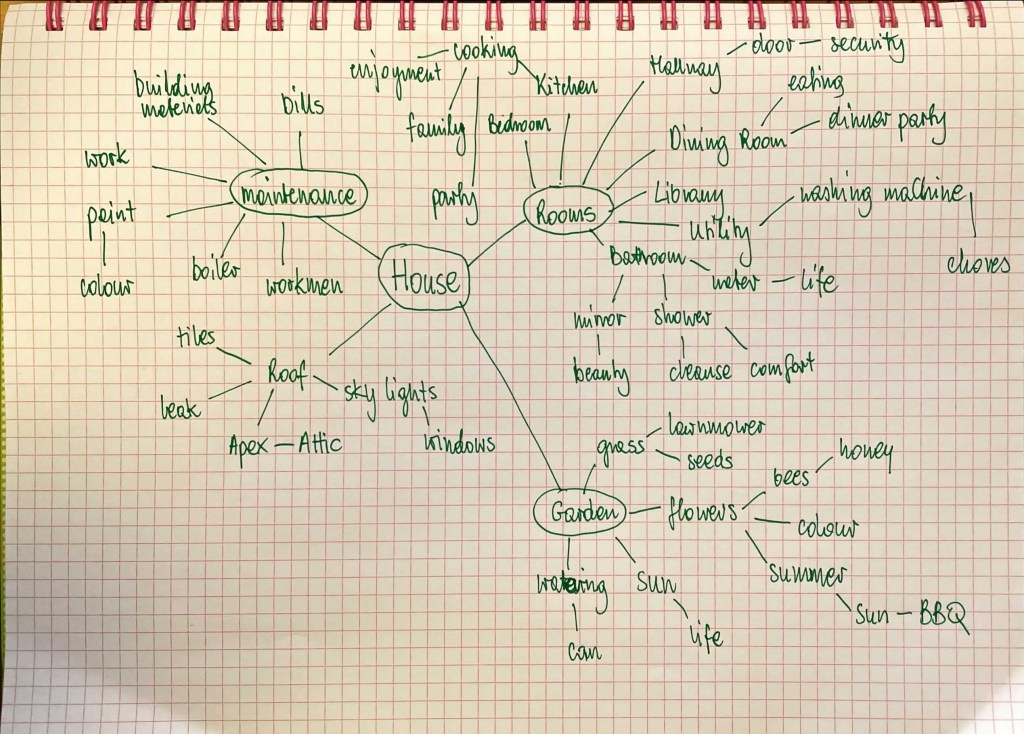
That was quite an unexpected exercise. To ‘create’ a person. At first, I created three mind maps to help me organise my ideas. Once I came up with those ‘facts’ about Hannah, I just typed it all out in the matter of minutes. It was very easy. I wonder if creative writers also draw mind maps to help them organise their ideas before sitting down to writing. It definitely helped me!

Fig 1 Now
Fig. 2 History
Fig. 3 Aims

List of illustrations:

Fig. 1 Shuttleworth, A. (2021) Now. [Digital MindMap] In possession of: the author: Epsom.

Fig. 2 Shuttleworth, A. (2021) History. [Digital MindMap] In possession of: the author: Epsom.

Fig. 3 Shuttleworth, A. (2021) Aims. [Digital MindMap] In possession of: the author: Epsom.

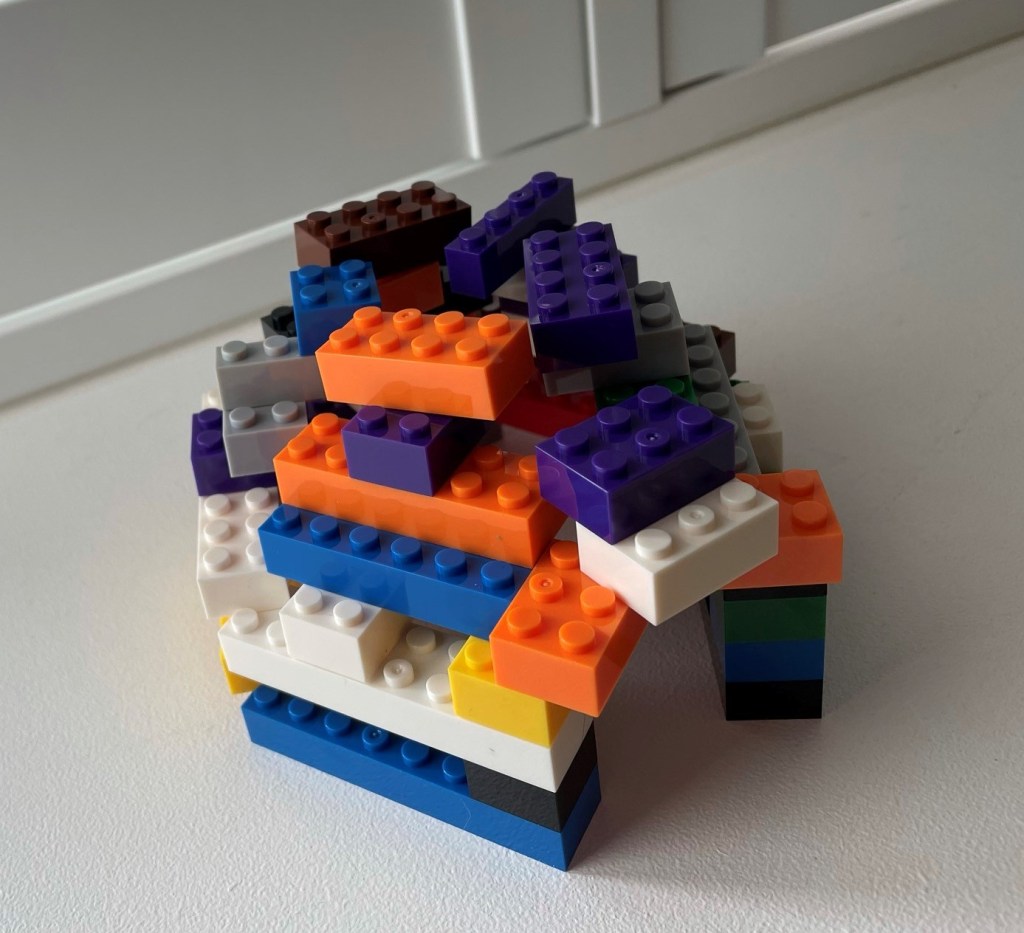
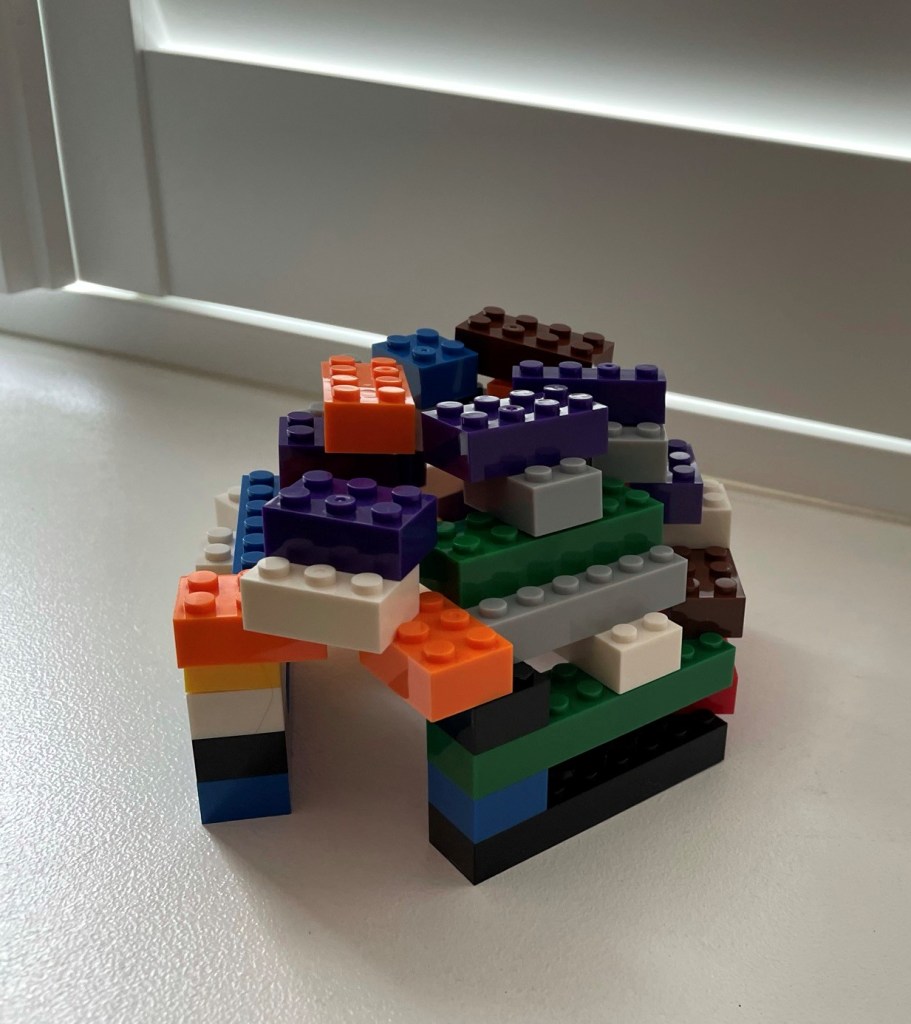
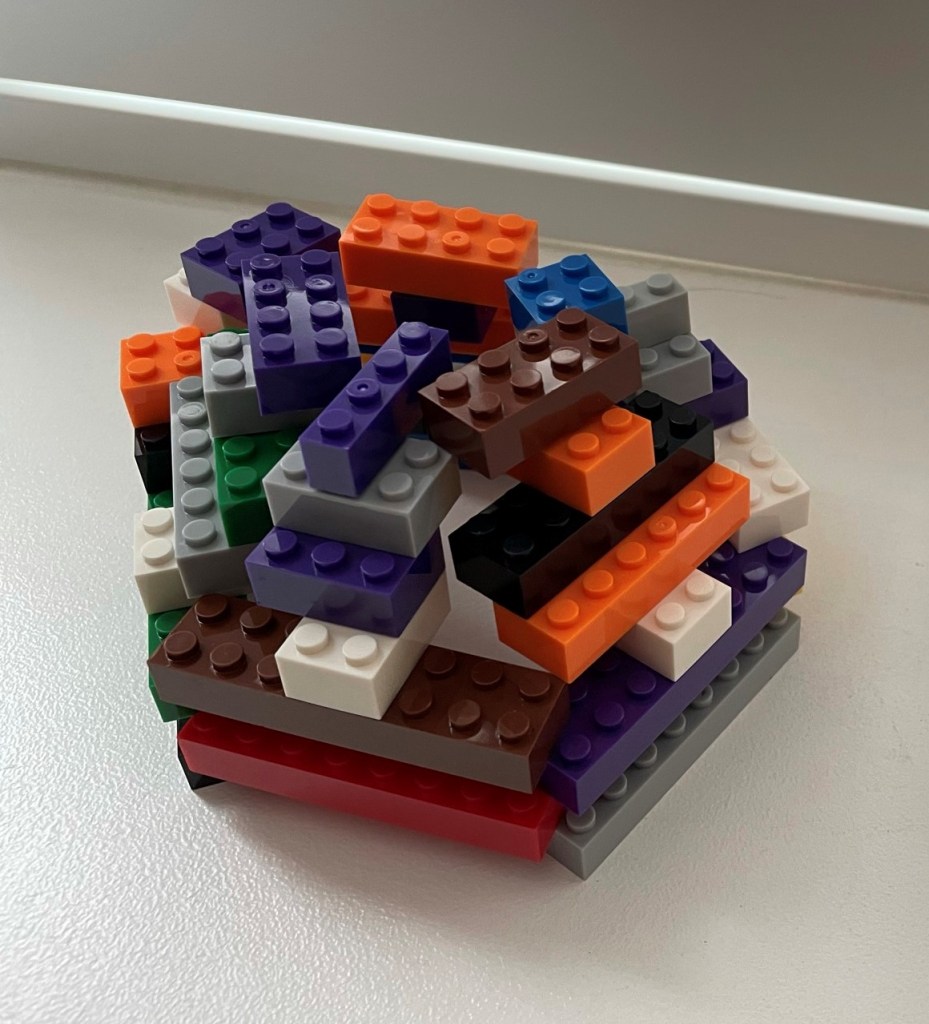
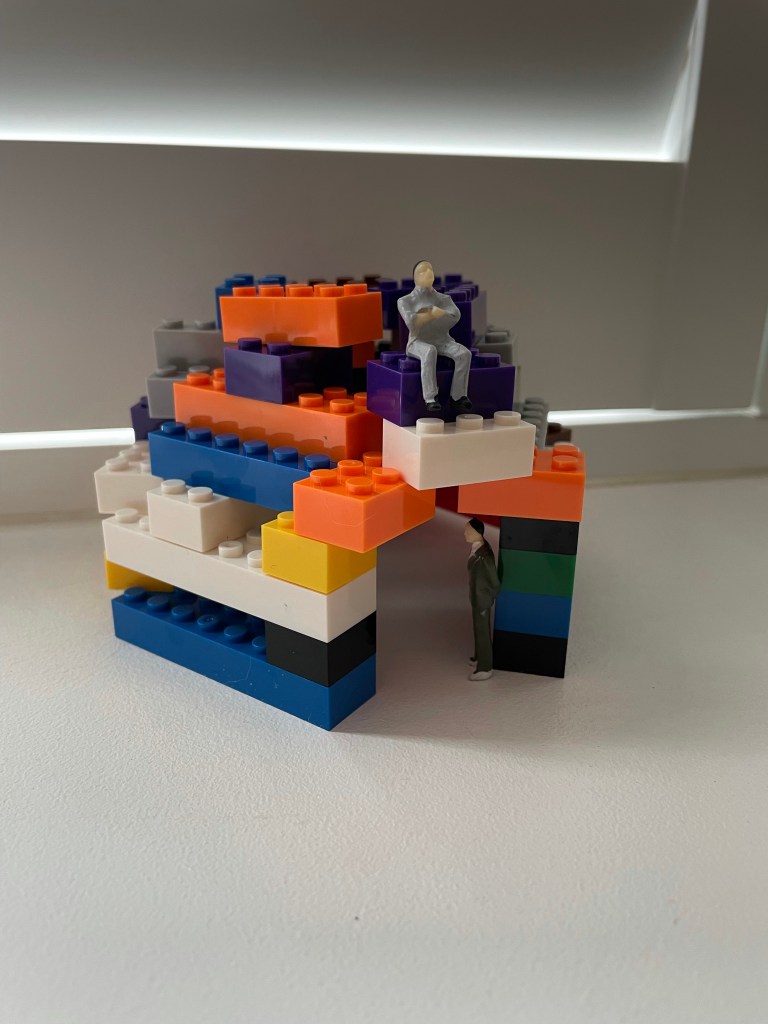
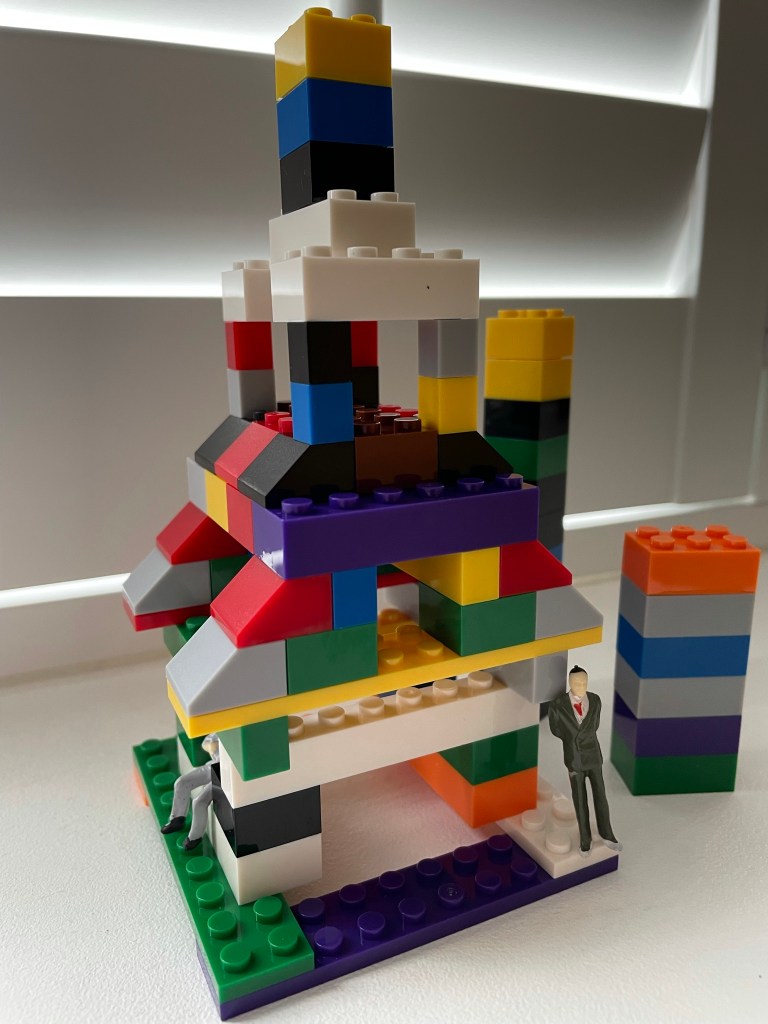
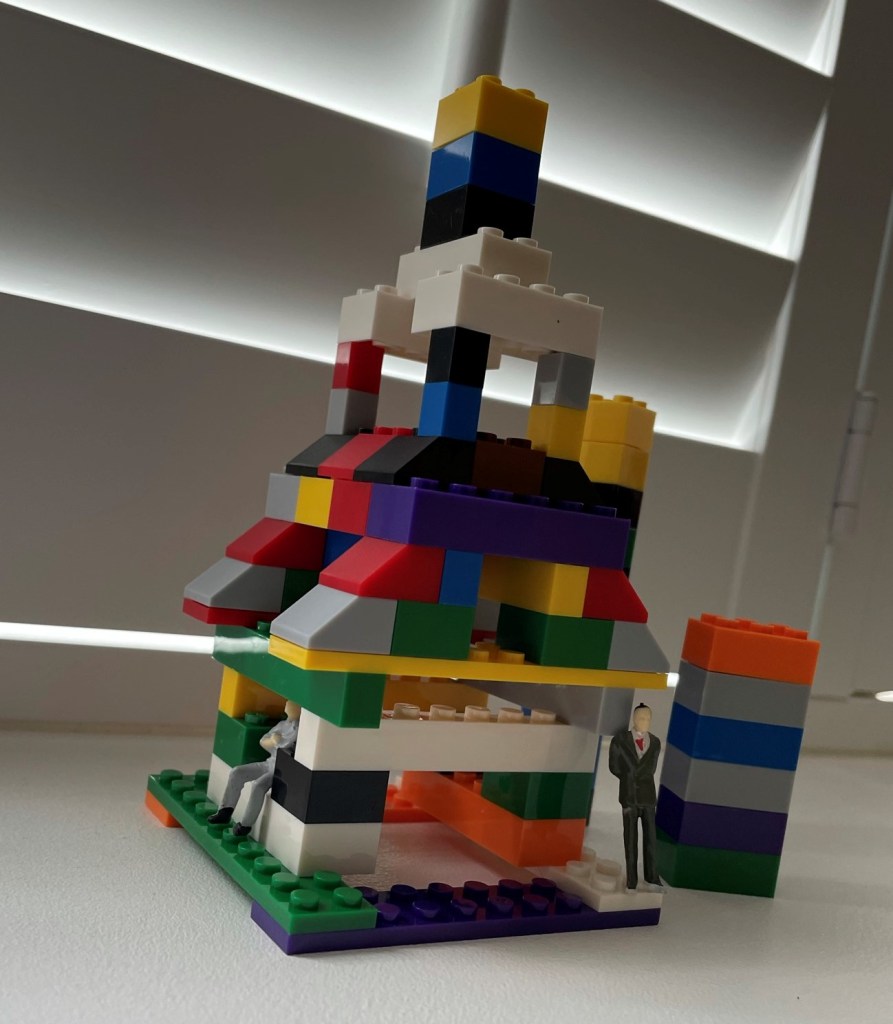
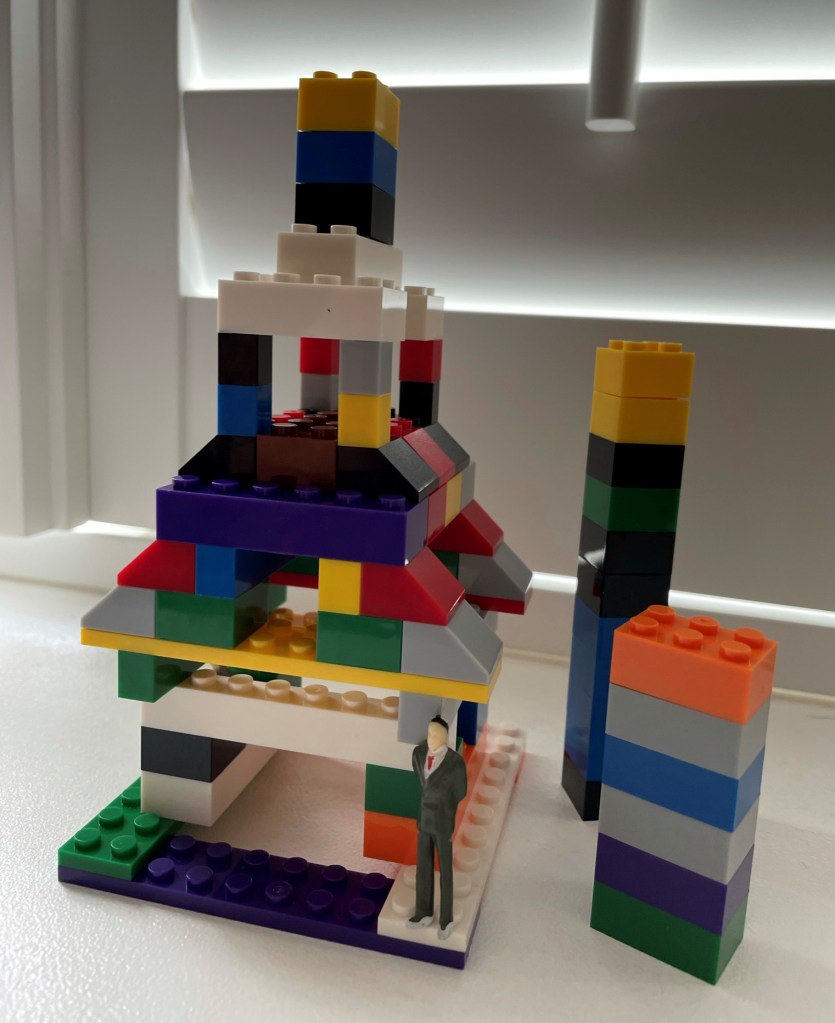
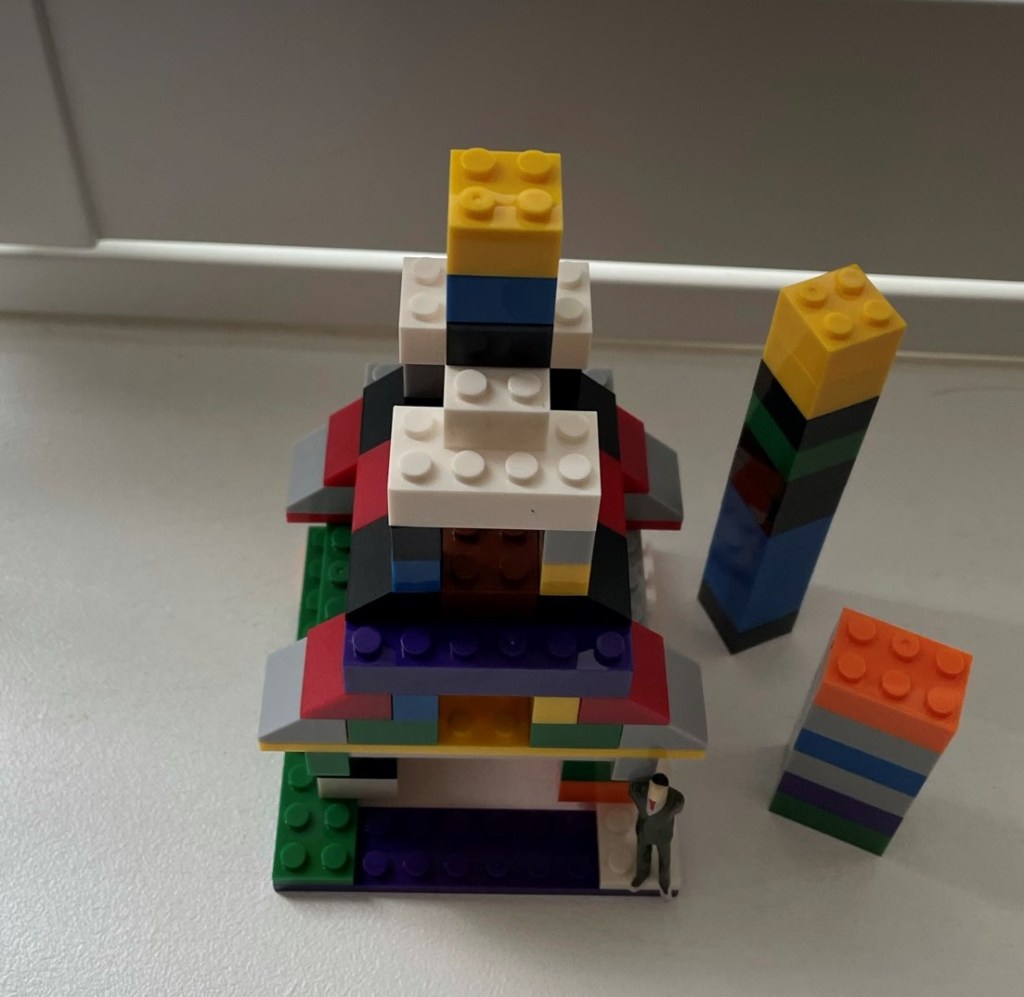
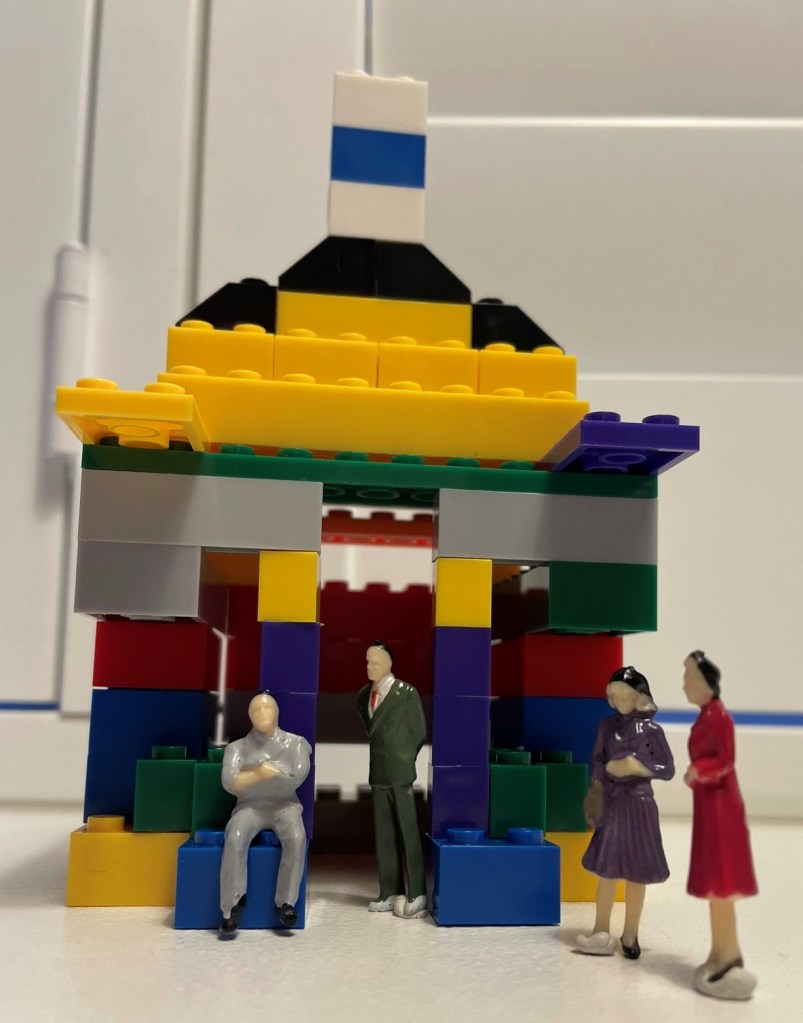
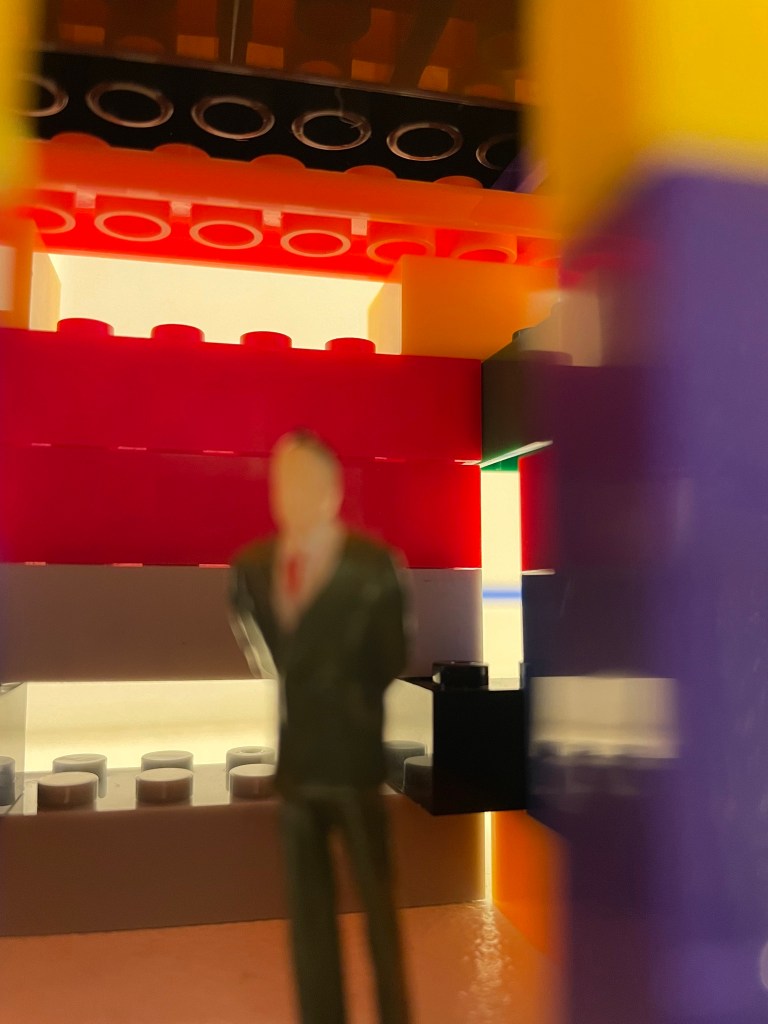
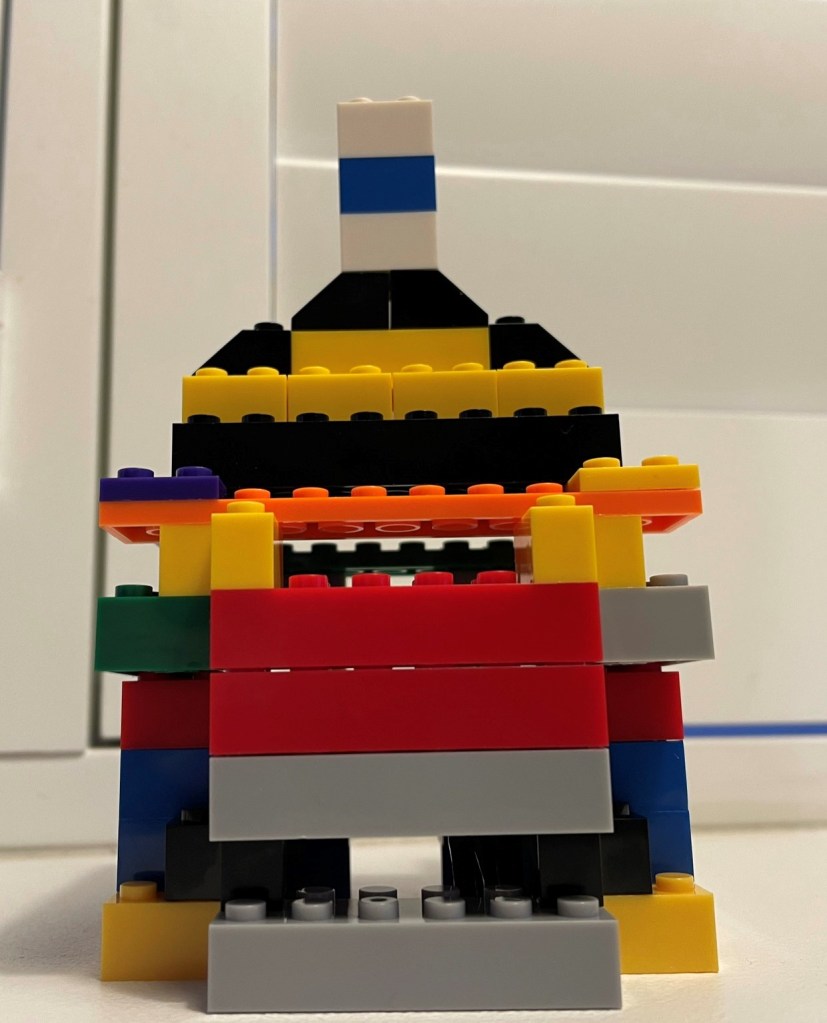
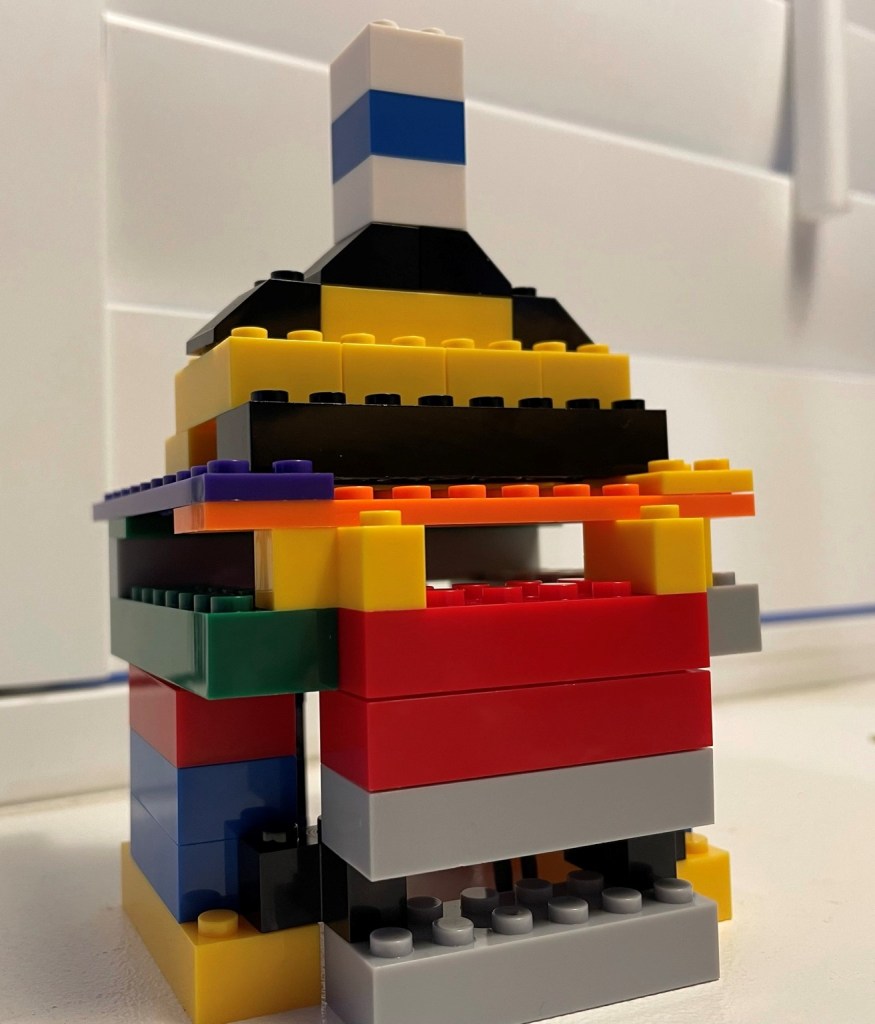
Unit 2, Part 1, Exercise 4: Serious Play

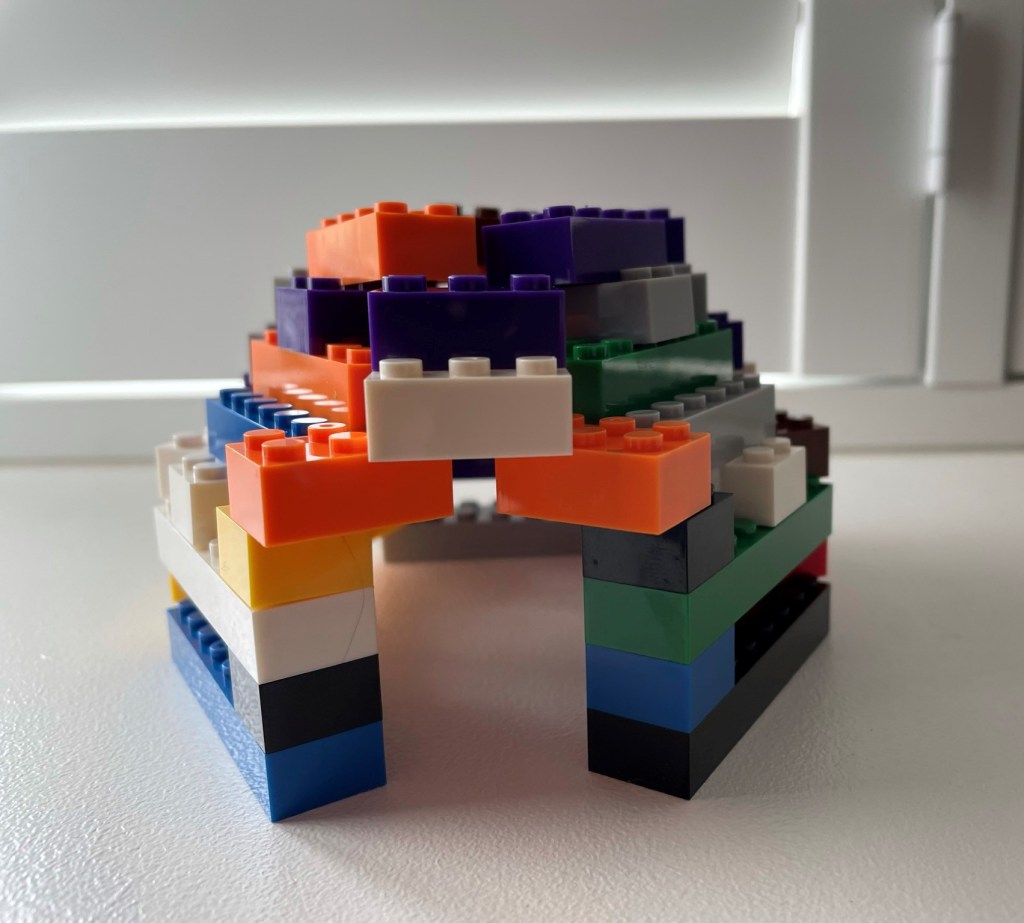
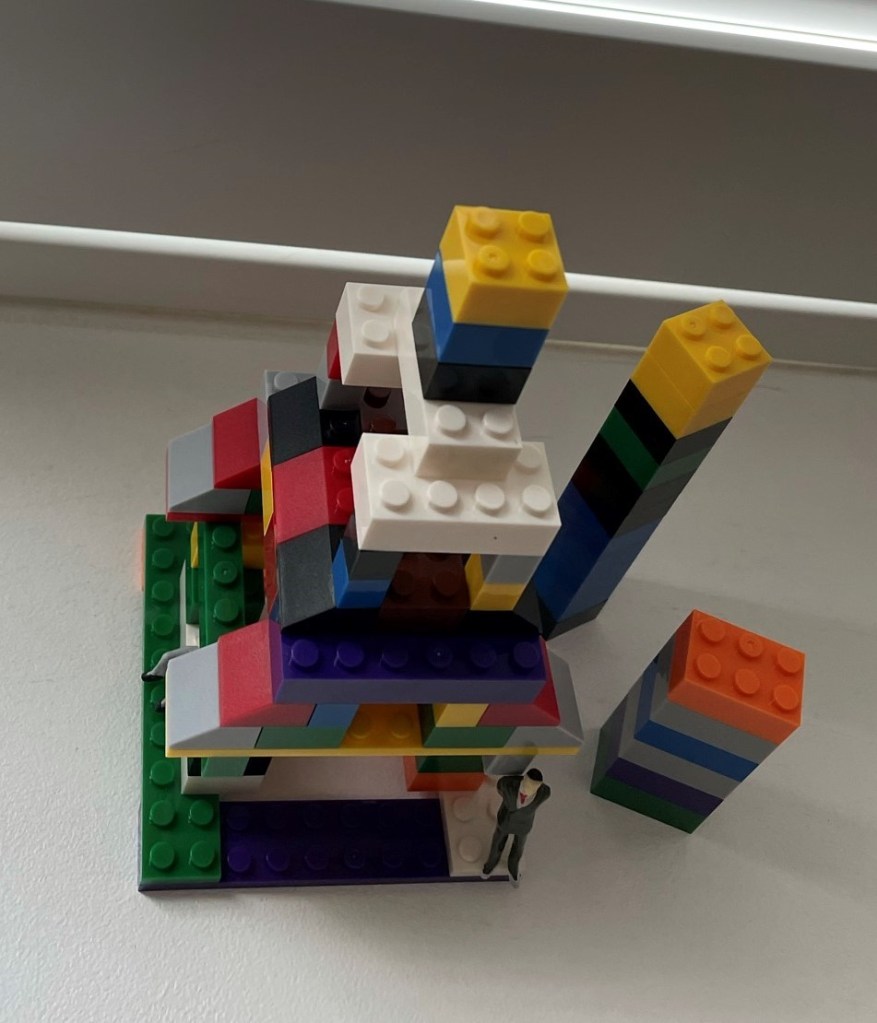
Model 1:

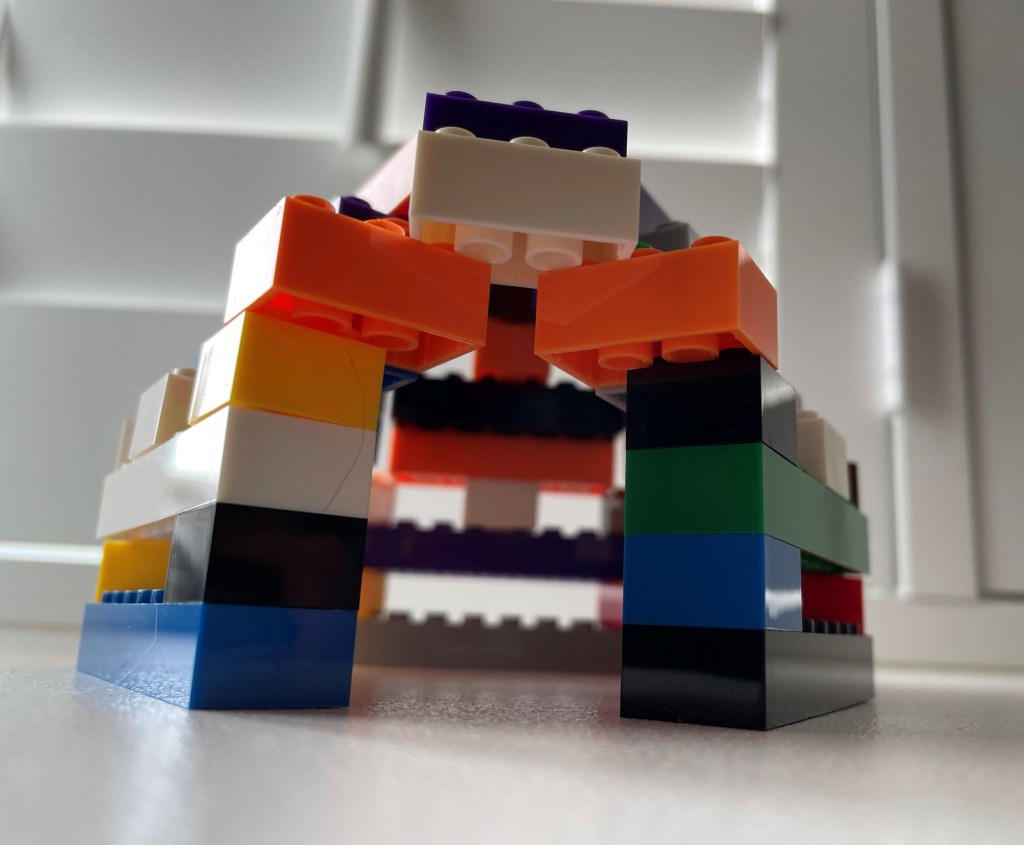
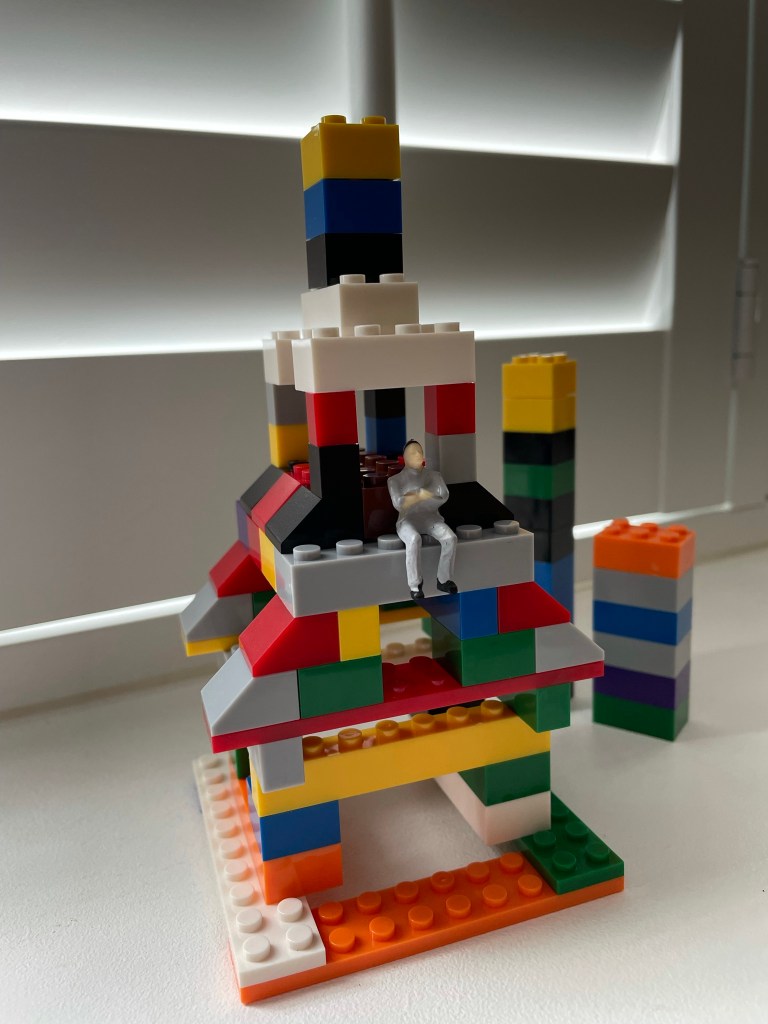
Model 2:

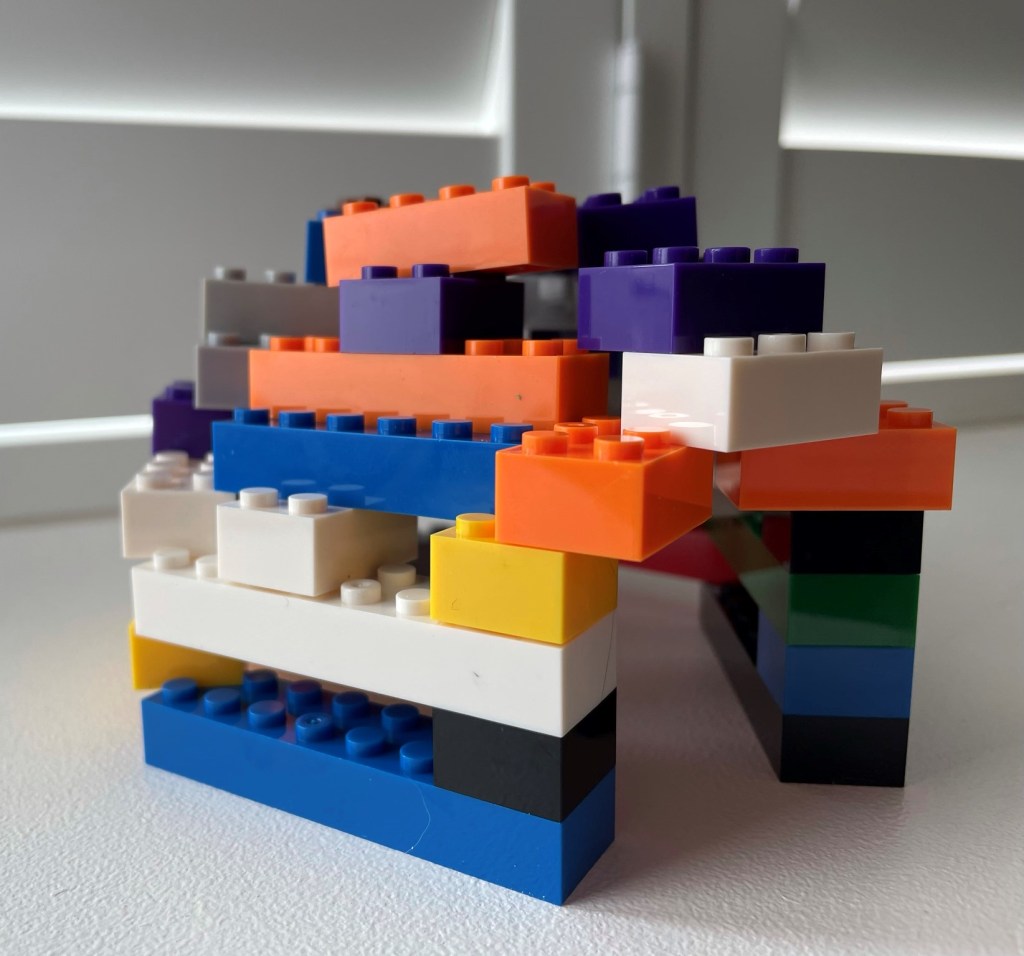
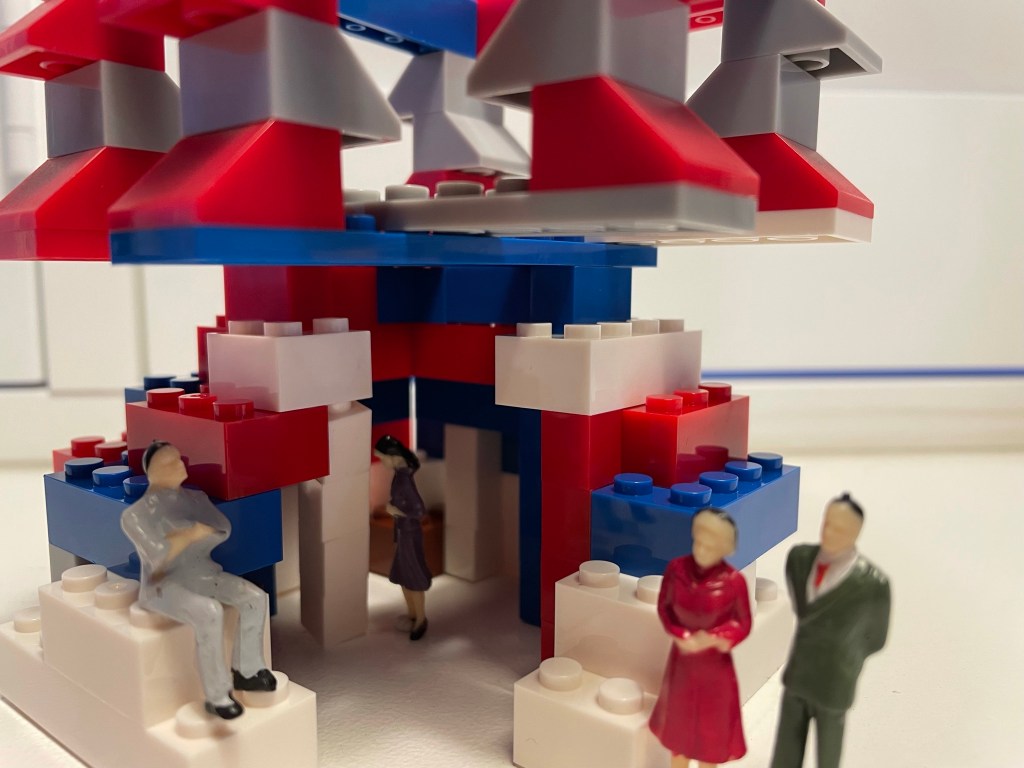
Model 3:

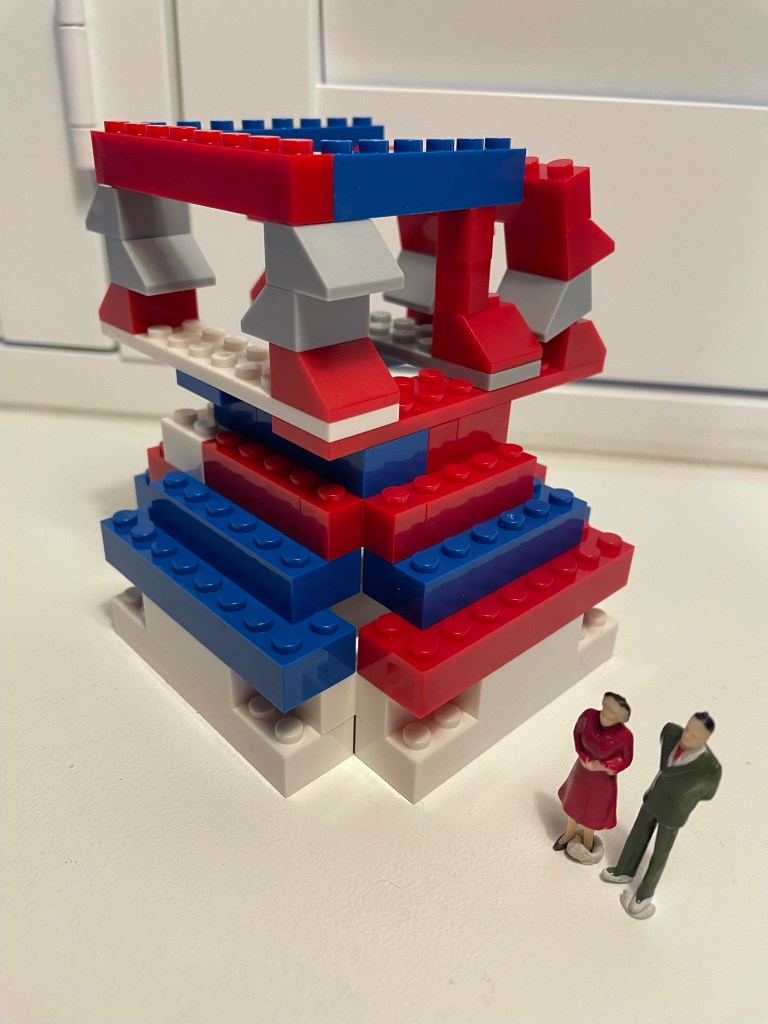
Model 4:

Reflection on the task:

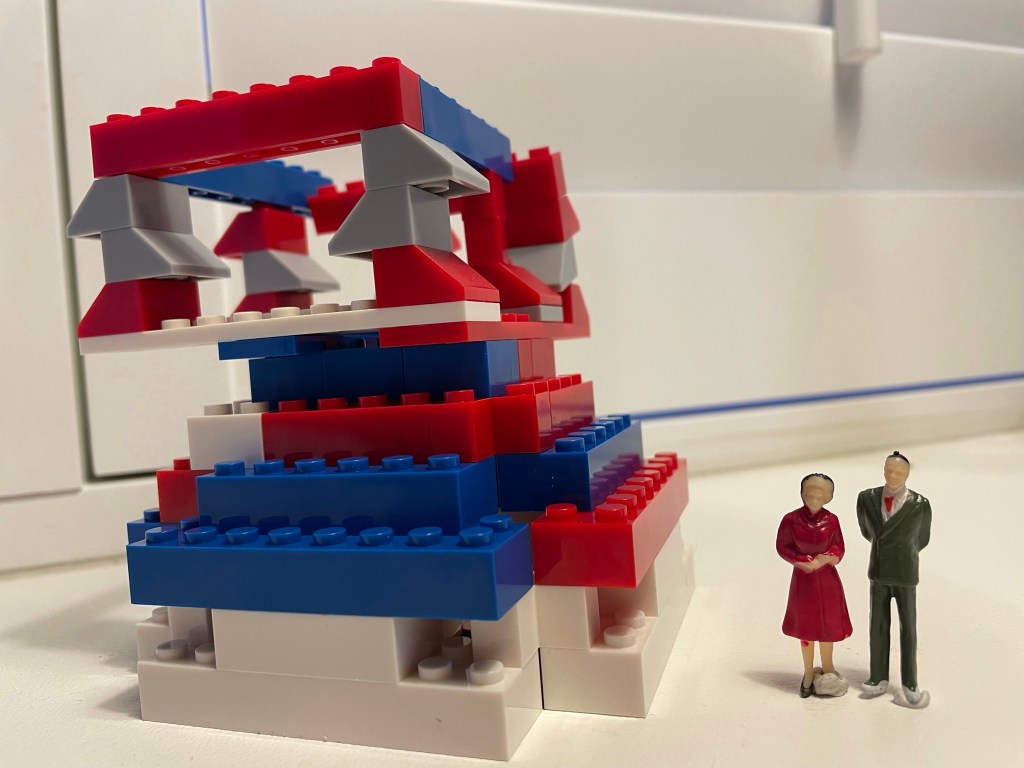
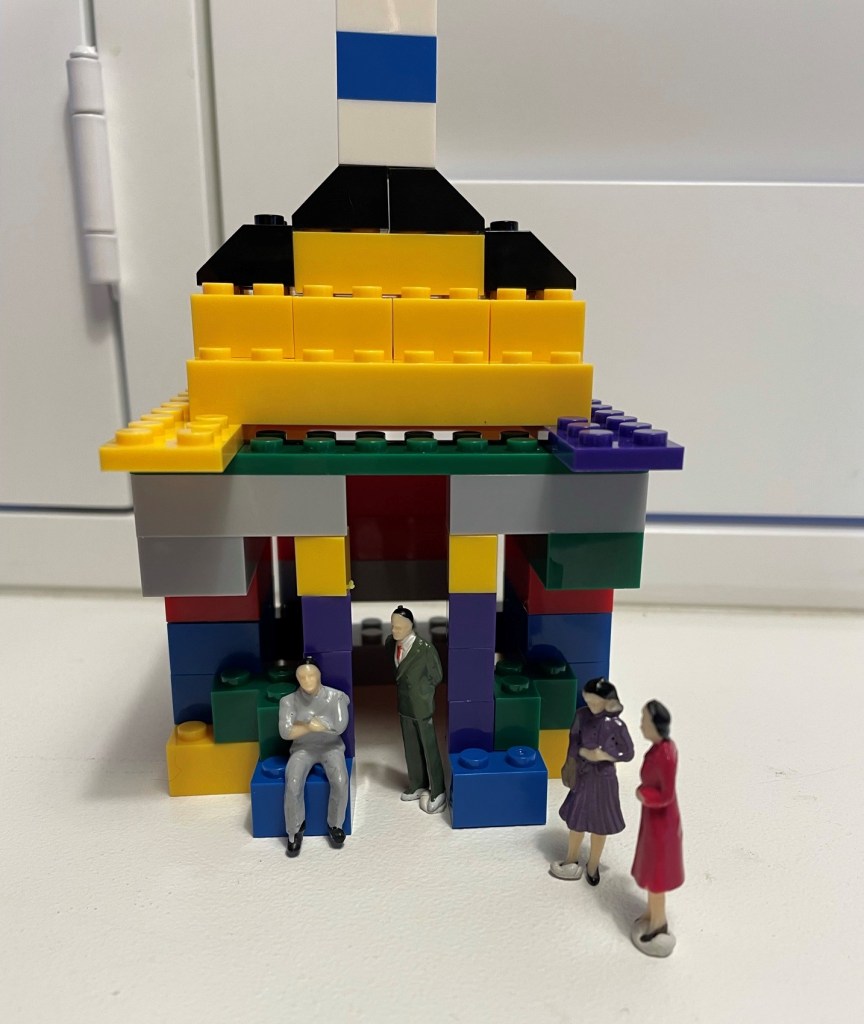
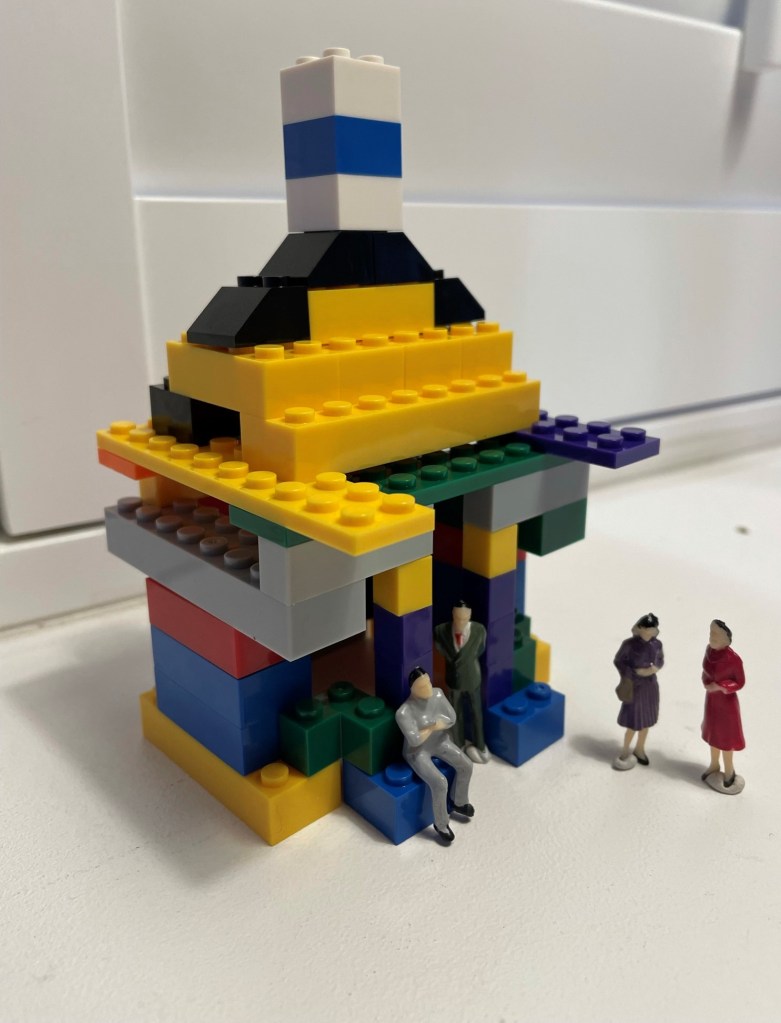
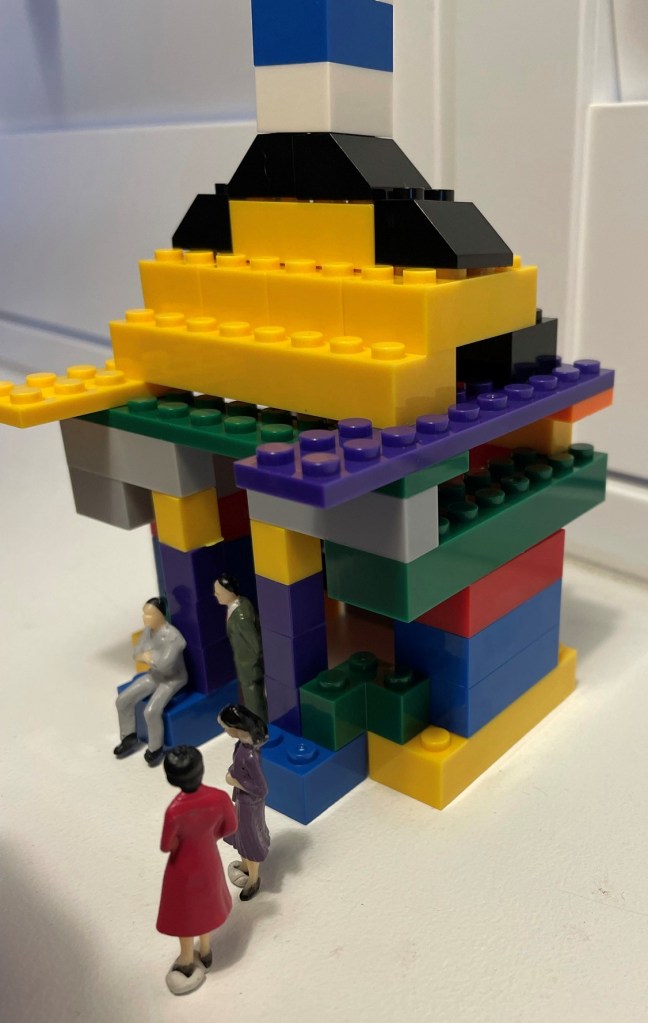
I had some lego blocks so finding the material was easy. For the people I used some figures in scale 1:50 (I got them during unit 1 work). There was not a process as such apart from a bit of thinking and planning how to proceed with first layer layout. Then I just went with a flow, seeing what blocks I could put next for the design to work. I tried to make model 4 looking less chaotic by grouping the colours together, where possible

Model 1 and 2 are little ‘chaotic’ as I did them before I organised my lego blocks by size, after wich I built model 3 and 4.

At first I did not like model 1 at all, but now I really like its irregular mass. Model one could be an outdoor piece of art / place to hang out, but could also be a very interesting looking house.

Model 2 could also be a building or perhaps just a piece of art, but I am yet to come with a purpose. I have a feeling people could not sit on the ledges in a way my figure does – health and safety would never allow it.

Model 3 could be structure with elevated viewpoints on the ‘balconies’.

Model 4 could be a tiny house, a pavilion, a kiosk or a shed.

Research Task: Charles and Ray Eames.

Research Task: Charles and Ray Eames.

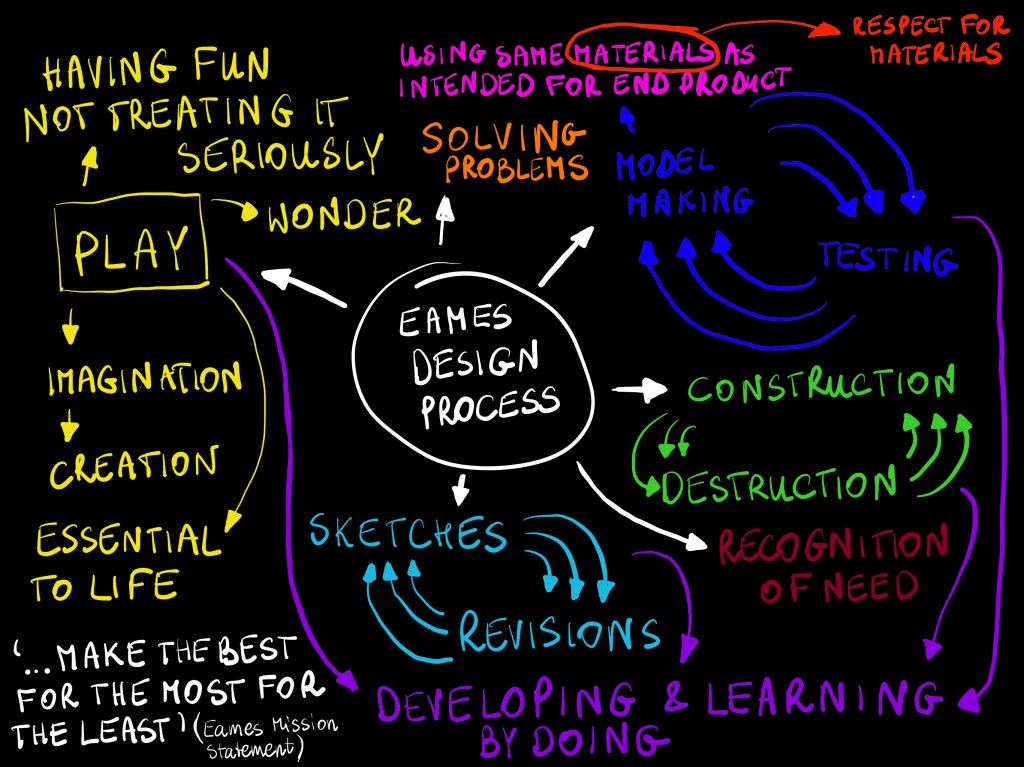
Fig. 1 Eames Design Process Mind Map

Charles and Ray Eames were a married couple who started working together in 1941 and revolutionised American interiors with their practical and playful designs. Charles trained as an architect and Ray as a painter, but the scope of their work went far beyond their professional training. They were always working as a team, Charles often creating the design and Ray embellishing it, making it attractive. They were active in the chauvinist era and Charles always made sure he recognised his wife’s input and stressed how the designs were the work of both, not just his. Their process involved repetitions of many steps, going backwards and forwards until the solution was found. Their mission statement said, ‘We want to make the best for the most for the least.’ It sums up they wanted to deliver quality, affordable, mass produced goods, that anyone can have.

Play was an important part of their processes. They must have realised that letting go and just playing let their creative juices flow.

In the Design Q&A Interview Charles Eames described their design process as solution to problems, response to the need. He also mentions drawing on precedent work as necessary tool. He considered design usually to be a result of group work.

I admire them and their work, the whole story of their lives, how they first came to establish the Eames Office (funds came from government contract – they solved a problem for the army during WW2 by designing plywood splints that were lighter than metal and didn’t use this valuable during conflict years material), how they worked together and how through play and hard work created so many iconic pieces.

I think the important part in all this for me is the realisation how important the ‘play’ in design is and to get lost in the ‘play’ tasks coming up. Also, to recognise the need and then repeat the design process steps as many times as necessary, until it works and the problem has been solved.

List Of Illustrations:

Fig. 1 Shuttleworth, A (2021) Eames Design Process Mind Map. [Digital Drawing / Mind Map] In possession of: the author: Epsom.

Ostroff, D. (2016) ‘Why did Charles and Ray Eames Make Models’ At: Why Did Charles and Ray Eames Make Models | Eames Office (Accessed 04/07/2021)

 ‘The Eames Creative Process’ (2016) [Online video] At: The Eames Creative Process – YouTube (Accessed 04/07/2021)

Cook, W. (2017) ‘Charles and Ray Eames: The couple who shaped the way we live.’ In: BBC Culture 18/12/2017. At: Charles and Ray Eames: The couple who shaped the way we live – BBC Culture (Accessed 04/07/2021)

Sorene, P. (2017) Charles Eames’ 30 Answers To ‘What Is Design?’ (1969). At: Charles Eames’ 30 Answers To ‘What Is Design?’ (1969) – Flashbak (Accessed 04/07/2021)

‘Design Q & A with Charles Eames’ (2011) [Online video] At: Design Q & A with Charles Eames – YouTube (Accessed 04/07/2021)

Exercise 3: Repeating the process

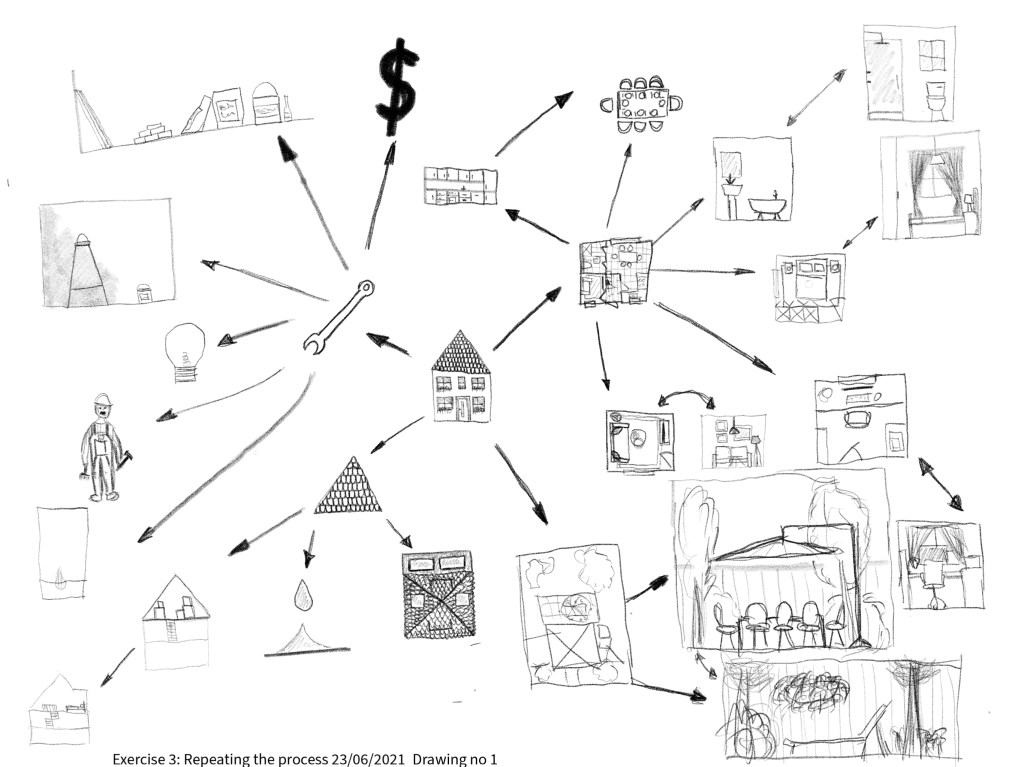
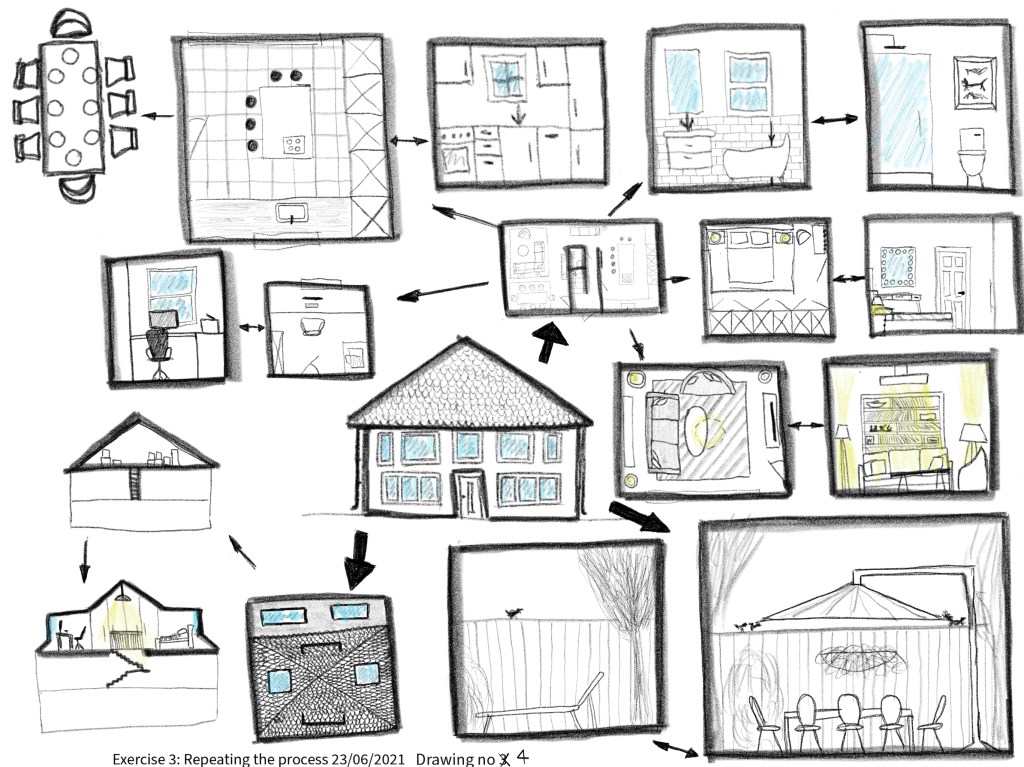
I explored the idea of a house.

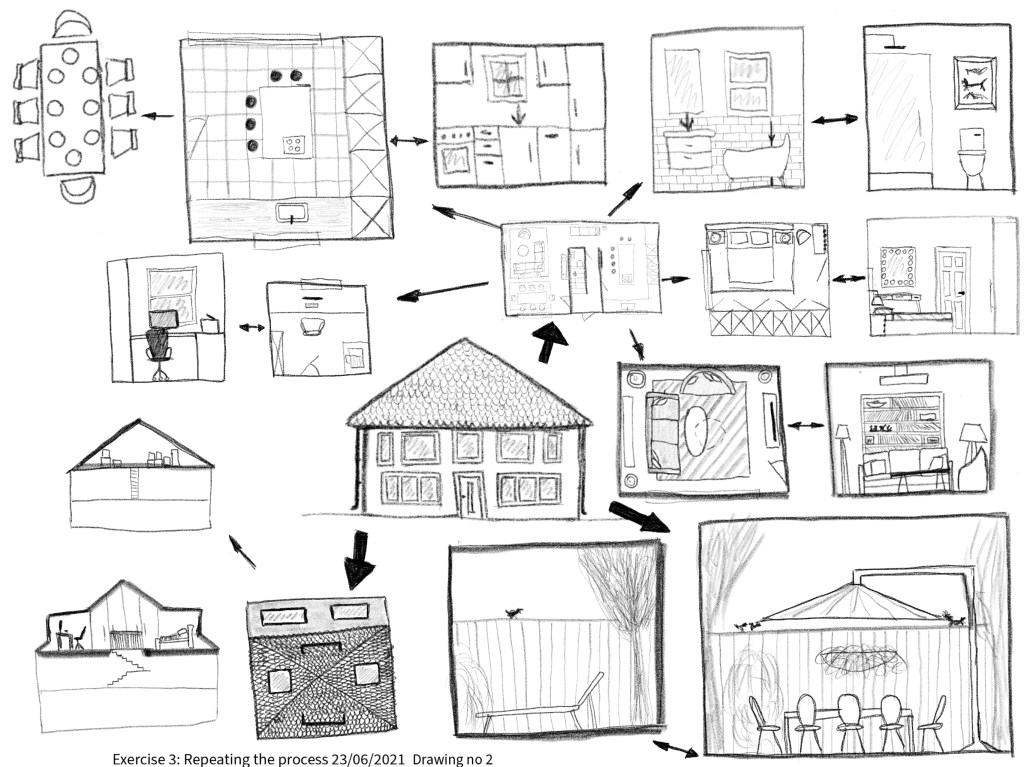
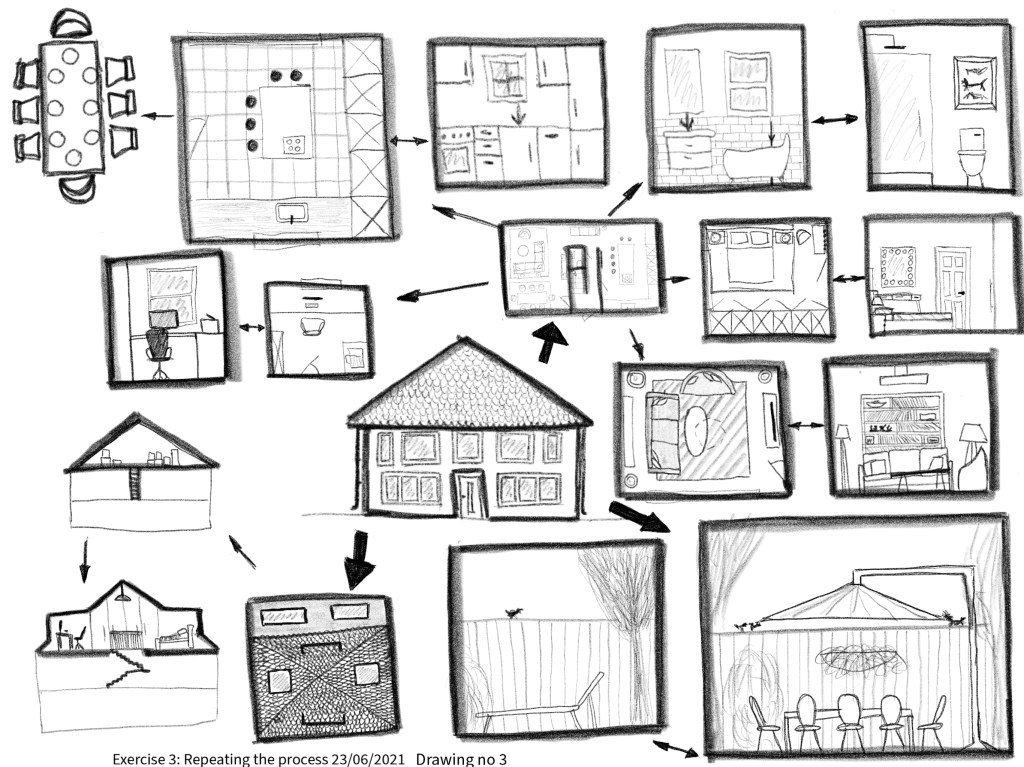
In Drawing 1 I tried to explore all aspects I included in my written mind map, including even the maintenance. In Drawing 2 I decided to concentrate on spaces, I was happy with my drawings. However, I decided to make the whole arrangement more uniform by drawing thicker frames around my spaces.

It was a good practice of quick sketching of ideas in plan and elevation. I enjoyed ‘fine-tuning’ my mini drawings with details such as tiles, floor surfaces or wooden kitchen counter surface. I think I starting to get the wood texture in drawings.

As I was about to upload this post, I decided I wanted to mark sources of light with yellow, and highlight windows, mirrors, and glass with blue colour. I think the whole arrangement looks more ‘alive’ with these small splashes of colour here and there…

Fig. 4 Repeating the process, Drawing no 4

List of illustrations:

Fig. 1 Shuttleworth, A. (2021) Repeating the process, Drawing no 1. [Digital Drawing] In possession of: the author: Epsom.

Fig. 2 Shuttleworth, A. (2021) Repeating the process, Drawing no 2. [Digital Drawing] In possession of: the author: Epsom.

Fig. 3 Shuttleworth, A. (2021) Repeating the process, Drawing no 3. [Digital Drawing] In possession of: the author: Epsom.

Fig. 4 Shuttleworth, A. (2021) Repeating the process, Drawing no 4. [Digital Drawing] In possession of: the author: Epsom.

Exercise 1: What is your creative or design process?

Exercise 1: What is your creative or design process?

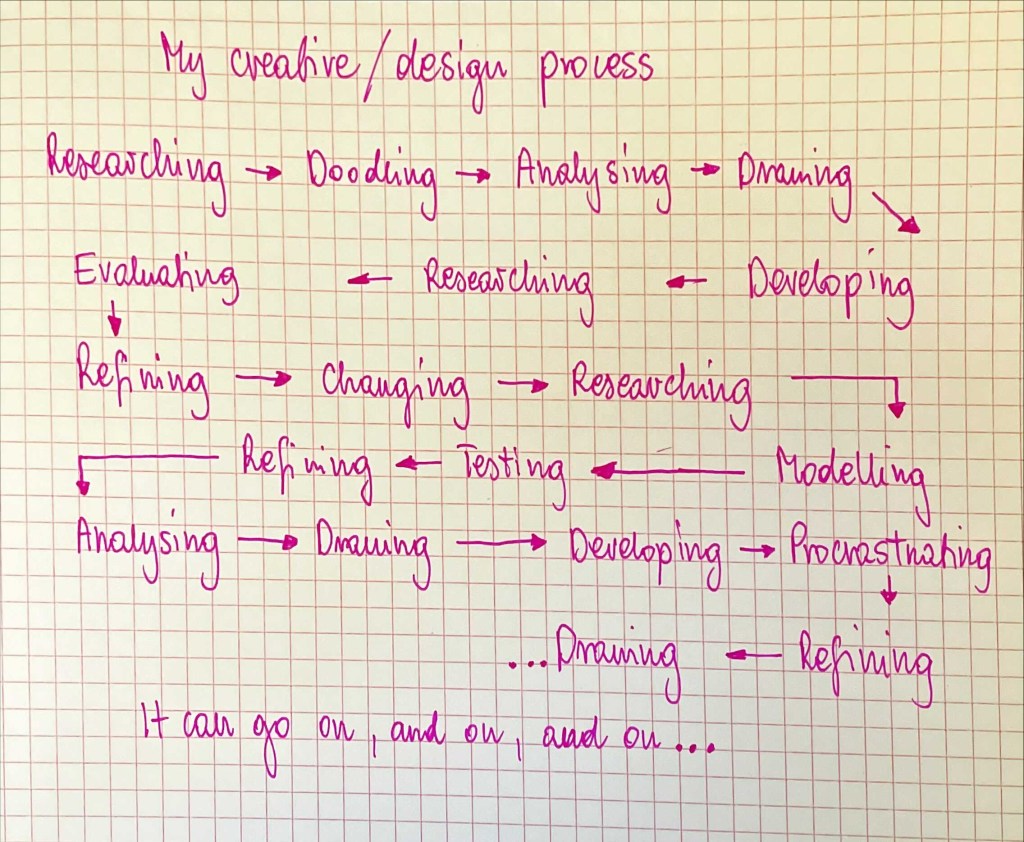
It is really hard to get the process written down since I haven’t been through a creative process much yet.

It is a linear process, but it goes back to certain tasks, many of them are repeated multiple times. I believe it would be an infinite process if not for a deadline. Also, I think the process can change depending on the project, if I have done something using similar materials, or same area, type of building then I would add drawing from my own work there too… The most important in my opinion fact is that you go back to previous tasks as needed, sometimes you need to take a step backwards to be able to move forward…

It is really hard to get the process written down since I haven’t been through a creative process much yet.

It is a linear process, but it goes back to certain tasks, many of them are repeated multiple times. I believe it would be an infinite process if not for a deadline. Also, I think the process can change depending on the project, if I have done something using similar materials, or same area, type of building then I would add drawing from my own work there too… The most important in my opinion fact is that you go back to previous tasks as needed, sometimes you need to take a step backwards to be able to move forward…

Design a site like this with WordPress.com
Get started