Drawing on the methods and processes learnt throughout Parts 1, 2 and 3, make
or write your own Spatial Design Manifesto to be used throughout the rest of this
unit.
Develop your manifesto to celebrate and visually present your position on an
issue related to spatial or interior design. Present it to reflect your position. For
example, you may want to explore the enjoyment of playful spatial design, the
importance of functionality through the material choices you make or
demonstrate your position by presenting examples of design you think are
unsuitable, ugly or dull.
Use your manifesto to say what key elements of interior design you find good,
interesting, bad or beautiful – and why. You may want to use quotes from other
artists or designers as part of your manifesto.
Reflect on your own experience as an occupant-of-interior-space. What kinds of
spaces do you enjoy and how do other spatial designers help to support this?
Celebrate these examples of good practice or innovative approaches by
proclaiming what makes for a better spatially designed world!
Use the most appropriate means or medium to do this (written, modelled,
2D/3D, digital, technical or hand drawn) to ensure that your manifesto ideas are
communicated in a coherent, clear and concise manner.
Reflection on the assignment / how did I get there:
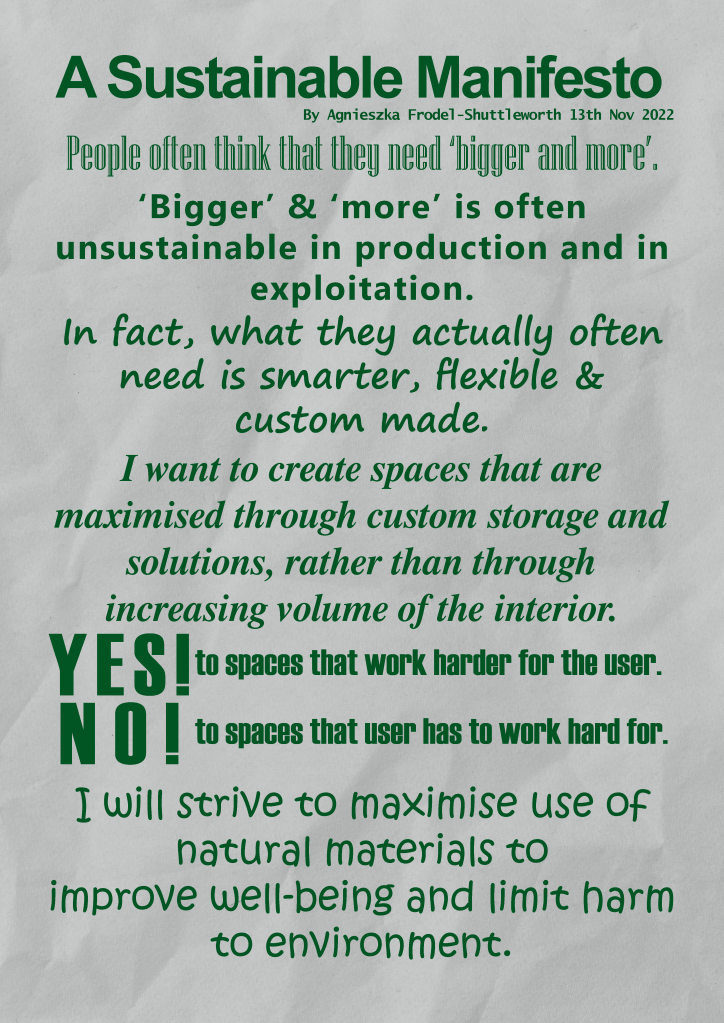
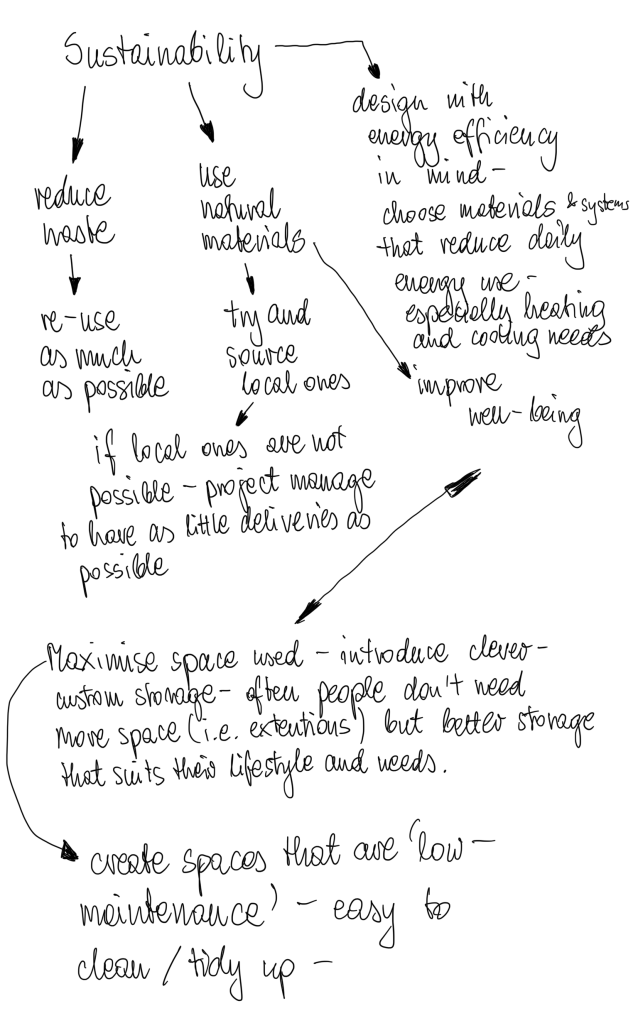
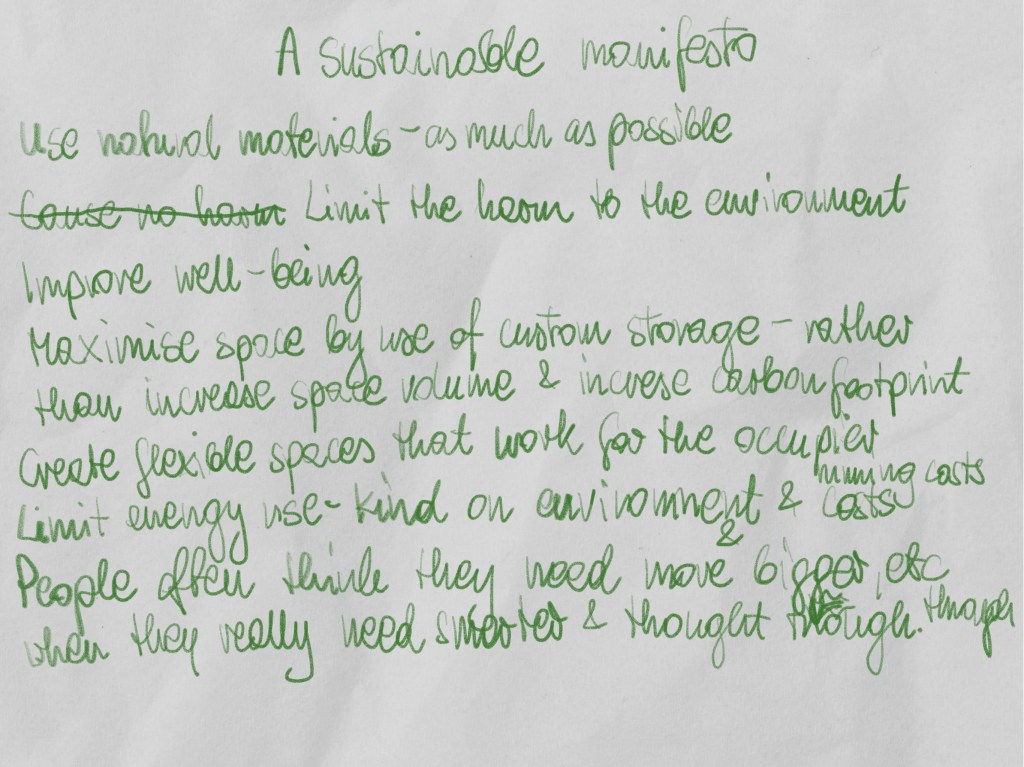
First, I thought long and hard about what is important to me and why. My main interest is in the interiors that have custom designed features, to suit the user needs. Sustainability is equally important to me. I believe that often we don’t need more space – we just need to use what we have wisely. I jotted some notes and then thought about how I can present my ideas. I purposely made my manifesto very concise. I want to get my message across, but I wanted to keep it short and sweet. Our lives are fast paced, and I wanted my manifesto fit in it. To underline the sustainability issue, I created a background of a crumpled piece of paper – one that you might discard otherwise – yet still perfectly usable. I made the text green as that colour is often associated with nature and well-being. I used different fonts for different points to add to the interest. I uploaded the manifesto into the padlet.
Finding the issue for my manifesto was relatively easy, yet it took longer than the hard part of deciding on the look of it.
I wanted my manifesto to look like poster, I think I achieved that goal.
Reflection on the unit as a whole:
I enjoyed most work in this unit. I found all exercises interesting and most importantly informative.
I found it interesting to read about philosophical approach to the idea of a home in research task one, now I am thinking I should actually read the entire books I briefly studied in 1st research task.
Case study: small space of living was just wonderful. I found it really interesting reading about the architect (Peter Barber), the project Holmes Road Studios and the architecture aiding the therapy. Creating the research presentation document also helped me brush up on the InDesign skills once more.
‘Your living space’ and ‘AN Others space’ exercises helped me brush up and improve my site surveying skills. I also chose to draw by hand for this exercise, despite my preferred method being digital – just to practice on paper.
Research into Barbican helped me to practice sifting through vast amounts of material available and selecting the important bits to present. It’s so easy to get lost in the research!
193 Grove Road research – I feel just grateful to learn it. Fascinating story but it was quite hard to find extensive information on what Sydney Gale might have been feeling. Just had to imagine I was in his position. Despite his bruised ego, it’s a shame the artwork was destroyed…
I found researching and analysing manifestos quite hard. Mainly because personally, I find most of them pompous and quite frankly many of them are long and boring… It was helpful to be given specific tasks in regard to the manifesto text –it helped me fleece out the relevant information out of it. I was pleased I chose Roberto Venturis ‘Non-straight forward manifesto’. Such a joy to find that signature with a shape of a house he designed in the past. It was also useful to just analyse his manifesto in bullet points.
It was a bit harder to draw it. Took me a while to come up with a concept but once it popped in my head, I knew what to do and had it ready in a matter of minutes.
Finding the right contemporary manifesto to analyse took a little bit of searching. Luckily, I came across Dezeen 15 Festival where 15 artists / designers wrote special manifestos for the occasion. I chose ‘Swap card for trees’ by Es Devlin’s the easiest to read and understand. Manifestos should be able to reach the reader rather than just exist for the benefit of its creator. It was also just nice to dream about what the future could look like. This text really spoke to me, I keep thinking about it – hope it comes true soon!
Jimmy Caunty and his ‘Riot in a jam jar’ was quite a hard story to research. There is a lot of information about him but not a lot about the exhibition. I even watched some music videos from his music career, and oh boy – some of them are something else. (The KLF – What Time Is Love? (Live at Trancentral) (Official Video) – YouTube )
Mind maps were invaluable in helping me to create my own manifesto.
Great part, enjoyed the work in part three very much!
 Aggie's interior design journey