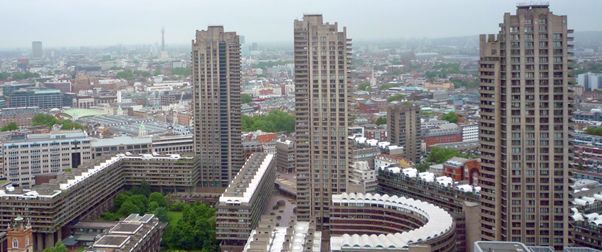
Brutalist in style, composing mainly of concrete and glass; Barbican estate has been built on a site that has suffered catastrophic bombing during WW2. Previously busy market area has had its community decimated with just a handful remaining there after the war. The site has been left derelict. A decision has been made to bring the community and life back into the area by changing the function of the space from commercial to residential with all amenities. There was a notion of the area becoming a factory city, rather than a place for living. Between 1971 and 1982 twenty-one residential blocks containing over two thousand flats were built along with schools, arts centre, shops and so on. The architects were Chamberlin, Powell and Bonn. They carefully thought of designing a place that is crowded, but at the same time gives you air. They introduced a large pond that reflects the sky and gives an air of space. The whole area is raised above traffic, so it is relatively tranquil for a central London location, the lake and green spaces aid that feeling. The designers took care to ensure all flats get at least some sunshine for at least portion of the day.
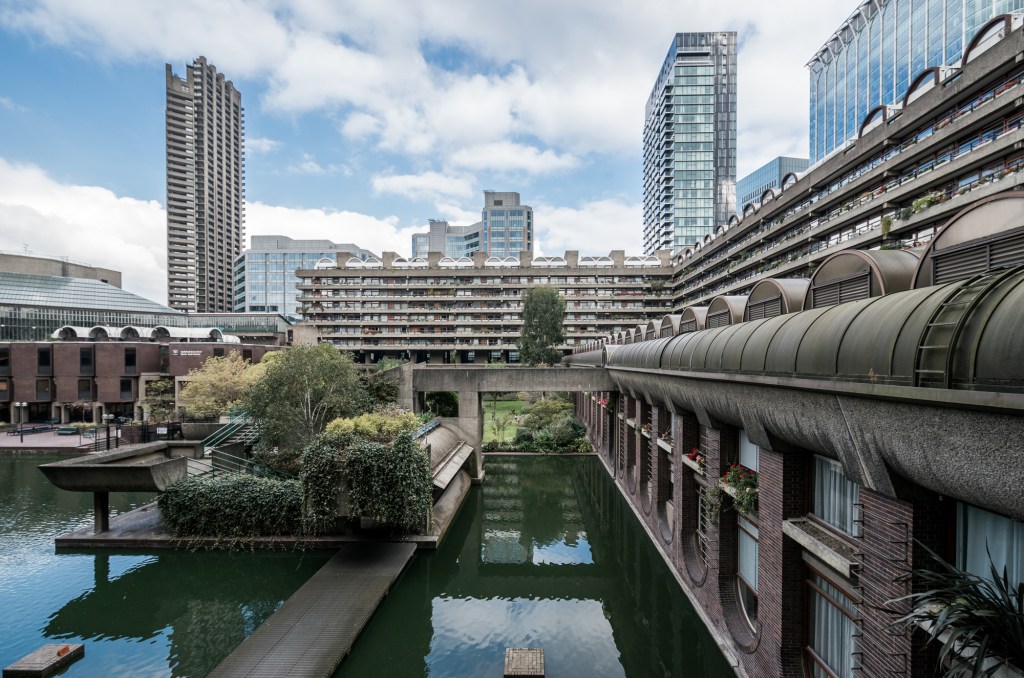
The care was taken during the building, ensuring no shortcuts or cheap substitutes were used, as opposed to similar developments built prior and afterwards in the UK.
The estate was intended for rental, but it was aimed at more ‘upmarket’ tenants – the rent was to be more expensive. Interestingly that Barbican has not suffered a plague of crime like other housing estates did.
The flats were designed so the utility areas such as kitchens and bathrooms were deeper in the building and living areas were closer to the windows therefore brighter.
There were spaces designed for families, couples and single people.
I looked at some flats available for sale in the estate and all that I looked at had a balcony and large windows letting plenty of light in.
Some of the flats, especially the ones located high in the towers have magnificent, far-reaching views of London.
I cannot imagine what a mammoth task it must have been, designing such a grand estate in every detail, without a CAD program, especially I can imagine much of the design of the flats was copy and paste, they layouts seem are quite repetitive.
The estate has been grade II listed in 2001, in 2003 it has been voted the ugliest building in Britain (in a poll organised to launch London Design Festival). It seems as British as marmite – you either love it or hate it.
List of illustrations:
Fig. 1 Rudquist, C (n.d.) Barbican Aerial View. [Photograph] At: https://barbicanlife.com/wp-content/uploads/2016/06/Flatwatch-intro-image.jpg (Accessed 07/06/2022)
Fig. 2 Lulko, M. (2018) The Barbican. [Photograph] At: https://live.staticflickr.com/1766/42795703934_9a23a9ca55_k.jpg (Accessed 07/06/2022)
References:
City Of London Corporation (2020) Barbican Estate history. At: https://www.cityoflondon.gov.uk/services/barbican-estate/barbican-estate-history (Accessed 07/06/2022)
Gray, H (2019) The Barbican at 50 – BBC London News. At: https://www.youtube.com/watch?v=B9ybWuOQ7K4 (Accessed 07/06/2022)
Hazzard, J. (2022) The Barbican in Brief. At: https://www.youtube.com/watch?v=Dp-v9W_Iygg (Accessed 07/06/2022)
London Metropolitan Archives (2012) Barbican, 1969: The development of the Barbican Estate following World War II. At: https://www.youtube.com/watch?v=vLPlJsoVq8k&t=2s (Accessed 07/06/2022)
Montcalm (2018) History of The Barbican Centre. At: https://www.montcalmroyallondoncity.co.uk/blog/history-barbican-centre/#:~:text=The%20name,shops%2C%20traders%20and%20market%20stalls. (Accessed 07/06/2022)
 Aggie's interior design journey

