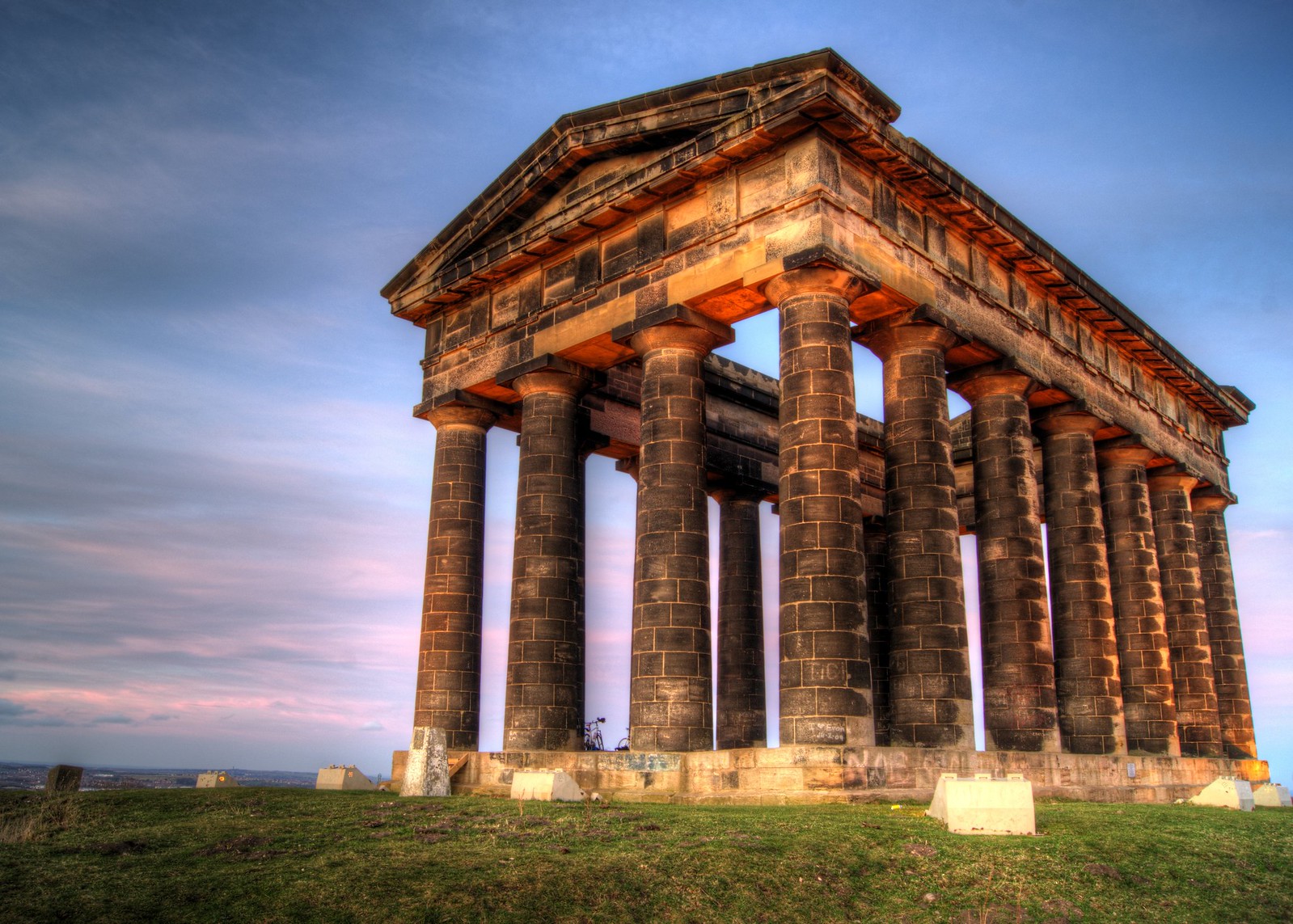
Follies are buildings with no true purpose, apart from pleasure. Traditionally they were garden structures built in English gardens and estates, imitating ruins, or historic buildings. They were supposed to enhance scenery. They were particularly popular in England in the 8th and 19th centuries and were usually inspired by classical ruins and structures seen during estate owners travels to Greece and Italy. Usually they were not very big, but I found a particular example that is rather large and visible from far away.
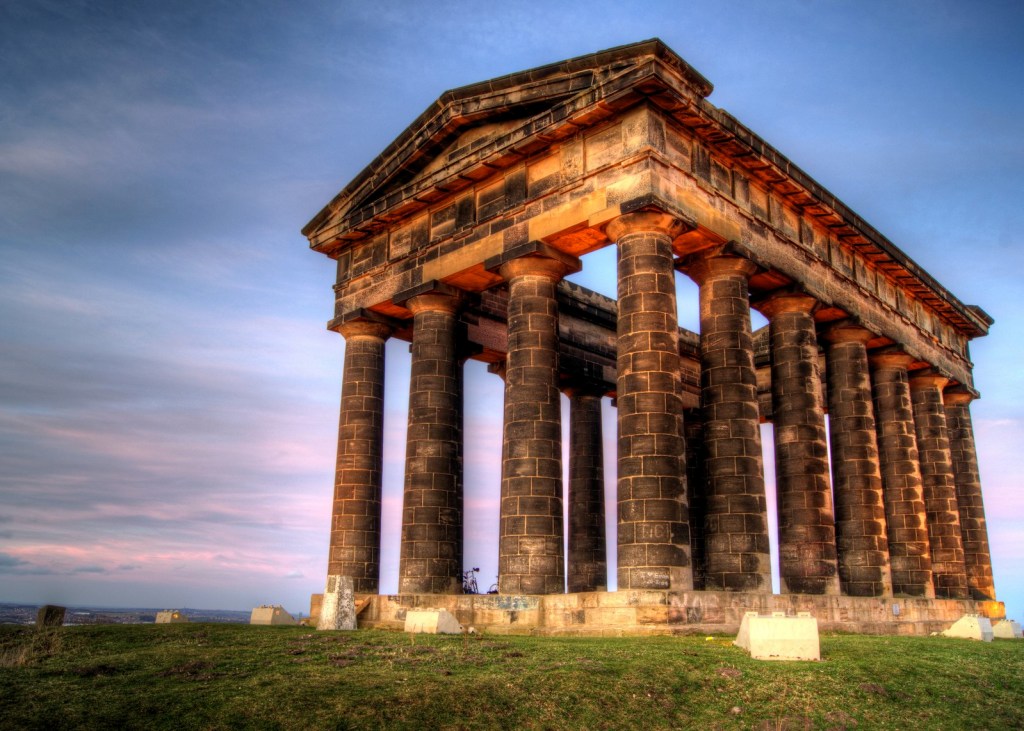
My chosen folly is the Earls of Durham’s Monument more commonly known as Penshaw Monument. It proudly sits on top of a large hill, surrounded by countryside and offering views all the way to Durham’s Cathedral. It has been designed by architects John and Benjamin Green of Newcastle and built by Thomas Pratt of Sunderland. It is a half-sized replica of Temple of Hephaestus in Athens. The classical greek construction, made of local gritstone is 30 metres long, 16 metres wide and 20 metres high. The built has been completed in 1844 and currently it is in the care of the National Trust. For a small fee, on the spring and summer weekends, the public can climb a staircase hidden within one of its columns and admire the views from top of the structure. The grounds around the monument are always open to the public and free to visit. The building is lit at night.
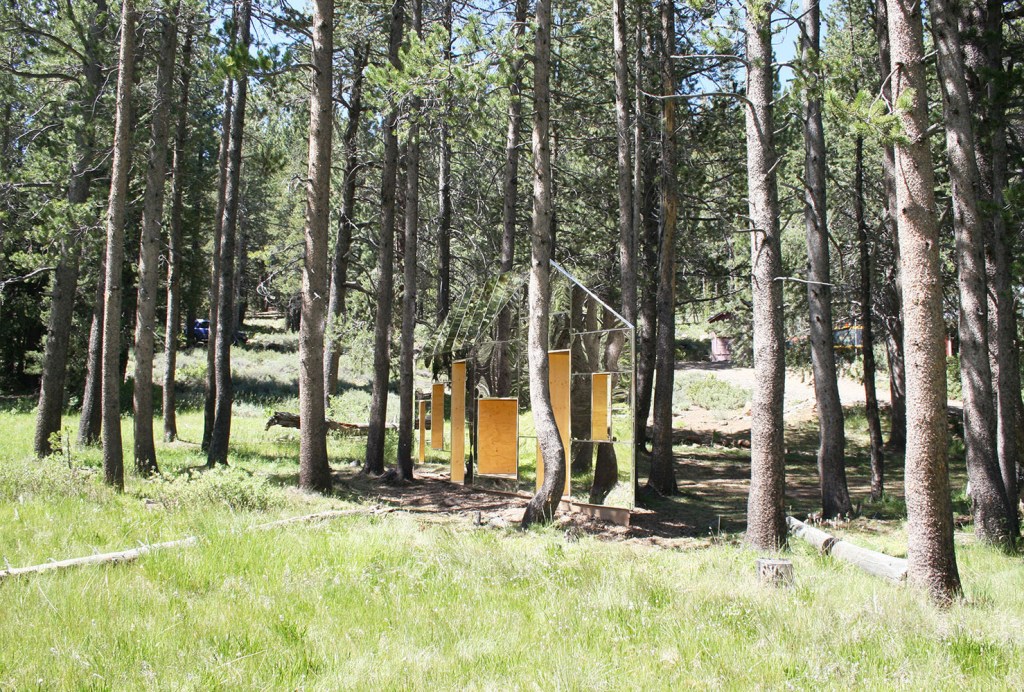
An example of an interesting contemporary folly I found is Invisible Barn. It has been designed by stpmj architects with the context of the site being the centre of attention. This design was desirable in this particular location because of the trees having similarly sized trunk and being equally spaced. This allows the mirrored walls to blend effortlessly with their surroundings. Plywood openings that pierce through the barn seem to be floating mid-air. Aluminized polyester film has been used as the reflective surface. It has been specially selected to give the desired illusion of invisible building but at the same time to be noticeable to birds, thus avoiding the wildlife colliding with the folly.
There seemed to have been an idea for the element of surprise as the ‘windows’ and ‘doors’ appear to be floating, and as curiosity draws the visitor in the structure reveals itself in its shiny blurriness. Part of the concept was for the building to blend within its surroundings, not for the nature to give way to it, but for the building to compliment it and blend within it.
The shape of the structure is unusual. Looking at it from the longer side it has an apparent shape of a typical house built on a rectangular plan, topped by a triangular on two sides and slopes on the other two surfaces roof. As if you look at this usual shape at an angle so you can see two walls, and two of the roofs’ surfaces. Yet on plan it appears as an extremely elongated diamond shape, with very narrow corners furthest apart from the centre.
The folly’s dimensions are 24’x3’x 12’ (approx. 7.3x 0.9x 3.6m) and its footprint is 72 sq. feet (6.68 m2). It has been built in 2015 and it is located in Truckee, United States.
I really like it; the building is enhancing its surroundings and allows public to have a bit of fun with the architecture.
List Of Illustrations:
Fig. 1 de Monerri, R. (2012) Penshaw Monument. [Photograph] At: https://live.staticflickr.com/7043/6827848038_0697a2ff8e_h.jpg (Accessed 04/05/2022)
Fig. 2 stpmj (2015) Photo Looking North East [Photograph] At: https://images.adsttc.com/media/images/55a5/e4bf/e58e/ce02/2900/00e8/slideshow/12.IB_Photo_Looking_North_East.jpg?1436935353 (Accessed 06/05/2022)
References:
Atlas Obscura (2022) Penshaw Monument. At: https://www.atlasobscura.com/places/penshaw-monument (Accessed 04/05/2022)
Co-Curate (2022) Penshaw Monument. At: https://co-curate.ncl.ac.uk/penshaw-monument/# (Accessed 04/05/2022)
Frearson, A. (2015) Invisible Barn is a mirror-clad folly camouflaged among the trees of a California forest. At: https://www.dezeen.com/2015/07/24/stpmj-invisible-barn-mirror-clad-cabin-camouflaged-among-trees-california-forest/ (Accessed 06/05/2022)
History Hit (2021) Penshaw Monument. At: https://www.historyhit.com/locations/penshaw-monument/ (Accessed 04/05/2022)
Stpmj architects (2015) Invisible Barn / stpmj. At: https://www.archdaily.com/770303/invisible-barn-stpmj?ad_medium=gallery (Accessed 06/05/2022)
Wearside Online (2013) Penshaw Monument. At: https://wearsideonline.com/penshaw-monument/ (Accessed 04/05/2022)
 Aggie's interior design journey